1890 Sherlock Holmes first edition found in charity donations sold for £11,520
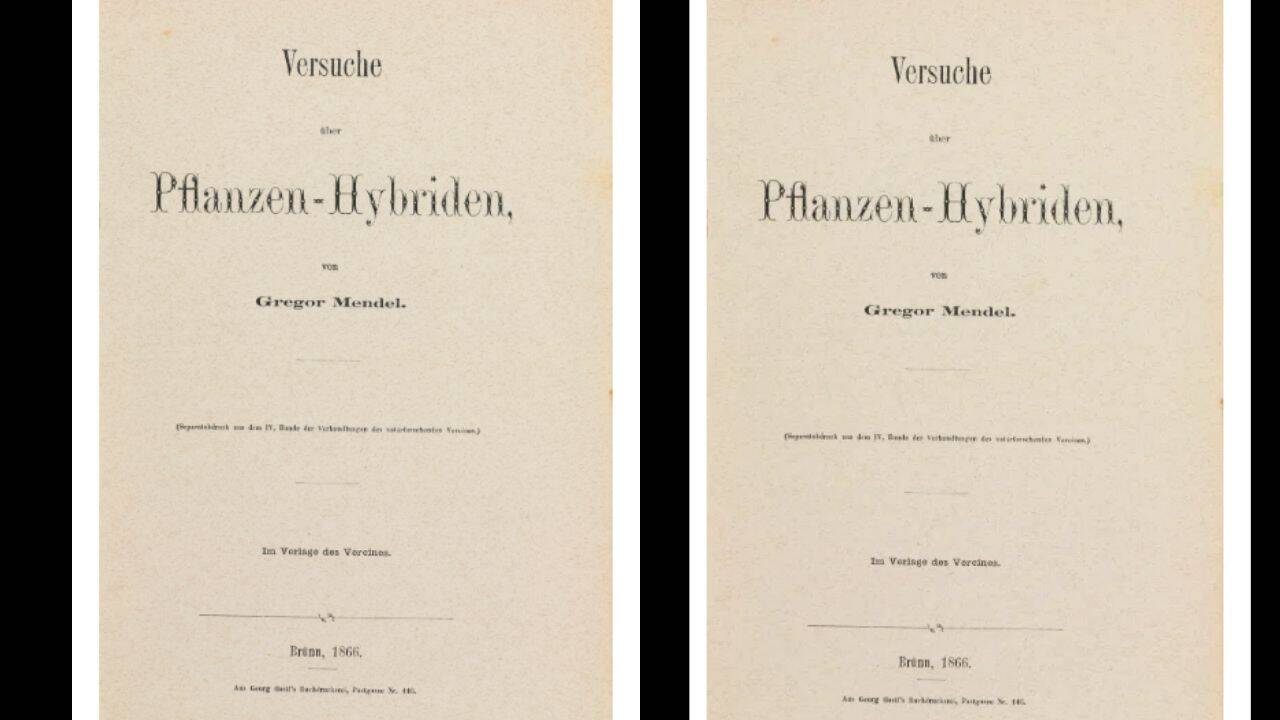
A scientific paper that went largely unnoticed during its author's lifetime has become one of the most valuable pieces of scientific history. Written by Gregor Mendel, an Augustinian monk whose experiments with pea plants helped establish the foundations of modern genetics, the rare 1866 publication sold for US$640,000, around Rs 6.10 crore, at a Christie’s auction in October 2026.The paper, titled “Versuche über Pflanzen-Hybriden”, or “Experiments on Plant Hybrids”, presented the results of years of carefully planned breeding experiments.
Today, Mendel is widely recognised for explaining patterns of inheritance, but his findings were not fully appreciated when they first appeared. The auctioned copy also has its own history, having previously been sold at Christie’s in July 2016 before returning to the auction house a decade later.The monk who turned pea plants into a scientific breakthroughBorn in 1822 to a farming family in Moravia, now part of the Czech Republic, Mendel chose a life of study rather than following the family’s agricultural tradition.
He entered the Augustinian monastery in Brno in 1843 and later studied at the University of Vienna, where he encountered scientific ideas that helped shape his research. After returning to the monastery, Mendel began investigating how characteristics passed from one generation of plants to another. His work involved cross-breeding pea plants and carefully recording the results.Over roughly a decade, he cultivated nearly 30,000 pea plants and studied seven pairs of contrasting characteristics.
These included visible differences in plant and seed traits. Rather than relying only on observation, he used numerical analysis to identify patterns in how characteristics appeared among successive generations. His results challenged the idea that inherited traits simply blended together. Instead, they suggested that hereditary factors were passed on in distinct units and followed predictable patterns.
These findings later became central to the study of genetics.Why the research remained overlooked for decadesMendel presented his findings to a local scientific society in Brno in 1865. The paper was subsequently published in the society’s proceedings in 1866. The work was also circulated as a separate printed edition, known as an offprint. According to Christie’s, 40 copies of this offprint were distributed to colleagues and correspondents at Mendel’s discretion, while the journal itself reached 134 scientific institutions in different countries.
Despite this circulation, the research attracted little attention. Mendel’s ideas remained largely forgotten until 1900, when botanists Hugo de Vries, Carl Correns and Erich von Tschermak independently reached similar conclusions and acknowledged that Mendel had anticipated their discoveries.His work eventually became known for explaining inheritance through dominant and recessive traits, as well as the independent assortment of different characteristics.
These principles helped scientists understand how variations could pass between generations and later became important to the study of evolution. The delayed recognition of Mendel’s research is now a striking example of how a scientific breakthrough can take decades to receive the attention it deserves.A rare copy with a history of its ownThe copy sold in 2026 is particularly significant because very few examples of the separate offprint are known to survive.
Christie’s estimates that only 16 or 17 copies remain, including eight held by institutions. The 47-page publication was printed in Brno in 1866 by Georg Gastl for the local natural history society. The auctioned copy retains its contemporary plain yellow paper wrappers over a grey-paper backstrip and comes in a green protective clamshell box.Its condition is described as very fine, with only minor marks and faint creasing.
For collectors, such details matter because surviving copies of foundational scientific works are rare and provide direct evidence of how important discoveries were originally communicated. The copy was sold at Christie’s on July 13, 2016, as lot 177, and acquired by its current owner at that auction. Its return to the auction market in October 2026 gave collectors another opportunity to acquire a publication closely associated with the beginnings of modern genetics.Why Mendel’s paper remains important todayThe sale price reflects the publication’s scientific significance as well as its rarity.
Mendel’s experiments helped establish a framework for understanding how inherited characteristics are transmitted, a subject that remains central to biology, medicine, agriculture and evolutionary research. His findings were not immediately recognised, but their eventual acceptance changed the direction of biological science. The rediscovery of his work in 1900 helped connect inheritance with the broader study of evolution, giving scientists a clearer understanding of how traits persist and vary across generations.
More than 160 years after its publication, the paper is both a landmark in scientific history and a reminder that important ideas may take time to find their audience.You use AI every day. Now get your AI Quotient. Take the AIQ testGet the latest Lifestyle News and more. Download the TOI app.