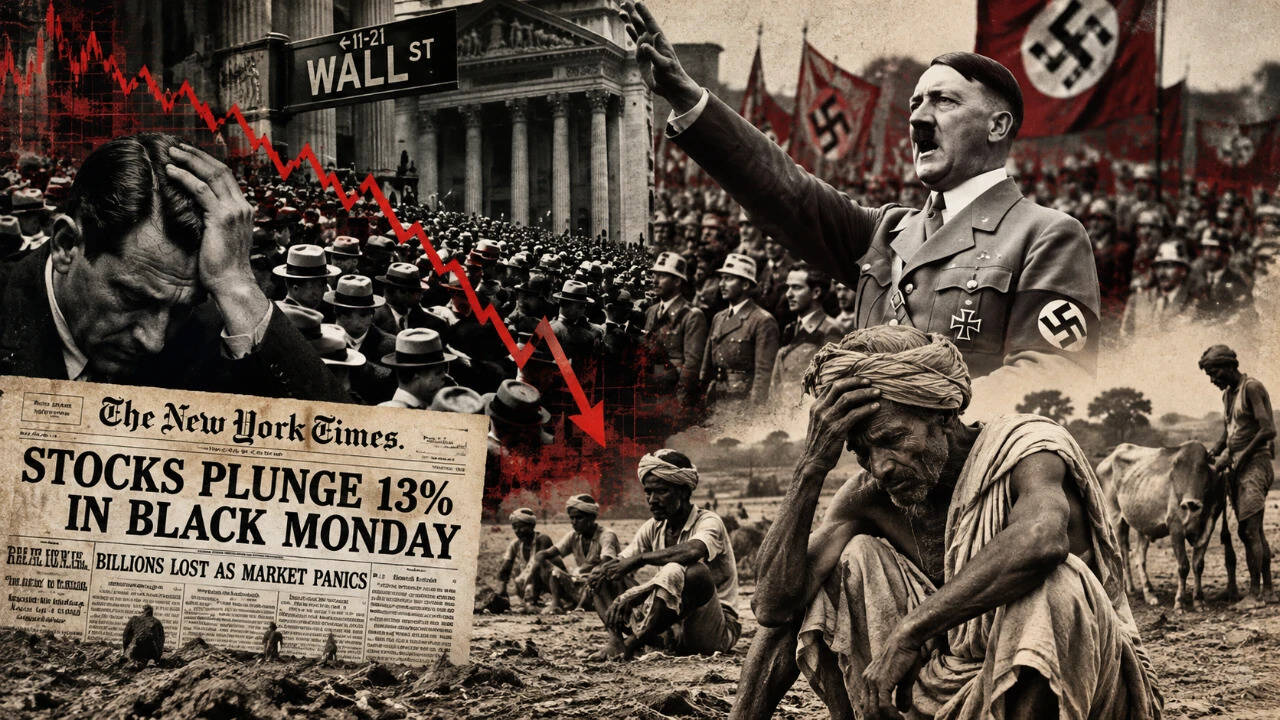
From Hitler to India’s farmers: How Great Depression changed lives beyond US
In October 1929, billions of dollars in wealth evaporated from the American stock market, setting off an economic catastrophe that would reach far beyond Wall Street.Years of speculative buying, easy credit and inflated share prices had created a market built on the expectation that stocks would keep rising. When confidence collapsed, investors rushed to sell. The Dow Jones Industrial Average plunged nearly 13 per cent on October 28 and another 12 per cent the following day, in what became known as Black Monday and Black Tuesday.But the crash was only the beginning.
Bank failures, collapsing demand and business closures deepened the American downturn, while the withdrawal of US loans, falling international trade and the constraints of the gold standard carried the crisis across borders.The result was the Great Depression, a global disaster that would help propel Adolf Hitler towards power in Germany, devastate farmers in colonial India, push millions of Britons into unemployment, and expose the fragility of economies around the world.What followed was not merely a financial collapse, but a decade of economic hardship and political upheaval that changed the course of the twentieth century.Germany’s economic collapse turned Hitler into a political forceThe Great Depression hit Germany at a time when its economy was already vulnerable, turning a global financial crisis into a national catastrophe.
The country was still struggling with the consequences of the First World War, including reparations, political instability and the devastating hyperinflation of 1923.Its recovery during the second half of the 1920s depended heavily on foreign credit, particularly loans from the United States.Under the Dawes Plan of 1924, American lending helped stabilise German finances and supported economic recovery.
But this dependence became a major weakness when the Wall Street crash struck in October 1929.As American banks and investors came under pressure, new lending dried up and foreign creditors recalled short-term loans. German banks and businesses struggled to obtain credit, investment declined and companies began cutting production and jobs.The consequences were severe. Industrial output contracted, businesses failed and unemployment soared.
By 1932, around 5.6 million Germans were registered as unemployed, while industrial production had fallen by approximately 40 per cent from its 1928 level.The crisis also paralysed political decision-making. Chancellor Hermann Müller’s coalition government collapsed in March 1930 amid disagreements over unemployment insurance, paving the way for increasingly unstable governments that relied on presidential emergency powers.This economic desperation created an opening for Adolf Hitler and the Nazi Party.
They portrayed the Weimar Republic as weak and incapable of protecting ordinary Germans, promising jobs, national revival and decisive leadership. Their message appealed to sections of the middle class, struggling farmers, small business owners and workers disillusioned with the political establishment.The electoral shift was dramatic. According to the United States Holocaust Memorial Museum, the Nazis won just 2.6 per cent of the vote in the 1928 parliamentary election.
Their share rose to 18 per cent in September 1930 and 37 per cent in July 1932, making them the largest party in the Reichstag.Nazi campaigning deliberately exploited the hardship. A 1932 election poster preserved by the US Holocaust Memorial Museum carried the slogan “Our Last Hope - Hitler”, presenting the Nazi leader as an answer to national despair.The party used mass rallies, newspapers, posters and speeches to promise economic recovery and political order.
At the same time, it spread antisemitic conspiracy theories, blamed Jews and communists for Germany’s problems, and attacked democratic institutions.Hitler did not win an outright majority in a free national election. On January 30, 1933, President Paul von Hindenburg appointed him chancellor following negotiations with conservative political leaders who believed they could control him.
The Nazis subsequently dismantled democracy and established a dictatorship.The Great Depression did not, by itself, cause Hitler’s rise. But the collapse of American lending, mass unemployment and the failure of Germany’s political leadership to restore confidence created conditions that the Nazis exploited with devastating consequences.India’s farmers were crushed as crop prices collapsedIn British-ruled India, the Great Depression turned a global economic crisis into a rural emergency, exposing the financial vulnerability of millions of cultivators and deepening resentment against colonial rule.As international demand weakened and agricultural prices plunged, farmers earned less from their crops but continued to face debts, rent and land revenue obligations.
For many, the crisis meant selling produce at a loss, struggling to repay moneylenders and risking the loss of their land.A 2022 research paper by historian Alok Oak, published in Studies in Indian Politics, documents the scale of the collapse. India’s agricultural price index fell from 203 in 1929 to 127 in 1931, using 1873 as the base year. The price index for raw cotton dropped from 133 to 70 over the same period.
The decline was particularly damaging for cultivators who depended on commercial crops to generate cash for household expenses, rent and taxes.The crisis was compounded by the structure of the colonial economy. According to Oak, the British government refused to devalue the rupee amid concerns about meeting its foreign financial obligations. Meanwhile, Britain’s exports to India fell from £90.6 million in 1924 to £52.9 million in 1930, a decline of about 41 per cent.
Falling trade and agricultural prices squeezed rural incomes and weakened economic activity.The timing was significant for India’s independence movement. At its Lahore session in December 1929, the Indian National Congress d…