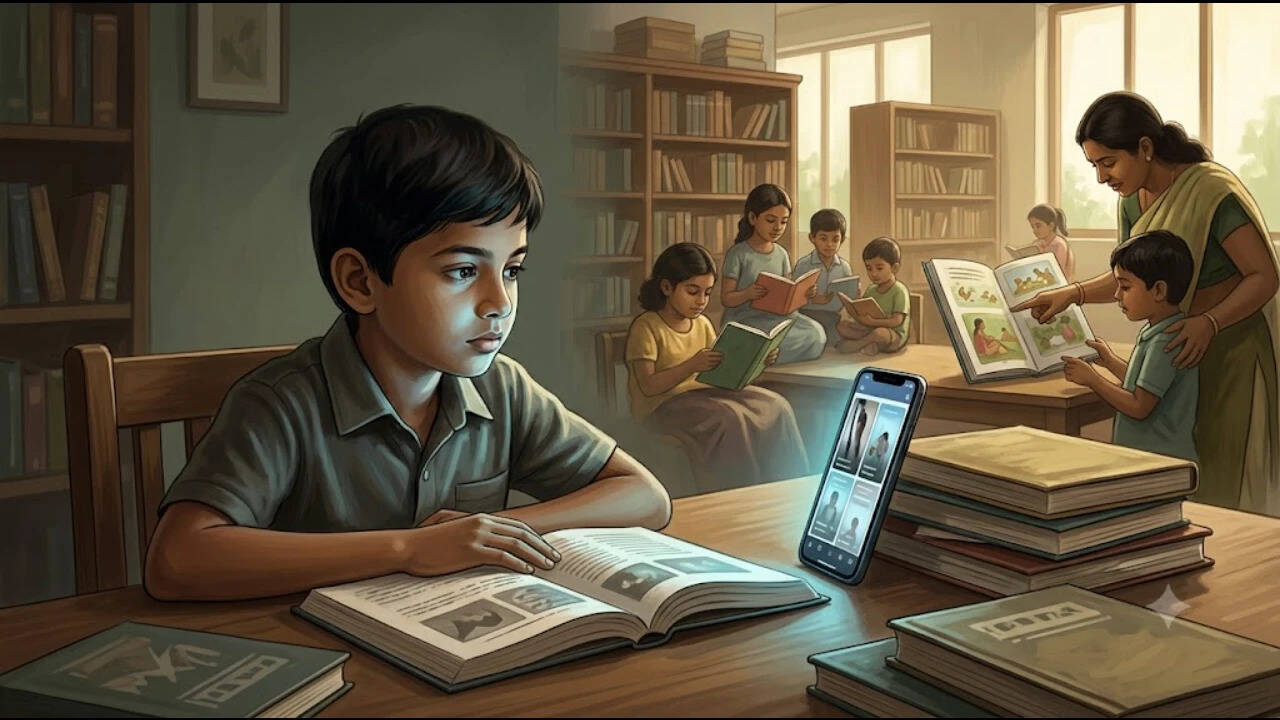
From unfinished books to 10-second reels: Is reading becoming lost art?
“Until I feared I would lose it, I never loved to read. One does not love breathing.” The words, written by Harper Lee in her classic novel To Kill a Mockingbird, published in 1960, carry a meaning that feels increasingly urgent today. Perhaps the time has come to fear the loss of something we once took for granted: the ability to lose ourselves in a book.Think of a moment when a close friend's words cut deep, when disappointment left you searching for solace, and the world seemed unwilling to listen.
Somewhere on a shelf, a familiar book waited. Sometimes, it was a companion; at others, a teacher. Its pages offered refuge when words failed and perspective when emotions overwhelmed. Books have a way of staying with us, even when people do not.For generations of readers, books were more than a means of acquiring knowledge. They were where we first encountered the ache of separation, the exhilaration of love, and the finality of loss.
Long before life introduced us to these emotions in their full complexity, books had already given us a vocabulary for them. They taught us to inhabit another person's world, sit with uncertainty, and recognise feelings beyond our own.Fast forward to today. Books that once offered solace remain unopened, their place taken by an unending stream of notifications, reels, and fleeting digital distractions.
The habit of staying with a story is giving way to the impulse to swipe past it. The relationship between readers and books is changing, but the deeper question is what this change is doing to our capacity for attention, reflection, and understanding.The concern is not simply that children may be reading fewer printed books. It is whether they are losing the patience to follow an idea to its conclusion, the curiosity to venture beyond a prescribed syllabus, and the willingness to remain with a text long enough for its meaning to unfold.At a time when information is available at the tap of a screen, access is no longer the principal challenge.
The harder task is learning how to absorb, question and connect what we encounter.When reading becomes an exercise in extractionProf. V. N. Rajasekharan Pillai, an educationist and institution builder who has spent more than five decades in Indian higher education, has observed this change over the course of his career. Having served as chairman of the University Grants Commission (UGC), executive director of the National Assessment and Accreditation Council (NAAC), and vice-chancellor of Indira Gandhi National Open University (IGNOU), he has witnessed the changing relationship between students, education, and knowledge.“Deep reading is not a leisure skill.
It is a foundational human capacity that shapes how societies think, decide, and live,” he told The Times of India, warning that fragmented scrolling can weaken sustained engagement with ideas.This brings us to a fundamental question about the changing purpose of reading. When a student reads primarily to locate a fact, check a definition, or prepare for an examination, what happens to the interpretative work that lies between the lines?
Reading is often described as a gym for the brain. But when it becomes an exercise in retrieving information, does it retain its full intellectual value?His observation finds a parallel in the concerns raised by Niyati Verma, science resource person at the State Council of Educational Research and Training (SCERT), Delhi, who has noticed increasingly fragile engagement with texts beyond the prescribed syllabus.“Over recent years, the appetite for reading, both academic and leisure, has undoubtedly shriveled.
Students now view texts beyond the syllabus as burdensome rather than portals to discovery,” she said.A prescribed chapter may fulfil an immediate academic requirement, but reading beyond it allows students to encounter unfamiliar perspectives, pursue questions independently, and develop interests that examinations cannot necessarily anticipate.Pillai said teaching practices and examination systems also shape reading habits.
“The loss of deep reading weakens the research culture NEP 2020 seeks to build, the multidisciplinary synthesis it promotes, and the capacity of graduates to contribute to public life with reasoned judgment rather than reactive opinion,” he said.If students are consistently assessed on their ability to retrieve and reproduce selected information, what incentive do they have to cultivate the patience required to understand an entire argument?
If reading is treated primarily as a means of passing examinations, an enduring relationship with books becomes harder to develop.The problem, therefore, is not confined to the attention economy outside the classroom. It may also lie within the pedagogical structures that determine what students read, why they read, and what they are ultimately expected to do with the knowledge they acquire.The numbers behind the reading deficitInternational research highlights the decline in reading for pleasure.
The National Literacy Trust’s 2026 survey of 125,375 UK children aged five to 18 found that among eight- to 18-year-olds, reading enjoyment rose from 32.7% in 2025 to 36.1% in 2026, while daily reading increased from 18.7% to 20.3%. Both remained below levels recorded a decade earlier.The survey also found widening socioeconomic gaps in reading enjoyment. Nearly half of respondents said reading helped them explore their interests, while 65.8% cited encouragement from teachers and 54.8% from parents.A HarperCollins UK survey released in April 2025 found that regular reading to children under five fell from 64% in 2012 to 41%, alongside declining recreational reading among five- to ten-year-olds.These findings suggest that reading habits depend not just on instruction but also on access to books, adult encouragement, and opportunities to read for pleasure.
If children associate books primarily with assessments, what will encourage them to read beyond school requirements?The tyranny …