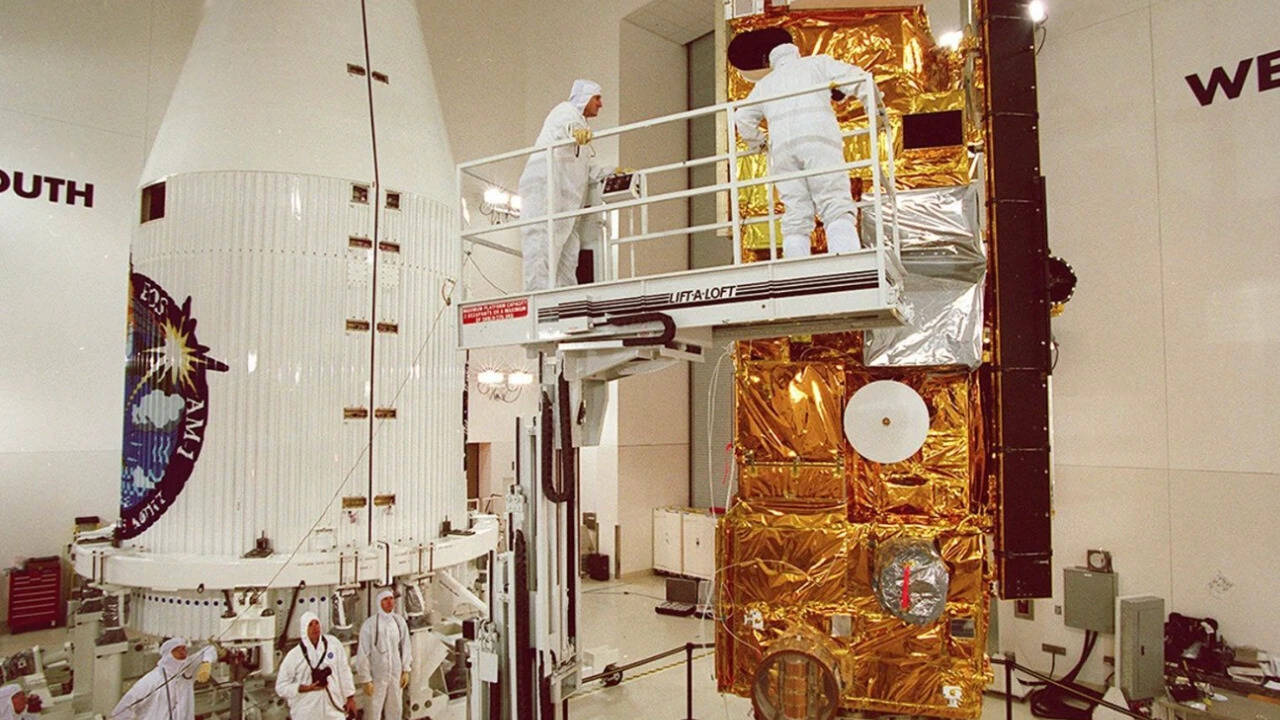
NASA to end Terra satellite's science mission after 27 years of Earth observations
Most of us have a gadget that was supposed to last a few years and just kept going. A phone, a toaster, a car that refuses to die. Now imagine that gadget is a satellite circling Earth about 400 miles overhead, and it has outlived its warranty by more than four times.That's Terra. NASA launched it in December 1999 with a plan for a six-year mission. This year, after 27 years of studying Earth's atmosphere, lands, oceans and biology, it will stop collecting science data on December 1.
Today's Instagram-addicted teenagers weren't born when it left the launchpad. Terra has been up there through five presidents, three iPhone eras and one global pandemic, quietly taking notes.A planet, under observationTerra's job was ambitious: it had to look at Earth as one connected system. Air, land, water and living things all influence each other, and you can't understand one by ignoring the rest.Its instruments included:ASTER (Advanced Spaceborne Thermal Emission and Reflection Radiometer): It took detailed pictures of Earth’s surface so scientists could study landforms, vegetation and temperatures.
It was also good at spotting change, like how terrain shifts over the years.CERES (Clouds and the Earth's Radiant Energy System): Earth is always taking in energy from the Sun and sending some back out to space. CERES kept track of that, helping researchers understand the planet’s energy balance and what clouds do in the process.MISR (Multi-angle Imaging SpectroRadiometer): MISR viewed Earth from several angles at once.
That gave scientists a richer picture of clouds, tiny particles floating in the air and the way sunlight behaves.MOPITT (Measurements of Pollution in the Troposphere): It tracked carbon monoxide in the atmosphere. That helped scientists see how pollution forms and how it travels, sometimes across entire continents.MODIS (Moderate Resolution Imaging Spectroradiometer): It monitored everything from wildfires and vegetation to ocean temperatures, snow cover and changes in land use.How did Terra help?Terra helped researchers follow fires, trace smoke and dust as they drifted through the atmosphere, watch ice cover shrink or shift, and see how people reshape the land.
The same information fed into decisions about farming, water supplies, public safety and disaster response. The photos were only part of it.The real value was in the measurements behind them, collected day after day for years, which gave scientists a steady record to measure change against. A single fire might burn for a few days, but years of observations show how fire seasons behave.
One glacier image is just a pretty picture of ice, but set beside decades of earlier ones, it shows how that ice is responding to a warming planet. NASA’s detailed account of the mission says Terra’s data has been cited in more than 27,000 scientific papers, which is a lot of research for a spacecraft that was only meant to last six years.NASA says Terra's data has informed decisions on public safety, agriculture and water resources, along with commercial, societal and humanitarian applications; becoming one of NASA's most important Earth-observing satellites.The end of its lifeNASA says the spacecraft's systems are aging and its orbit is drifting.
Some of the science kit has already been retired to save power: the MOPITT instrument, along with parts of CERES and ASTER, was previously switched off to conserve power. After science collection stops on December 1, the team will begin decommissioning. They'll use the spacecraft's remaining fuel to lower its orbit, then power down all systems in January 2027.Terra will be back, what stays?Terra's retirement doesn't leave Earth without eyes in the sky.
Other satellites run by NASA and international space agencies are still watching the planet, and they build on the groundwork Terra laid. Data from the Visible Infrared Imaging Radiometer Suite, or VIIRS, flown on the Suomi NPP and NOAA-20 satellites, will carry on several of the observations that Terra's MODIS instrument used to provide.Keeping those records unbroken matters because scientists studying climate change need measurements they can compare across years and decades, not one-off snapshots.
A continuous record helps them distinguish natural swings from longer-term shifts. NASA's Terra team and the wider scientific community are now working to keep Terra's observations useful and to help people who rely on its data move over to other sources.Fearless legend or grounded realist? Rate yourself on 11 categories in the Great Indian Confidence Survey – find out in 3–6 min