27.1% to 2.6%: India's poverty decline significant, but there’s a catch
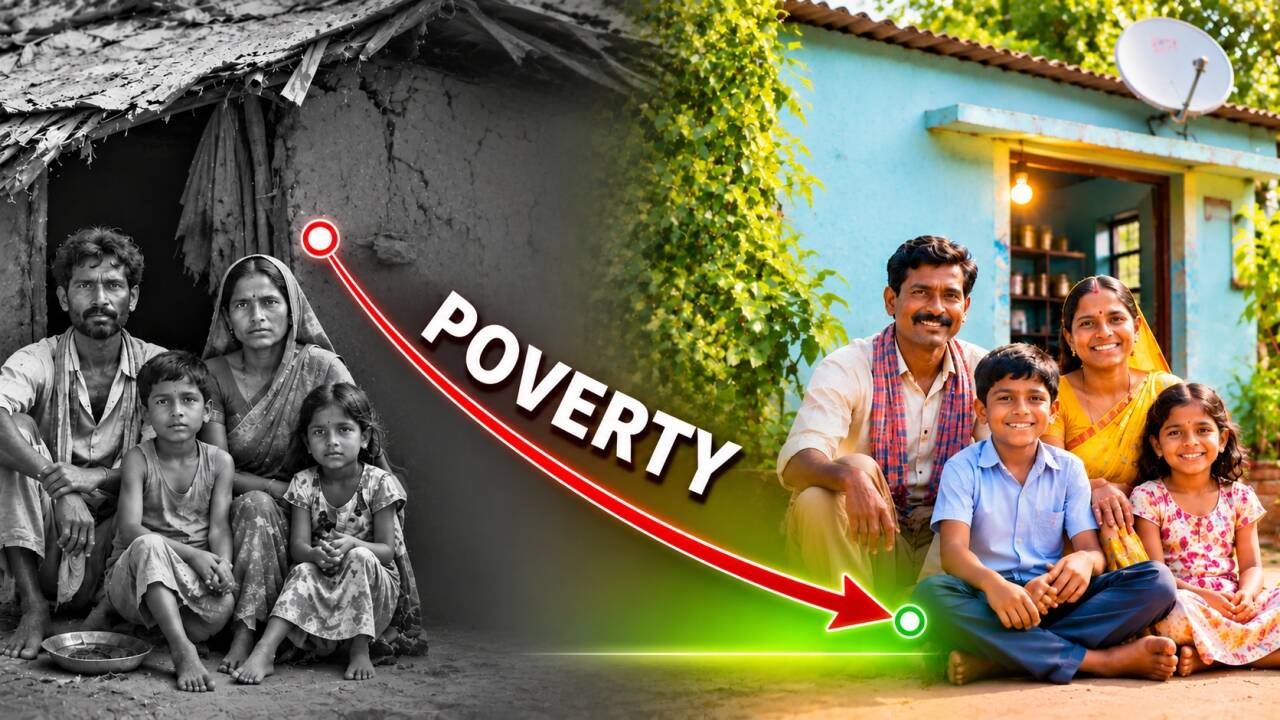
India, among the world’s biggest economies, has also made significant strides in reducing poverty, especially extreme poverty in recent years. According to the latest World Bank report, India has managed to achieve one of the fastest poverty declines in the world - in both monetary and non-monetary dimensions.Garibi hathao has been a slogan for decades, and now with extreme poverty falling from 27.1% to 2.6% between 2011 and 2023, the question is how far India has come in its fight against poverty, and how much further it still needs to go.India’s remarkable poverty decline in numbersHow is poverty defined?
Poverty in India, as well as in assessments by multilateral institutions, is measured with reference to specified poverty lines or thresholds.The World Bank currently defines the international extreme poverty line at $3.00 per person per day in 2021 purchasing power parity (PPP) terms. According to the World Poverty Clock, extreme poverty may be considered eliminated when the poverty headcount ratio falls below 3%.With the World Bank estimating India’s extreme poverty rate at about 2% in 2024, India can, on this measure, be considered to have crossed that threshold.Between 2011 and 2023, the proportion of Indians living below the Lower Middle-Income Country poverty threshold of $4.20 a day (2021 PPP) dropped from 57.7% to 16.1%.
This decline lifted an estimated 496 million people out of poverty. Over the same period, extreme poverty, measured against the $3-a-day threshold, fell from 27.1% to 2.6%.“Poverty is projected to continue declining, albeit more gradually, with the poverty rate at the $4.20/day line expected to fall from 14.2 per cent in 2026 to 12.1 per cent by 2028,” World Bank has said in its report.Not just that, India has also recorded big improvements in non-monetary indicators of poverty.
According to the Oxford Poverty and Human Development Initiative’s (OPHI) Multidimensional Poverty Index (MPI), the poverty rate fell from 53.8% in 2005-06 to 16.4% in 2019-21. The World Bank’s MPI measure put the rate at 15.5% in 2022-23.“As poverty declined, it became increasingly concentrated among households with lower education, fewer assets, limited access to stable employment, and higher dependency ratios.
Wage disparities, however, remain pronounced, as median earnings among the top 10 per cent of workers were about 13 times those of the bottom 10 per cent in 2023,” the report says.How did India reduce poverty significantly?The World Bank says progress was mainly driven by strong consumption growth, rising employment, especially among women, and expanded social transfers, including food subsidies.
India's poverty reduction story is one of both convergence and concentration.“Households in both rural and urban areas experienced substantial welfare gains, with faster progress in rural India significantly narrowing the rural-urban gap. Yet many of the households that remain poor continue to live in rural areas, where productivity is lower and access to higher-quality non-farm employment opportunities remain more limited,” the report says.Experts say the decline in poverty reflects a combination of income and employment growth, together with an extensive social protection system, including subsidised food provision and rural employment support.DK Srivastava, Chief Policy Advisor, EY India says rural employment guarantee programme, earlier known as MGNREGA and presently referred to as VB-G-RAM-G, has also played an important role.“India’s domestic approach to measuring poverty has traditionally used consumption thresholds consistent with minimum nutritional requirements and expenditure on specified non-food items.
In 2011-12, the Rangarajan Committee re-estimated these poverty thresholds, with separate poverty lines for rural and urban areas and variations across states. These thresholds were substantially higher than the international extreme poverty line,” he explains.Recent studies have updated the Rangarajan Committee-based poverty lines to 2022-23.For example, a recent RBI study provides poverty estimates for 19 states using updated rural and urban poverty thresholds.“On a population-weighted basis across these states, the poverty headcount ratio declined from 31.1% to 6.7% in rural areas and from 26.9% to 6.8% in urban areas,” he tells TOI, adding that several factors have contributed to this substantial decline.Apart from broader income and employment growth, important policy interventions include the rural employment guarantee programme and the Pradhan Mantri Garib Kalyan Anna Yojana (PMGKAY).While Direct Benefit Transfer allows the government to transfer welfare benefits, subsidies and other payments directly to beneficiaries’ bank accounts, the Pradhan Mantri Garib Kalyan Anna Yojana (PM-GKAY) aims to provide free foodgrains to eligible households.State governments have also implemented income-transfer and subsidy programmes targeted at lower-income households.“The free food scheme has released resources for spending on other goods and services.
Further, we have created new low paying but still income generating jobs in new sectors which have been booming like ecommerce, logistics and construction. This has added to income and spending power,” explains Madan Sabnavis, Chief economist, Bank of Baroda.“Governments have paid attention to welfare which is needed at a time when the private system is unable to create jobs for all,” he adds.Yet another major factor has been the accelerated capital expenditure by the government over the years.“This has been a significant contributor to impacting poverty.
It has connected farms to markets and has led to better realisations for the farmers,” says Ranen Banerjee, Partner and Leader, Economic Advisory, PwC India.Besides, it has allowed mobility of labour to urban areas for casual labour besides directly generating construction jobs.Then, there are the multiplier effects of sectoral growth.“The growth of the service sector and services…