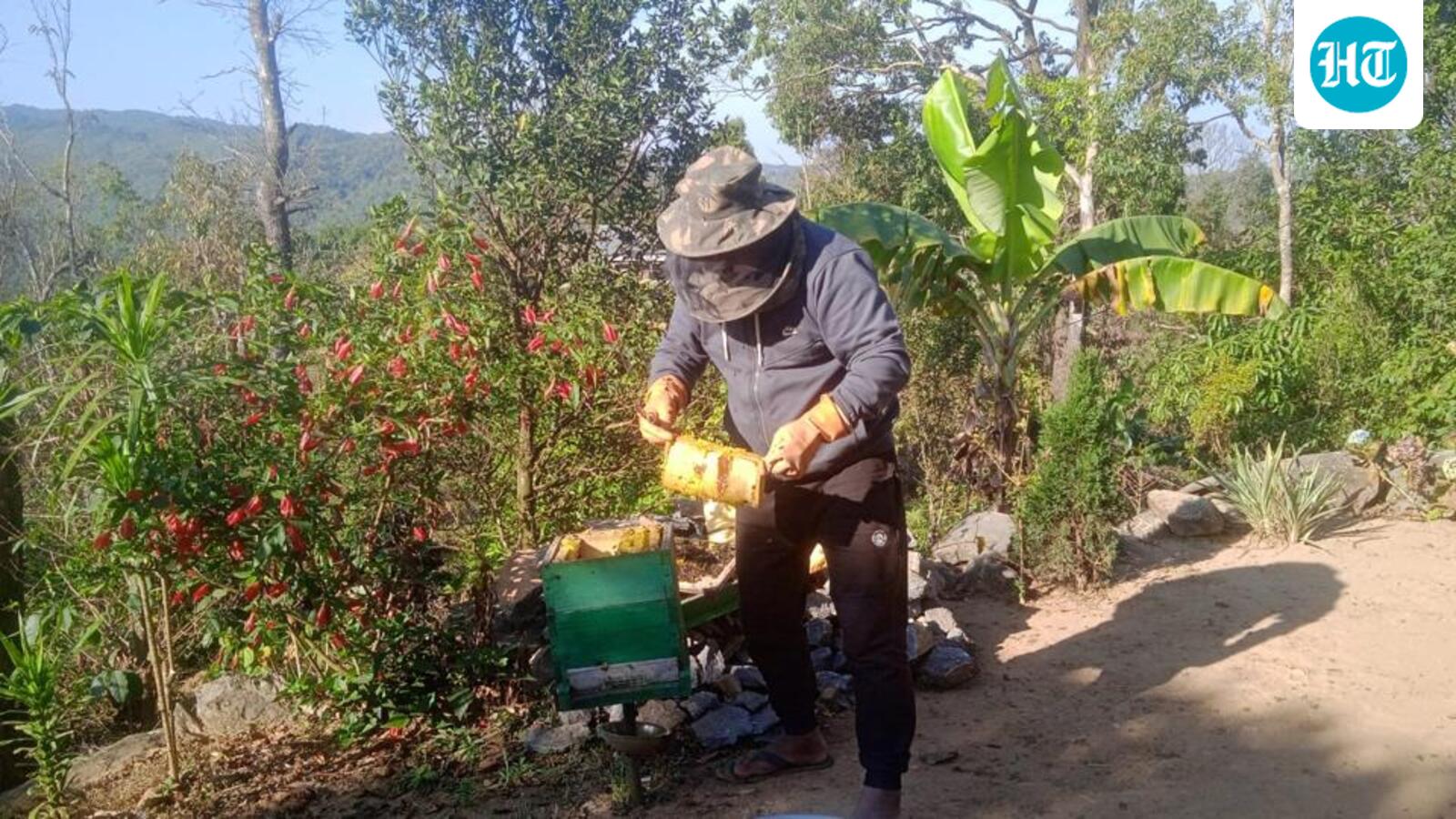
Meghalaya’s hills hum with a hidden world of bees key to honey economy, crop pollination, conservation
Meghalaya’s hills are home to a diversity of bees, from honey-producing species to lesser-known pollinators that help sustain farms and forests. As research begins to map this hidden wealth, the state is looking to put its honey on the global map, raising questions about conservation, traditional knowledge and the future of rural livelihoods.Chief Minister Conrad K. Sangma highlighted this potential on Tuesday while inaugurating an Apiculture Multi-Facility Centre-cum-Processing Unit at Mellim in Rerapara block of South West Garo Hills.
He said the government was considering a Bee Museum and Interpretation Centre to showcase Meghalaya’s honey, explain how it is produced and help market premium local products. “Honey from Meghalaya has been termed as the best in the world and there is potential if it is produced and marketed properly,” Sangma said. He envisaged a facility “where organic and best honey can be sold and digital interpretation of honey production can be shown”.“Meghalaya’s organic honey, if supported with scientific beekeeping, processing and branding, can become a major rural enterprise and take Meghalaya to the world,” he added.The ₹1.52-crore centre at Mellim will support honey collection, processing, bottling, testing and marketing, as well as bee-box manufacturing.
Under Apiculture Mission 2.0, the state is working across all 12 districts through 87 clusters, covering 6,491 beekeepers. The programme has provided 32,455 bee boxes and 6,491 equipment sets. The 39 clusters covered under Phase III produced 157.69 metric tonnes of honey in 2024–25.But building a successful honey industry will require more than processing facilities and better marketing.
It will also depend on healthy habitats, flowering plants and farming practices that allow bees to thrive.Mapping Meghalaya’s hidden bee diversityA national assessment of pollination services recorded 62 bee species in Meghalaya, including 48 free-living and 14 cleptoparasitic species. These account for about 7.49% of India’s recorded bee diversity. A separate taxonomic study by researchers at the Indian Agricultural Research Institute documented 108 bee species across 30 genera in agricultural ecosystems in seven districts of the state.
The studies used different methods and covered different areas, so their findings are not directly comparable. Together, however, they highlight Meghalaya’s importance as a habitat for bee diversity and the need for further research and conservation.Bees do far more than produce honey. As pollinators, they help plants reproduce and support the production of fruits, vegetables and seeds.
In agricultural landscapes, their activity can influence crop yields and the health of ecosystems.Researchers at the ICAR Research Complex for the North Eastern Hill Region in Umiam studied insect pollinators visiting cucurbit crops, including ridge gourd, sponge gourd, pumpkin, teasel gourd, chow-chow, bottle gourd and cucumber. They recorded 25 pollinator species belonging to three insect orders: Hymenoptera, Diptera and Lepidoptera.
Hymenoptera, which includes bees and wasps, accounted for 80% of the relative abundance recorded.Bumblebees were abundant on ridge gourd, pumpkin and sponge gourd, while carpenter bees were also observed on sponge gourd. Indian honeybees visited cucumber and chow-chow.“Native bees are equally contributing to pollination service so conservation of these bees is also a demand of nature,” the researchers wrote.The findings also have practical implications for farmers.
Knowing when pollinators are most active can help farmers avoid spraying pesticides during peak activity, reducing the risk of harming insects that contribute to crop production.Traditional knowledge keeps the hives aliveLong before scientists began systematically documenting Meghalaya’s bee diversity, local communities had developed their own methods of keeping bees and managing their relationship with the land.Documentation by the North East Society for Agroecology Support (NESFAS) describes traditional apiculture practices among Khasi and Garo communities.
In Daribokgre and Tosekgre in West Garo Hills, households use traditional wooden boxes to rear Apis cerana indica, locally known as Bija kol.In Khapmaw, traditional and modern methods coexist, with bees housed in hollow wooden boxes called Ksing pyllun. In Borgang Marngar in Ri-Bhoi, communities capture wild bees, while in parts of East Khasi Hills, wild colonies are transferred to wooden cabinets.
These practices reflect generations of knowledge about bees, farming and the natural environment. They could also help guide sustainable beekeeping as the state expands its apiculture sector.In Daribokgre, near Nokrek, citrus cultivation and beekeeping are closely linked. The area has around 20 varieties of wild and domesticated citrus. NESFAS has documented that 14 of the 15 farmers in an Agroecology Learning Circle there also keep bees.
The bees forage on orange flowers, helping pollinate the trees, while honey provides an additional source of income.Community facilitator Sengte Marak has described the connection: “We rear bees for honey and also because bees have been found to increase fruit production, and both of these are important sources of income for our livelihood.”Lotsing M Sangma, a farmer and beekeeper from Daribokgre, has kept bees for 17 years and maintains around 50 hives across his farm, orange orchard and kitchen garden.“Beekeepers are also vegetable farmers in Garo Hills,” he said.His experience shows how beekeeping can complement a diversified farming system, supporting crop production while providing an additional source of income.From awareness to actionFor Phang Roy, founder of NESFAS, protecting pollinators requires public awareness, scientific documentation and farming practices that safeguard their habitats.“The first concrete step is to raise awareness on the importance of pollinators beyond bees by documenting and mapping their roles within …