Baler isn’t a bailout: Why stubble subsidies still bypass small farmers
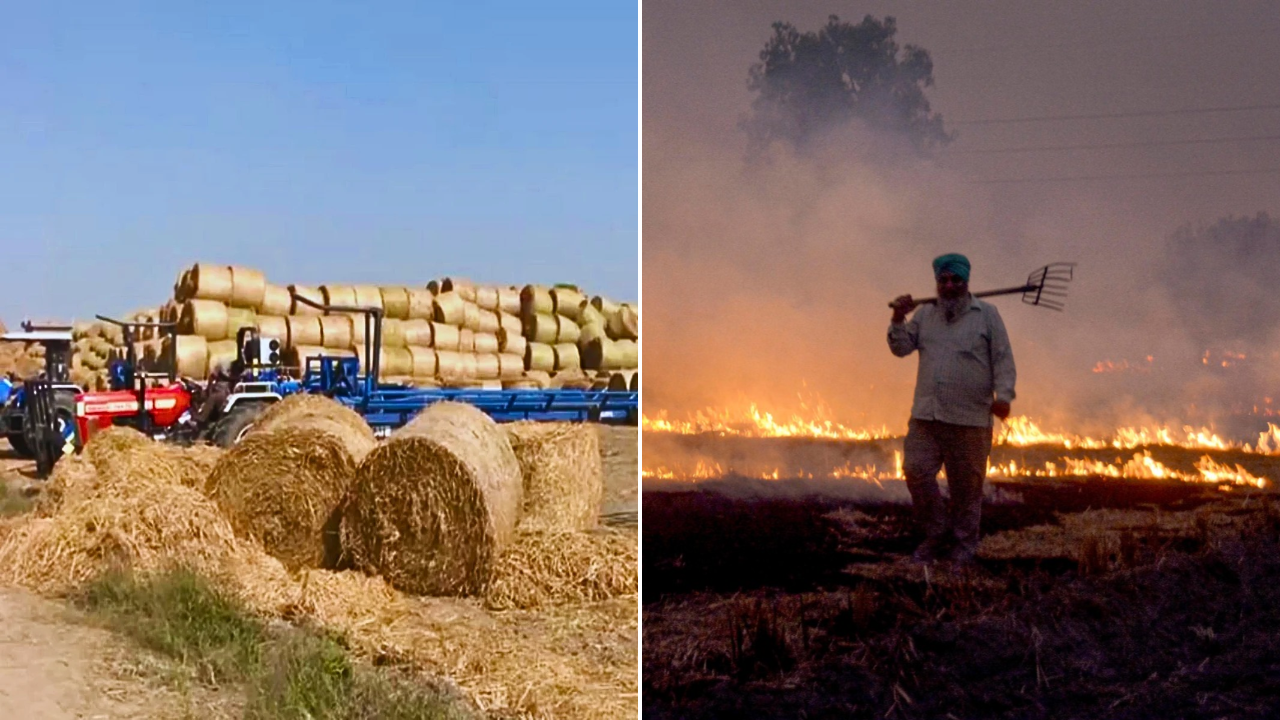
On October 23, Surjeet harvested paddy across eight acres in Atta village in Haryana’s Panipat district. Four days later, without burning a single stalk of stubble, his entire field had been cleared of parali (paddy residue) and was ready for the sowing of winter wheat.Private tractor-baler operators had arrived on his land, cut and dried the straw, compressed it into neat rectangular bundles and hauled it away to industrial buyers, all without charging Surjeet a rupee.Weeks later, the Haryana government's direct benefit transfer of Rs 1,200 per acre for managing crop residue without burning was on its way to his bank account."There is no problem now," says Surjeet.
"In our village of around 10,000 to 15,000 people, I don't think there is anyone left who still burns parali. If the field gets emptied in three or four days, there is no issue at all."Yet, several hundred kilometres northwest, across the state border in Punjab, and in dozens of agricultural hotspots across the Indo-Gangetic Plain, autumn skies told a different story during the 2026 harvest season.Despite thousands of crores invested in subsidies, satellite monitoring and enforcement, farm fires persisted in 2026, official data show.Ground interviews with farmers and machine operators across Haryana and Punjab, examined alongside parliamentary records and assessments by the Commission for Air Quality Management (CAQM), reveal a more complex picture.
Government subsidies have helped create a commercial ecosystem of private baling entrepreneurs, but access to the machinery and its services remains uneven, particularly for small and marginal farmers.Official scorecard: Who still burns stubbleOver a nine-year period, official data presented in Parliament point to a sharp decline in agricultural fires.Between the 2017 and 2025 Kharif seasons, active fire counts fell by 92.4 per cent in Punjab, from 67,079 incidents to 5,114, and by 94.9 per cent in Haryana, from 13,085 to 662.(function{function e{window.addEventListener(`message`,function(e){if(e.data[`datawrapper-height`]!==void 0){var t=document.querySelectorAll(`iframe`);for(var n in e.data[`datawrapper-height`])for(var r=0,i;i=t[r];r++)if(i.contentWindow===e.source){var a=e.data[`datawrapper-height`][n]+`px`;i.style.height=a}}})}e});However, the 2026 harvest season disrupted that downward trend in Punjab, according to data compiled by CAQM and the Punjab Pollution Control Board (PPCB).By late November 2026, Punjab had recorded 6,874 stubble-burning incidents, exceeding its entire 2025 tally.
Fires were concentrated in districts such as Ferozepur, Amritsar, Tarn Taran and Patiala.Haryana, by contrast, recorded 214 incidents during CAQM's mid-November review period.To understand why the two states have seen different outcomes, it is important to examine the economics and logistics of crop-residue management.Following Supreme Court scrutiny, the Union environment ministry doubled the environmental compensation for stubble-burning incidents in November 2024.
The fines vary according to the size of a farmer's landholding:Less than two acres: Rs 5,000Two to five acres: Rs 10,000More than five acres: Rs 30,000In May 2025, CAQM issued Direction No. 90, explicitly asking Punjab and Haryana to ensure that crop-residue management (CRM) machines were available to small and marginal farmers without rental charges.Pre-poll politics heats up over smoke and blameWith Punjab heading towards assembly elections in early 2027, stubble burning has become more than an environmental issue.
It is also a political flashpoint.The tensions were visible around Diwali in early November 2026.Delhi minister and BJP leader Kapil Mishra pointed to a sharp rise in Punjab's farm fires on Diwali night, calling the spike "suspicious" and demanding an investigation into what he described as a conspiracy.Punjab's leadership pushed back, accusing the BJP of using Delhi's smog to portray Punjabi farmers in a negative light ahead of the elections.Chief minister Bhagwant Mann argued that paddy is also grown in Uttar Pradesh, Haryana and even Lahore.
He questioned why smoke from Punjab was being blamed for pollution in specific parts of Delhi while neighbouring areas were being treated differently.Later in the month, AAP chief Arvind Kejriwal cited remarks by Union agriculture minister Shivraj Singh Chouhan, who had earlier praised the broader decline in farm fires in Punjab. Kejriwal argued that even the Centre's own agriculture minister had acknowledged farmers' efforts, while political opponents continued to blame them.The zero-cost clearance ecosystemGround reports suggest that where farmers are connected to private operators and industrial buyers, stubble burning has become far less common, without the need for coercive enforcement.In Atta village in Panipat, Surjeet recalls that farmers routinely burned paddy residue three to four years ago because they had few alternatives and feared that straw left on the fields would obstruct wheat germination.(function{function e{window.addEventListener(`message`,function(e){if(e.data[`datawrapper-height`]!==void 0){var t=document.querySelectorAll(`iframe`);for(var n in e.data[`datawrapper-height`])for(var r=0,i;i=t[r];r++)if(i.contentWindow===e.source){var a=e.data[`datawrapper-height`][n]+`px`;i.style.height=a}}})}e});"Earlier, we were forced to burn the parali because it stayed on the soil and the seeds wouldn't grow properly," he says.
"Now we have facilities. Private tractor operators come, cut the straw, let it dry for two to three days, make bundles and take it away for their own benefit."Industrial boilers, brick kilns, which have been directed under CAQM Direction No. 92 to co-fire paddy-straw pellets, and compressed biogas (CBG) plants buy baled straw. This demand allows private operators to clear Surjeet's eight-acre field without charging him.Surjeet, along with 10 lakh other farmers, has also registered his crop on Haryana's Meri Fasal Mera Byora portal to claim …