Civil war & terror: Why Libya is still broken 15 yrs after Gaddafi's bloody end
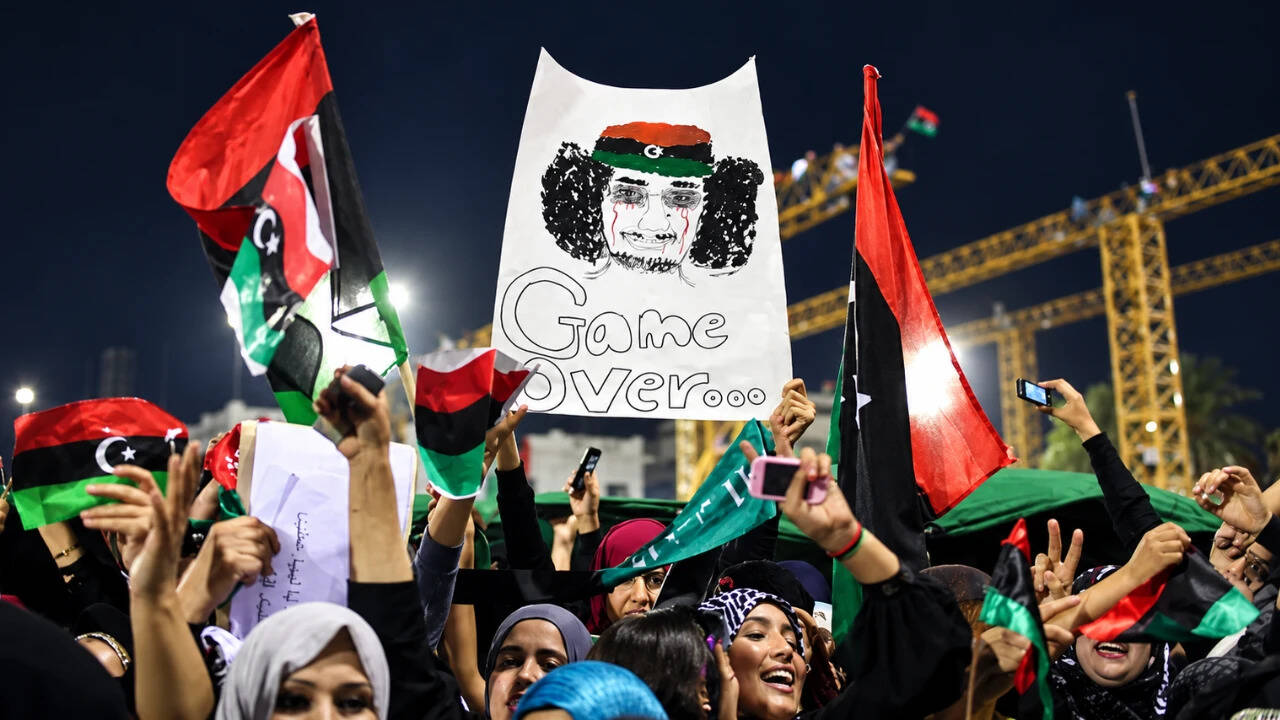
Muammar Gaddafi's 42-year rule over Libya ended violently near his hometown of Sirte on October 20, 2011, when opposition fighters captured and killed him.His death marked the culmination of an uprising that began months earlier and was bolstered by a Nato-led military intervention. But the fall of one of Africa's longest-serving rulers did not bring the oil-rich North African country the stability many Libyans had hoped for.Fifteen years later, Libya remains divided between rival political administrations and competing centres of military power.
Although a unified national budget was approved in April 2026 and a United Nations-backed agreement in August set out steps towards long-delayed elections, the country continues to struggle with political fragmentation, armed groups and disputes over state resources.The question, therefore, is not just how Gaddafi fell, but why his removal failed to bring stability to Libya.Why Gaddafi's regime fellThe uprising against Muammar Gaddafi began in February 2011, amid the Arab Spring protests that had toppled long-serving rulers in Tunisia and Egypt.Protests erupted in Benghazi on February 15, following the arrest of government critics, including a lawyer representing families of prisoners killed in the 1996 Abu Salim prison massacre.
Libyan security forces responded with tear gas, batons and violence against demonstrators.The crackdown escalated the protests into an armed rebellion, with opposition forces taking control of parts of eastern Libya. On February 26, the UN Security Council adopted Resolution 1970, imposing sanctions and referring the situation to the International Criminal Court.On March 17, it adopted Resolution 1973, authorising member states to take “all necessary measures” to protect civilians.
Nato took command of the military operation on March 31, enforcing an arms embargo and no-fly zone and conducting military operations.Tripoli fell to opposition forces on August 21, 2011, forcing Gaddafi's regime out of the capital. Two months later, as rebels overran his hometown of Sirte, Gaddafi attempted to flee in a convoy that came under Nato air strikes.He was captured alive by fighters from Misrata on October 20 and killed shortly afterwards.
A subsequent Human Rights Watch investigation found evidence that he had been beaten and wounded after his capture, raising questions over a possible extrajudicial killing.What happened to Libya after Gaddafi's deathGaddafi's death in October 2011 left Libya facing the challenge of building a new political system while armed groups that had fought his regime retained their weapons and influence.The National Transitional Council oversaw the transition before handing power to an elected General National Congress in August 2012.
However, successive governments struggled to bring militias under state control, while political divisions and insecurity continued to deepen.Libya's civil war deepens the divideLibya descended into a full-scale civil war in 2014, as political divisions and rival armed groups fractured the country.In May that year, military commander Khalifa Haftar launched Operation Dignity against Islamist militant groups and other opponents in eastern Libya, including Benghazi.
Two months later, a separate campaign known as Libya Dawn emerged in western Libya, as Misrata-based armed groups and their allies fought rival factions, particularly over control of Tripoli International Airport.The fighting left Libya divided between rival political and military camps in the east and west, each establishing its own institutions and command structures.The security vacuum also allowed Islamic State (ISIS) to expand its presence.
The group established a foothold in Derna before consolidating control over Sirte in 2015, turning Gaddafi's hometown into its main stronghold in Libya.ISIS imposed its rule through public executions, kidnappings and intimidation, while recruiting local fighters and former regime personnel.The United Nations Security Council warned in 2015 that the group's growing presence, alongside other extremist organisations, posed a serious threat to Libya and the wider region.In December 2015, a UN-brokered political agreement paved the way for the Government of National Accord, intended to reunify Libya's institutions.
But the arrangement struggled to establish authority across the country. However, forces aligned with the internationally recognised government, supported by US air strikes, drove ISIS from Sirte in December 2016.Haftar's forces eventually launched an offensive against Tripoli in April 2019. The United Arab Emirates and Egypt supported Haftar's eastern camp, while Turkey provided crucial military support to Tripoli-aligned forces.
Russia also backed Haftar's forces, including through personnel linked to the Wagner Group. These competing external interests reinforced Libya's internal divisions and complicated efforts to reach a political settlement.A UN-backed ceasefire in October 2020 halted large-scale fighting between the principal camps, but rival administrations and competing security structures endured.Libya after 2020The ceasefire of October 2020 ended large-scale fighting between Libya's rival eastern and western camps, but failed to reunify the country's political and military institutions.A UN-backed process installed Abdul Hamid Dbeibah as head of the Government of National Unity (GNU) in 2021, with elections intended to end the transitional period.
The vote was postponed indefinitely amid disputes over electoral laws and candidate eligibility.In 2022, the eastern-based House of Representatives appointed a rival administration, leaving Libya divided between competing governments.The division remains central to Libya's current political and military landscape.The GNU, led by Dbeibah, operates from Tripoli in the west, while an eastern-based administration led by Osama Hamad is backed by the House of Representatives and Khalifa Haftar's Libyan Arab Armed Forc…