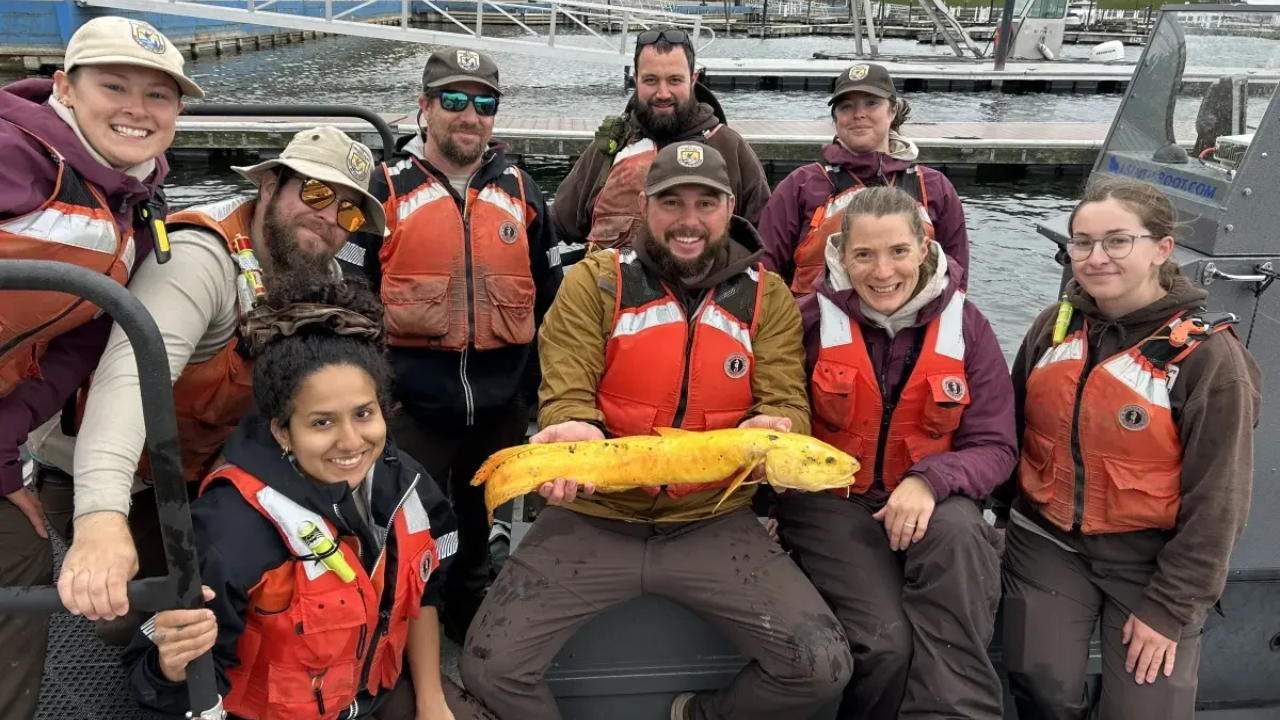
Yellow-orange burbot caught in NY harbor called 'one in a million' by officials
It was the kind of catch that could make even the brightest autumn leaves look dull. Scientists surveying a harbour on the shores of Lake Ontario pulled up a fish that looked unlike the burbot they were accustomed to seeing, its body was an intense yellow-orange instead of the species’ usual earthy, mottled shades.The unusual fish was caught by biologists from the US Fish and Wildlife Service (USFWS) during a routine aquatic invasive species survey in Oswego Harbor, New York, in October.
The agency described it as a “one-in-a-million” discovery, saying the fish’s rare pigmentation made it an especially unusual find. The discovery was announced on November 10.The fish was a burbot (Lota lota), a native freshwater species also known as ling or eelpout. Its striking colour was attributed to xanthochromism, a rare biological condition that produces an unusually saturated yellow or orange appearance.
According to the USFWS, the condition is associated with a genetic mutation that suppresses normal pigmentation, allowing yellow pigment to dominate. It is considerably less common in wild fish than albinism, which causes unusually pale or white colouring, or melanism, which produces darker pigmentation.Although the colour made the fish stand out, its presence in the harbour was significant for another reason.
Burbot populations in Lake Ontario are extremely low, and the species typically inhabits deeper, colder waters than those found in Oswego Harbor.The catch was the first documented detection of a burbot during a fisheries survey in the harbour, although anglers have reported catching the species there previously, the agency said.The discovery came during a programme designed to look for invasive species entering the Great Lakes.
The USFWS’s Aquatic Invasive Species Early Detection and Monitoring Program surveys harbours, rivers and embayments to identify potentially harmful species before their populations become established.The teams use several methods, including electrofishing, fyke-netting, gill-netting and environmental DNA analysis. Since invasive species are often present in very small numbers when they first enter a new waterbody, detecting them early can give fisheries managers a better chance of preventing their spread.Most fish caught during these surveys are native species that scientists expect to find.
However, the agency said the discovery of an uncommon native fish demonstrates that the monitoring programme can detect species that are less frequently encountered, and potentially identify newly arriving invaders when their numbers are still low.The yellow burbot may also offer researchers an opportunity to investigate the health of a species whose population decline in Lake Ontario remains poorly understood.While processing the fish, US Geological Survey fisheries biologists familiar with burbot noticed that it was emaciated and appeared to be in poor health.
Given its condition and the continuing questions about the species’ low numbers, the fish was sent to Cornell University College of Veterinary Medicine for examination.A subsequent necropsy revealed that the fish had stopped eating and had multiple skin lesions. It was also found to have carcinoma, a type of cancer originating in epithelial cells that line the skin and organs, as well as a mild parasite infection in its kidneys, according to a November 17 update from the USFWS’s Lower Great Lakes Fish and Wildlife Conservation Office, cited by Smithsonian Magazine.Scientists do not yet know what caused the cancer.
They have suggested that factors such as age, environmental contaminants, viruses and other conditions could play a role. The findings may help researchers understand disease-related problems in burbot and investigate whether they contribute to population declines.Burbot are cold-adapted fish found across northern North America and Eurasia. In New York, they occur in several watersheds, including the Ontario and Oswego watersheds, and generally prefer deep lakes and large, cool rivers.
The species is the only freshwater member of the cod family and is known for its long, eel-like body, broad head and a distinctive barbel beneath its chin. It is a bottom-dwelling predator that feeds on fish and other aquatic animals, often becoming more active at night.The New York State Department of Environmental Conservation’s species assessment says burbot have a sporadic distribution across the state, with abundance declining in some waterbodies.
It also notes that warmer summer water temperatures may limit the species in certain lakes, raising concerns about how climate change could affect its habitat.For scientists, the unusual fish could prove valuable beyond its vivid appearance. The USFWS said the specimen may provide insight into the health of burbot populations across the Lake Ontario basin and help inform future management decisions.Fearless legend or grounded realist?
Rate yourself on 11 categories in the Great Indian Confidence Survey – find out in 3–6 min