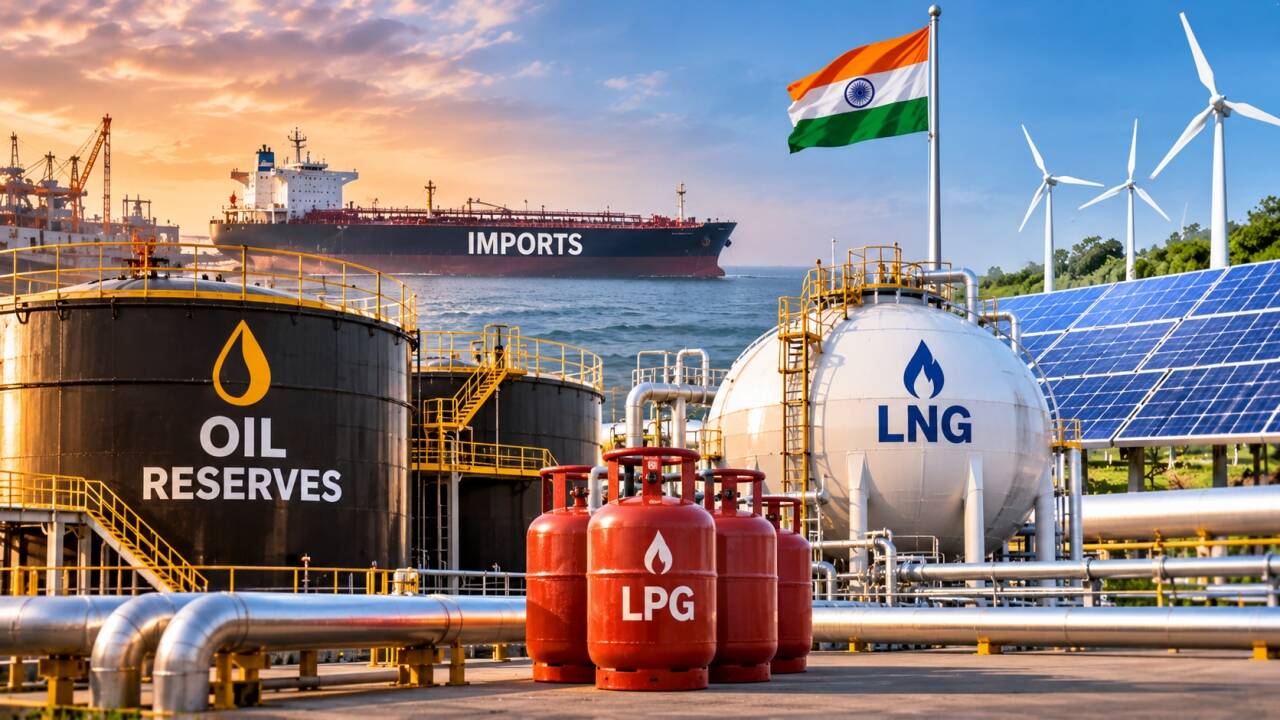
How India can secure its energy future without trying to eliminate oil, LPG, LNG imports
By Amit KumarIndia’s energy-security strategy is increasingly a portfolio of diversified imports, domestic production, strategic reserves, cleaner substitutes and a more flexible power system. The next step is to connect these initiatives into a measurable resilience framework.Energy security is sometimes confused with race to eliminate imports. For India, that would be an expensive and potentially misleading benchmark.
A large, fast-growing economy is more secure when energy remains available and affordable not only in normal times but through geopolitical disruptions, commodity-price shocks, extreme weather and technology transitions. That requires multiple suppliers and routes, strategic stocks, domestic production where competitive, efficient demand and alternatives that can achieve scale.This is broadly the direction of current government policy.
Oil and gas measures emphasise exploration, supplier diversification, refining, pipelines and strategic reserves. It also includes: household policy supporting LPG access; electricity generation through non-fossil fuel, transmission, storage and domestic manufacturing on solar cell, batteries, electrolyser etc. The policy architecture is substantial. The remaining challenge is execution across institutions and measuring security by outcomes—days of cover, route concentration, contract flexibility, grid reliability and affordability—not capacity announcements alone.Oil: high import exposure, balanced by refining strengthIndia’s most visible vulnerability is crude oil.
In FY2025-26, domestic crude production was about 28 million tonnes and import dependence reached 88.7%, according to the Petroleum Planning and Analysis Cell (PPAC). Yet the same system has a major strength: installed refining capacity of 258.1 million tonnes a year and petroleum-product output of 284.9 million tonnes in FY2025-26. India is therefore heavily dependent on imported crude, but comparatively capable in processing, product supply and exports.Government policy addresses the domestic-supply side through the Hydrocarbon Exploration and Licensing Policy and Open Acreage Licensing Program, which offer a uniform licensing framework and allow companies to propose exploration blocks.
These reforms may moderate import dependence, but geology, project economics and long development cycles mean that domestic exploration should be treated as one hedge rather than a promise of self-sufficiency.The second hedge is diversification. India now buys crude from a wider set of producers, while refiners retain flexibility to alter grades and suppliers. This reduces single-country exposure, although shipping chokepoints—especially the Strait of Hormuz—remain material.
A cargo sourced farther away may improve route security but increase freight, insurance and working-capital costs. For businesses, resilience therefore has a price that should be compared with the cost of disruption.The third hedge is inventory. Indian Strategic Petroleum Reserves Limited operates 5.33 million tonnes of strategic storage at Visakhapatnam, Mangaluru and Padur. The Government has approved a second phase of 6.5 million tonnes at Chandikhol and Padur through public-private partnership models.
Commercial inventories held by refiners add another layer. The policy gap is not only storage volume: India also needs transparent release triggers, coordinated emergency exercises and a clear method for rotating stocks without distorting markets.LPG: physical supply and refill affordability must be managed togetherLPG is a special case because energy security reaches directly into household welfare.
India consumed roughly 31 million tonnes in FY2025-26; domestic production was about 13.1 million tonnes, leaving close to three-fifths of demand dependent on imports, according to PPAC. Gulf suppliers remain important, so supply disruption and freight costs can quickly affect the subsidy bill and retail affordability.The Government’s response combines import diversification, coastal and inland infrastructure, and the Pradhan Mantri Ujjwala Yojana (PMUY), which has expanded access to clean cooking fuel.
PMUY had released more than 10 crore connections by 2024, according to the Ministry of Petroleum and Natural Gas.Connections, however, are not the same as sustained use. Refill affordability, last-mile delivery and household cash flow determine whether LPG displaces traditional fuels.A proportionate next step would be to maintain geographically distributed LPG stocks, widen supplier and contract options, and target fiscal support toward vulnerable households rather than suppressing prices across the market.Natural gas and LNG: infrastructure exists, but flexibility is unevenIndia consumed 68.5 billion cubic metres (bcm) of natural gas in FY2025-26.
Net domestic production was 34.3 bcm and LNG imports were 34.2 bcm, implying import dependence of about 50%, according to the Petroleum and Natural Gas Regulatory Board (PNGRB). As of March 2026, India had eight operational LNG terminals with 53.5 million tonnes per annum of regasification capacity and 27,905 km of operational natural-gas pipelines.These figures show that the constraint is not simply terminal capacity.
Utilisation differs sharply by location because pipeline connectivity, anchor demand, delivered prices and contractual commitments vary. Government plans to expand the national gas grid and city-gas networks can improve market depth, but new infrastructure needs credible demand and open, predictable access.LNG security requires a balanced procurement book:long-term contracts for essential demand, multiple pricing benchmarks and origins, destination flexibility, and a measured spot-market allocation.
India should also complete technical and commercial assessments for underground or depleted-field gas storage. Gas is not automatically a ‘secure’ transition fuel if buyers remain exposed to spot prices without seasonal buffers.Renewables: “the strategic hedge” now depend…