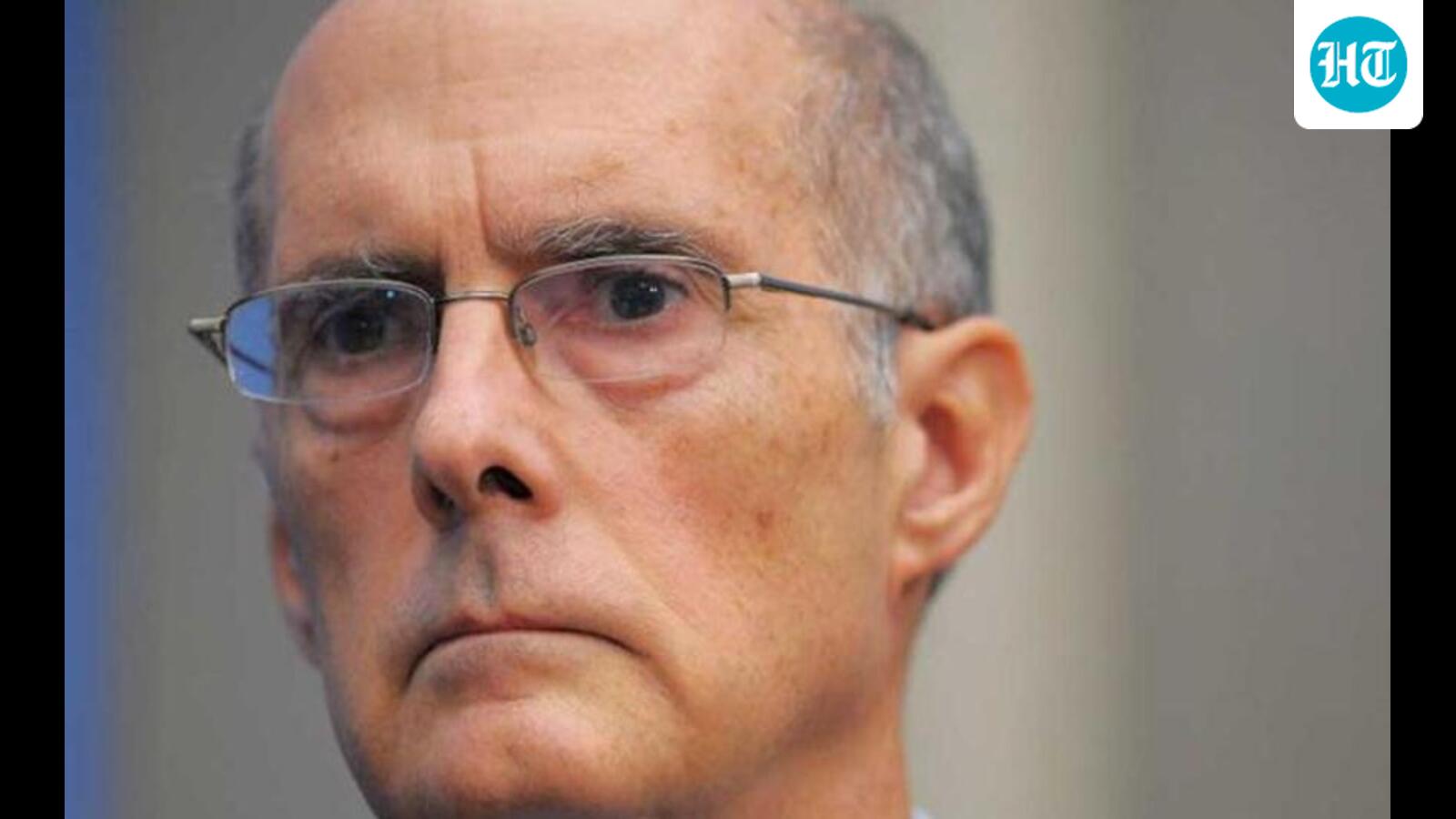
Strobe Talbott, one of the architects of the turnaround in India-US ties, dies at 80
“We’re going to come down on those guys like a ton of bricks,” a steaming US President Bill Clinton told his team in the White House’s Oval Office in May 1998. Only 24 hours before, India had conducted a series of nuclear tests in the dusty sands of Pokhran and unambiguously declared itself a nuclear weapons state. Clinton was furious, and all the more so because Washington, distracted by conflicts in West Asia and Europe, had not seen the tests coming.But less than two years later, Clinton visited India, addressed the Indian parliament, launching a new era in the India-US relationship.
It was a startling transformation in the bilateral ties 22 months after the nuclear tests. One of the principal architects of that turnaround, Strobe Talbott, died in New York on Friday. He was 80.As deputy secretary of state, Talbott launched a dialogue with external affairs minister Jaswant Singh after the 1998 tests, allowing the two countries to start the slow, painful process of burying the distrust and tensions that had dogged their ties for half a century.“We met 14 times at 10 locations in seven countries on three continents.
Those encounters added up to the most intense and prolonged set of exchanges ever between American and Indian officials at a level higher than ambassadors,” Talbott recalled.Born in 1946, Talbott was a product of the postwar American foreign policy establishment: Yale, a Rhodes Scholarship at Oxford, and a foreign affairs correspondent for Time, one of the most influential publications.
He struck up a friendship with Clinton at Oxford. Clinton brought Talbott into the State Department after a two-decade career in journalism.Talbott was an unlikely choice to repair and relaunch the US-India relationship. Much of his career was spent as an analyst of the Soviet Union during the Cold War. America was in search of a new approach to the world after the Cold War. Clinton was the first president born after the Second World War.
He believed the end of the Cold War had propelled him to the presidency, and the idea of laying out a new vision for what came after appealed to him. India benefited.In the 1970s, Talbott covered Secretary of State Henry Kissinger’s diplomacy with Indira Gandhi in the months after India’s nuclear tests. Bill and Hillary Clinton, Talbott later recalled, were interested in India since the late 1960s.
Once he entered the White House in 1993, Clinton was determined to turn the relationship with India around. But that was easier said than done. An opening to India fell by the wayside as conflicts in West Asia and Eastern Europe sidetracked the Clinton administration. There was also the matter of building a new relationship with Russia, which Talbott handled.The little attention paid to India largely centered on the country’s nuclear programme and the widespread fear that India would test a nuclear weapon.
In 1995, the Clinton administration successfully cautioned Prime Minister PV Narasimha Rao against detonating a nuclear device.The Atal Bihari Vajpayee government’s decision to declare India a nuclear weapons state in 1998 infuriated the Clinton administration. But as Talbott soon recognised, it forced Washington to pay attention to India in a way it had not before. “He [Clinton] had been frustrated at not having made much of a dent in US-Indian relations during his first six years in office.
With only two years to go in his presidency, the nuclear tests gave him a powerful incentive to make up for lost time. Heading off an Indian-Pakistani arms race, and perhaps something much worse, was a compelling goal in itself,” he recalled.Soon afterwards, the two sides began to talk about repairing their relationship. Vajpayee picked Jaswant Singh, an erudite former cavalry officer, to lead the talks.
Talbott volunteered to act as the American interlocutor. The two first met in Washington in June 1998, in Talbott’s State Department office, which reminded Singh of the “comforting disorder of a postgraduate student’s room”.Over the next two years, Talbott pressed America’s five “benchmarks” on India: Sign the Comprehensive Test Ban Treaty (CTBT), halt production of fissile material, show restraint in deploying missiles and warheads, tighten export controls, and resume dialogue with Pakistan.
The prize for compliance would be relief from the slew of sanctions that Washington imposed on India after the Pokhran tests. Singh resisted, facing opposition to compromise from both the general public and within the Indian cabinet.New Delhi was so concerned about the perception of giving in to American pressure that the Strobe-Jaswant talks were referred to as a “dialogue” rather than a “negotiation”.The two struck up a warm friendship.
Singh praised Talbott’s “outstanding intellectual ability, transparent integrity, and an incredible ability to see the other person’s point of view”. But in a strict sense, the Strobe-Jaswant talks failed. Amid fierce domestic opposition to any compromise with Washington over nuclear issues, India never signed the CTBT and met few of the benchmarks. “Jaswant Singh came closer to achieving his objective in the dialogue than I did to achieving mine,” Talbott admitted.But their talks laid the groundwork for a new era in the US-India relationship.
When Pakistani troops snuck across the Line of Control to launch the Kargil war in 1999, Washington, for once, sided unambiguously with India.“We were finally making headway with the Indians—not in getting them to address our concern over the future of their nuclear weapons programmes, but in allaying their doubts, accumulated over 50 years, about whether we would take their security interests properly into account, especially when push came to shove with Pakistan,” Talbott wrote.Soon after, Clinton reversed two decades of relative neglect and visited India in March 2000, drawing a rapturous reception.At their first meeting, Singh told Talbott about a Rajasthani proverb: “Do not ask the way to a village if you d…