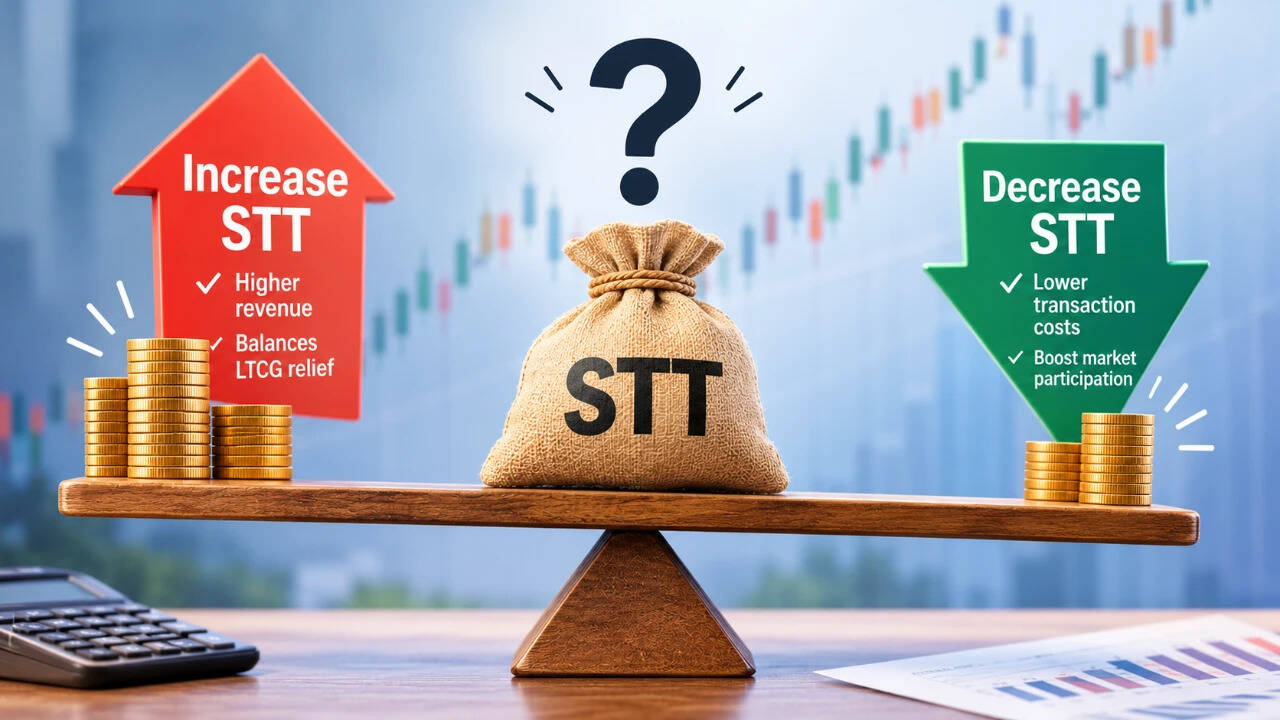
Union Budget 2027: Should government scrap LTCG tax and hike STT instead?
The pre-budget consultation has just wrapped up, and the proposals have put the long-term capital gains (LTCG) tax back at the centre of the policy conversation. Industry bodies have largely converged on one demand: that the levy be lowered or removed altogether, though they differ on specifics. SBI, for its part, has floated a graded, slab-style tax structure. The sharpest disagreement among these proposals is over what should happen to the Securities Transaction Tax (STT).With Budget 2027-28 approaching, two conflicting opinions have emerged: SBI Research's Ecowrap report has studied the option of scrapping or reworking the 12.5% equity LTCG tax, a move estimated to cost the exchequer ₹40,000–₹50,000 crore in FY28.
To plug that hole, it suggests raising STT by 50%, which would bring in around ₹45,000 crore. PHDCCI argues the reverse. It wants equity LTCG abolished, the Short-Term Capital Gains (STCG) tax halved from 20% to 10%, and STT rates brought down at the same time.Two questions follow. Can a steeper STT genuinely replace the revenue the government would give up on LTCG? And would lighter taxation of gains pull more capital into equities?The same trade, taxed twiceSTT applies to defined securities transactions executed on recognised stock exchanges.
What sets it apart from LTCG tax is its base: it has nothing to do with how much an investor earns. Someone who exits a position at a loss still has to pay STT on the sale.That is why industry groups describe equity investors as carrying two distinct burdens. STT is measured against the value of the transaction, whereas LTCG tax is measured against the gain realised when eligible shares are sold after the qualifying long-term holding period.PHDCCI objects that STT paid cannot be subtracted when capital gains are worked out.
It therefore wants both taxes reviewed together. In its reading, a non-deductible STT stacked on top of a tax on gains is double taxation, and it erodes the competitiveness of Indian capital markets.FICCI has taken a more balanced line. It would like the LTCG exemption brought back, and it is open to a higher STT on delivery-based trades to make up the revenue shortfall. SBI Research likewise lists an STT hike as one way of financing the abolition of LTCG tax.Where the last budget left thingsUnion Budget 2026 lifted STT on Futures and Options (F&O) from April 1, 2026, with the stated intention of restraining speculative trading and systemic risk.
Delivery-based equity trades and mutual fund units escaped any change.Critics of any further hike argue that the derivatives market has little room left to absorb additional costs. As one assessment puts it:Former senior public sector banker Kulvinder Singh Sethi said, “After consecutive increases in STT, derivatives volumes are already sensitive to cost friction. Raising STT by another 50% risks compressing trading activity and liquidity — meaning actual revenue gains can fall short of linear projections while nudging liquidity toward lower-friction instruments or offshore venues.”From enactment to evolution: 22 years of STT reformsThe tax is hardly new.
It arrived in 2004 as a substitute for LTCG tax on listed equities, and successive Finance Acts have since pushed it in both directions, sometimes raising rates, sometimes trimming them, and sometimes changing the base on which it is computed.Read in sequence, the timeline shows a broad run of increases in the first two years, a spell of relief around 2012 and 2013, and then, from 2016 onwards, a series of hikes aimed mostly at derivatives.Foreign inflow has not taken the baitOn the revenue front, the latest hikes have clearly delivered.
As of September 17, STT collections for 2026-27 stood at ₹40,214.36 crore, up nearly 53% from ₹26,305.72 crore recorded over the same stretch a year before.The jump traces back to the new rates. STT on futures went from 0.02% to 0.05% of traded value. On options, the levy on premium turnover climbed from 0.1% to 0.15%, and the levy on exercised options moved from 0.125% to 0.15% of intrinsic value.However, higher STT has not translated into stronger interest from foreign investors.
NSDL data shows net foreign portfolio investor (FPI) flows swinging between inflows and outflows through 2026.“FPIs already navigate rupee currency dynamics alongside capital gains tax rules. Because STT is levied as an upfront transaction toll regardless of whether a trade ends in profit or loss, higher STT raises round-trip execution friction for foreign funds running hedged, arbitrage, or cross-market strategies—making competing Asian markets look comparatively cleaner on transaction costs,” Sethi said.Signals from the street and finance ministryThe market's sensitivity to this topic was on display on October 13, 2026.
The BSE Sensex climbed by more than 1,100 points and the Nifty 50 gained about 1.6%, adding over 350 points. The catalyst was Finance Minister Nirmala Sitharaman's willingness to hear out stakeholders on LTCG tax and STT in the run-up to the 2027 Budget.At the Bloomberg New Economy Forum 2026, asked whether LTCG tax and STT might be rationalised, she replied: “We are very close to the Budget, and the preparation for the Budget has started.
It may not be the best time for me to say what I will or what I will not consider,” and added that she would welcome suggestions on the subject.The rally points to an expectation among investors that the tax framework will be revisited. Some observers stress that the way the revenue gap is bridged counts as much as the relief itself:“From a market-microstructure standpoint, easing transaction friction—or offering calibrated LTCG relief without punitive STT hikes — is far healthier for price discovery than using STT as a mechanical revenue plug,” Sethi said.Sethi added that since STT is charged on the transaction value, regardless of whether you make a profit or incur a loss, increasing the tax rate will lead to penalising liquidity and discouraging market p…