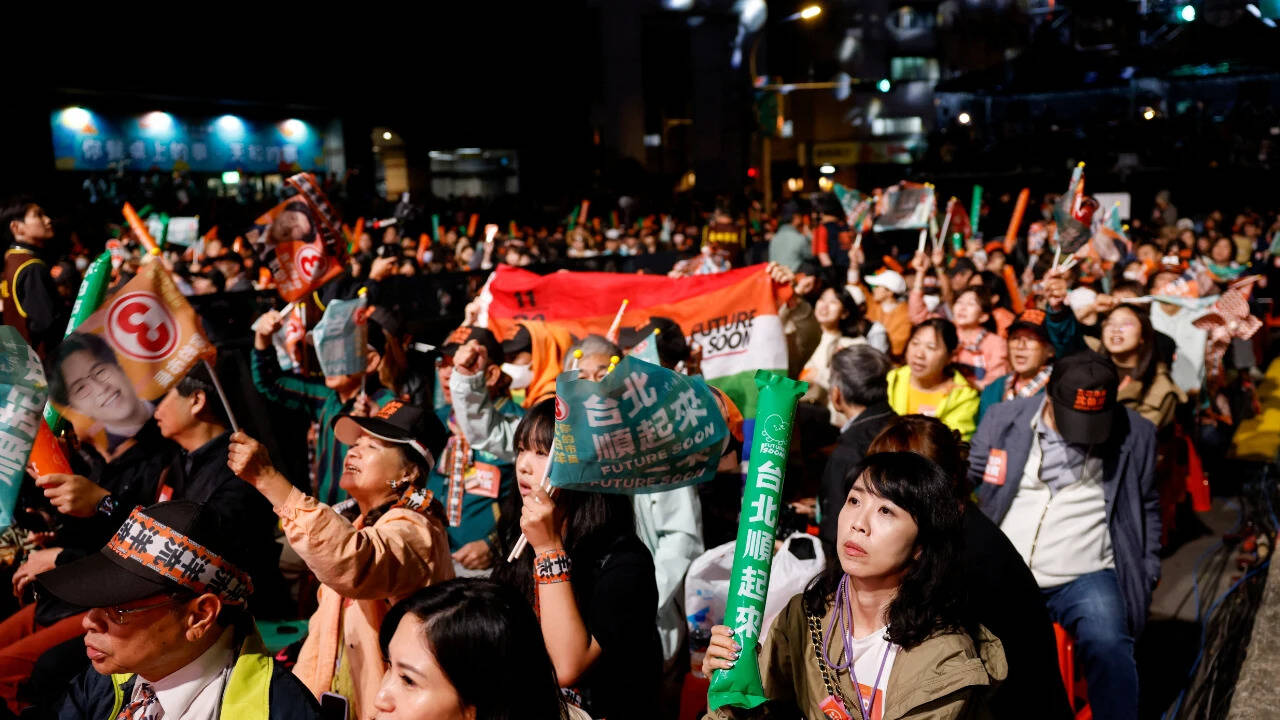
Taiwan's ruling DPP loses Taipei mayoral race as KMT retains capital and New Taipei
Taiwan's ruling Democratic Progressive Party (DPP) conceded defeat in the Taipei mayoral election on Saturday but secured victories in nine of the island's 22 cities and counties in closely watched local polls.The opposition Kuomintang (KMT), which favours closer ties with China, retained control of Taipei and neighbouring New Taipei City, as well as eight other localities, according to the semi-official Central News Agency.Two more county races remained too close to call on Saturday night.Taipei has traditionally been a stronghold of the KMT, which secured another term for incumbent mayor Chiang Wan-an against DPP candidate Puma Shen.With votes from 1,606 of the 1,790 polling stations counted, Chiang had 53.8 per cent of the vote against Shen's 45.6 per cent, according to electoral authorities.Shen conceded defeat and said he had called Chiang to congratulate him.“I know there’s many people crying here.
I want to thank every person who voted for me,” he told thousands of supporters.A teary-eyed Chiang thanked his supporters, saying, “After a long, hard-fought democratic election, we fought together until the end, thank you everyone.”The result denied the DPP its first victory in Taipei since 1994. Shen, who gained attention for organising civil defence courses, had campaigned on issues including planting more trees and making the city government more responsive.Beijing had labelled him a separatist, imposed sanctions on him and launched an investigation into his activities.DPP sees significance ahead of 2028 presidential electionDespite losing Taipei, the DPP's performance across the island was described as a modest victory by Chen Shihmin, a political science professor at National Taiwan University.“This result will allow the DPP to be united in supporting (President) Lai Ching-te when he seeks another term in 2028,” Chen said.The KMT traditionally performs strongly in local elections.
In the 2022 polls, the DPP had won in only five of Taiwan's 22 cities and counties.Unlike presidential elections, which are often dominated by cross-strait relations and pressure from Beijing, Saturday's contests focused largely on local concerns, including social welfare benefits and livelihood issues.However, China remained part of the wider political backdrop. Taiwanese authorities have accused Beijing of attempting to undermine public trust in the island's electoral system, allegations rejected by Chinese authorities.Taiwan's Ministry of National Defense reported around 33 sorties by Chinese military aircraft, including bombers and fighter jets, towards the island between Friday and Saturday.Nuclear power referendum also draws attentionVoters also participated in a referendum on overturning Taiwan's ban on nuclear power.
The proposal seeks to allow nuclear energy to be used to support economic growth and meet rising electricity demand.Supporters argued that additional energy sources would be needed to meet the growing power requirements of the artificial intelligence industry. The referendum does not specify concrete steps to reopen nuclear power plants, which were shut down last year, but its outcome gives the government a political mandate to pursue nuclear power development.Economic concerns also featured prominently among voters.
Chang Li-fen, who declined to disclose her voting choice, said the economy was her main concern.“If the Taiwan economy is good, only then will people be able to live well,” she said. “In France and in Italy, people are protesting because of energy costs, which raised the cost of living, so I think the economy is most important.”You use AI every day. Now get your AI Quotient. Take the AIQ test.