India hits immunisation milestones, but why are many still missing their shots?
NEW DELHI: What began with do boond zindagi ki has grown into one of the world's largest vaccination drives. Now, smallpox is history, polio has been eliminated, and maternal and neonatal tetanus are no longer public health threats in India.That's quite a flex!India's vaccination story is one of ambitious campaigns, millions of doses and some remarkable public health victories.
The country was declared polio-free in 2014. A year later, it eliminated maternal and neonatal tetanus as a public health problem. Then, during the Covid-19 pandemic, it administered over 200 crore vaccine doses, including indigenously developed and licensed vaccines manufactured in India.And the drive is far from over.Earlier this year, the government added another shot to India's public health armoury with a nationwide human papillomavirus (HPV) vaccination campaign for 14-year-old girls, aimed at protecting them against cervical cancer.
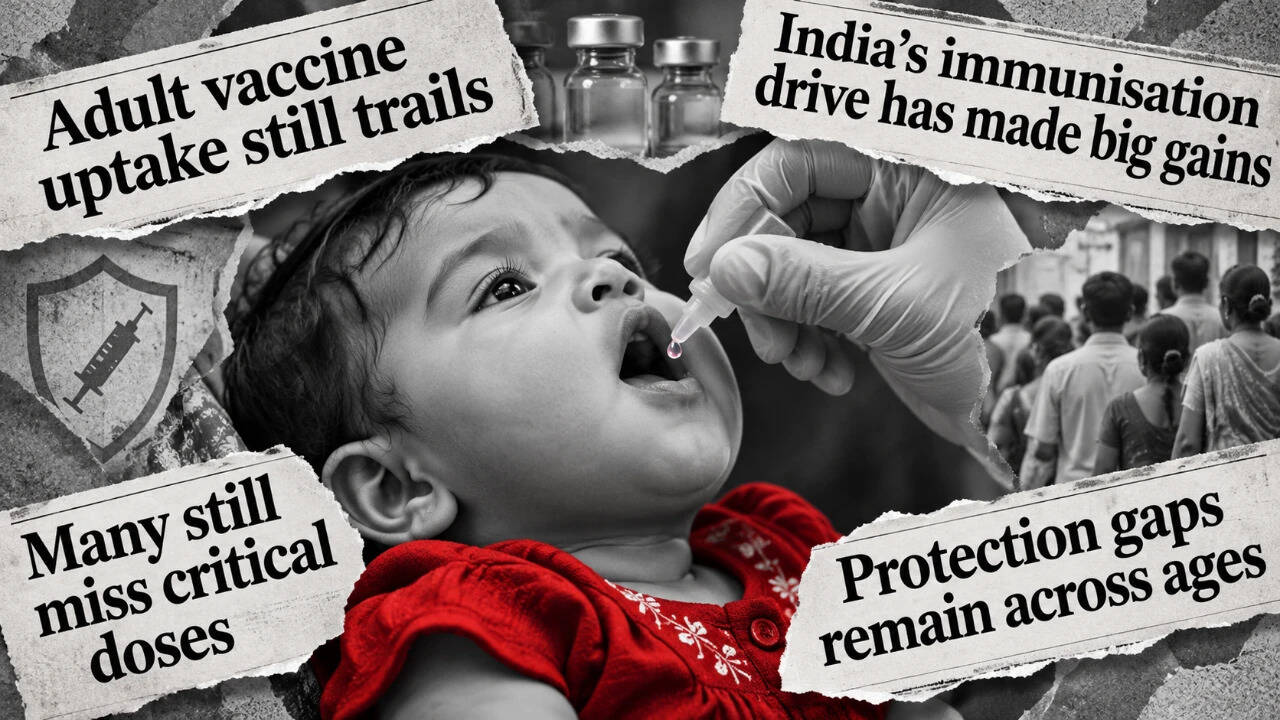
It also launched an indigenously manufactured tetanus-diphtheria (Td) vaccine. From fighting childhood infections to preventing cancer,India's vaccine drive is continuously levelling up. According to the Union health ministry, full immunisation coverage climbed from 62% in 2015 to 98.4% in January 2026. Last year, the figure stood at 97.9%.However, there is still a long way to go.Lakhs of children are missing essential shots with coverage remaining uneven across states.
At the same time, many older adults are still largely missing from the vaccination picture.But if India has come this far, why are so many people still missing their shots?India’s vaccination story: From Bombay's first jab to nationwide driveIndia's vaccination story goes back more than two centuries. The first smallpox vaccination in the country was administered in Mumbai on June 14, 1802, after vaccine lymph arrived from abroad.
Nearly a century later, in 1897, Dr Waldemar Haffkine developed India's first indigenous vaccine against plague, also in Bombay.The government's efforts to make immunisation more organised gathered pace in 1962 with the launch of the national BCG programme to control tuberculosis. This was followed by the Expanded Programme on Immunisation (EPI) in 1978, which marked another step towards wider vaccine coverage.However, 1985 proved to be a bigger turning point.
India launched the Universal Immunisation Programme (UIP), bringing free vaccines against 12 preventable diseases to children and pregnant women. The initiative laid the foundation for what has since grown into one of the world's largest publicly funded vaccination programmes.The scale of the operation today is enormous. Every year, the UIP reaches 2.9 crore pregnant women and 2.54 crore newborns every year, free of cost.
A vast network of government healthcare centres, frontline health workers, cold-chain facilities and digital systems supports the delivery and tracking of these doses.The programme's vaccine basket has also grown over the years. What initially focused on diseases such as tuberculosis, polio and tetanus now offers protection against a wider range of infections, including rotavirus diarrhoea, rubella and serious illnesses caused by pneumococcal bacteria.Alongside this expansion came some major public health victories.
India eliminated smallpox, yaws, polio and maternal and neonatal tetanus as public health threats. Immunisation has also contributed to lower child mortality and reduced the burden of diseases such as measles and rubella.One campaign, in particular, became a defining moment in this journey. Launched in 1995, the Pulse Polio Programme took vaccination beyond healthcare centres and turned it into a nationwide public movement.
Its now-familiar slogan, do boond zindagi ki, helped bring millions of people into the campaign. The last reported case of wild polio in India was recorded on January 13, 2011, in Howrah, West Bengal. In 2014, the country was certified polio-free.But maintaining high vaccination coverage is an ongoing exercise. Full immunisation coverage stood at 94.7% in 2022-23, slipped to 93.7% in 2023-24, rose to 98.3% in 2024-25 and eased to 97.9% in 2025-26.India has also made progress in reaching children who have not received any routine vaccines, commonly referred to as zero-dose children.
Their share declined from 0.11% in 2023 to 0.06% in 2024.The science behind every shotVaccination is not a one-and-done exercise. Some shots are given at birth, others follow at carefully spaced intervals, and a few need boosters to keep protection going. But what exactly do these jabs do?A vaccine essentially prepares the immune system for an encounter with a disease-causing germ.
It teaches the body to recognise the threat and respond faster if it comes into contact with it later. This reduces the risk of infection and, in many cases, prevents severe illness.In India, this protection begins at birth. Newborns receive vaccines against tuberculosis (BCG), polio and hepatitis B. The hepatitis B birth dose is particularly time-sensitive and should ideally be administered within the first 24 hours.The next round begins when the baby is six weeks old, with follow-up doses at ten and fourteen weeks.
These vaccines protect against diphtheria, whooping cough, tetanus, hepatitis B, polio, rotavirus diarrhoea and infections caused by Haemophilus influenzae type B (Hib).Pneumococcal vaccines are also included in the schedule to protect infants against serious infections, including certain types of pneumonia and meningitis.The vaccination calendar does not stop once babies become toddlers.
Between nine and 12 months, children receive their first measles-rubella dose, followed by a second at 16-24 months. Japanese encephalitis vaccines are also offered in endemic districts.As children get older, booster doses become part of the routine. DPT boosters are given during early childhood, followed by tetanus-diphtheria (Td) shots at the ages of ten and 16 to maintain protection.The schedule is also expanding beyond child…