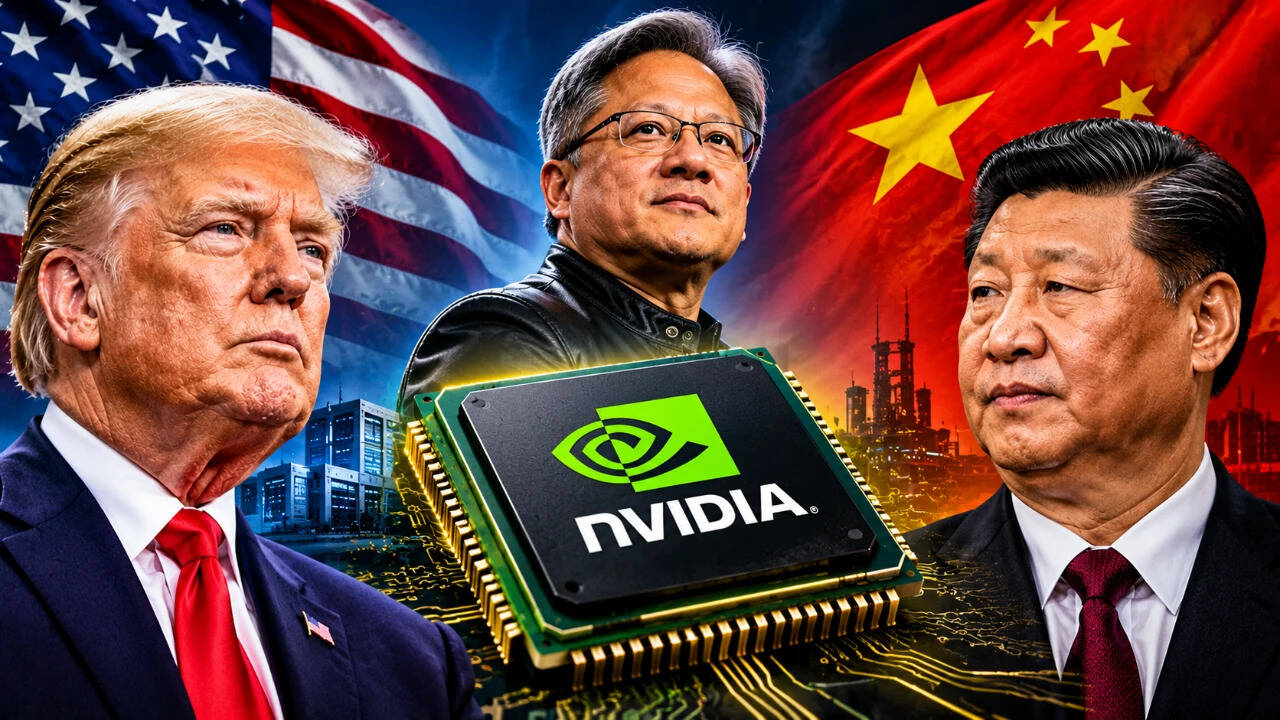
Nvidia's AI chips: The technology China wants and America guards
America wants to keep its most powerful AI chips out of China's hands. But China is also a market Nvidia cannot afford to lose.That contradiction has long been at the heart of the technology war between Washington and Beijing. Now, an alleged espionage scandal involving Nvidia CEO Jensen Huang has brought the battle over AI chips into focus.Huang has admitted to an extramarital affair with Alice Huang, a former executive of Singapore-based Megaspeed, a company under scrutiny over the suspected diversion of advanced Nvidia chips to China.
US intelligence assessments have reportedly raised concerns about her alleged links to Chinese intelligence — claims that remain unproven and that Beijing has rejected.Nvidia's board has launched an independent investigation into whether its CEO was targeted by foreign intelligence. The company says it has no reason to believe its secrets or US national security were compromised.But beyond the personal controversy lies a much bigger question: What makes Nvidia's AI chips so valuable that the world's two largest economies are fighting over who gets access to them?Why Nvidia's AI chips are so valuableNvidia's graphics processing units (GPUs) have become central to the development and operation of modern AI systems.
Unlike conventional processors, which are designed to handle a broad range of computing tasks, GPUs can perform large numbers of calculations simultaneously.This makes them particularly suited to training and running AI models, which require enormous computing power.Their importance extends beyond the technology industry. Advanced AI can be used in areas such as scientific research, industrial automation, intelligence analysis, surveillance and military applications.
Governments therefore view access to high-performance chips as a matter of economic competitiveness and national security.Nvidia's advantage is not limited to the hardware itself. Its CUDA software platform allows developers to write and run applications on its GPUs. Over the years, researchers, technology companies and AI developers have built tools and systems around this ecosystem, making it difficult for rivals to replace Nvidia products without additional time, investment and engineering work.For Washington, this dominance creates considerable strategic leverage.
American companies lead important areas of chip design and semiconductor technology, while US export-control rules can also restrict the supply of certain products manufactured overseas using American technology.Why the US is restricting chip sales to ChinaThe US has tightened restrictions on exports of advanced semiconductors to China since October 2022. The measures are intended to limit Beijing's access to computing power that could support advanced AI development and military capabilities.The company has developed less powerful versions of certain chips for the Chinese market in the past, but Washington has continued to adjust the rules to prevent restricted technology from reaching Chinese customers through alternative products or supply routes.Nvidia chief executive Huang has repeatedly criticised the restrictions, arguing that excluding American companies from China could strengthen local rivals.The policy has not been entirely static.
In January 2026, the US Commerce Department revised its licensing approach to allow certain exports of Nvidia's H200 processors and comparable chips to China to be considered on a case-by-case basis.The permission came with conditions, including requirements relating to US supply capacity, customer compliance procedures and third-party testing in the US. It was not a blanket approval for unrestricted sales, according to the US Bureau of Industry and Security.Why China also needs Nvidia chipsChina has invested heavily in developing its own semiconductor industry, but domestic companies have yet to fully match Nvidia's capabilities across the high-end AI computing market.Data from research firm IDC, reported by Reuters, showed that Nvidia held 34% of China's data-centre AI chip market in the first half of 2026.
It shipped about 678,000 AI accelerators during the period, compared with Huawei's 572,000, giving the Chinese company a 28% share.The H200 has become a particularly important point of friction. After Washington introduced a conditional licensing route for exports, Chinese authorities reportedly restricted purchases to special circumstances, such as university research. Beijing has also sought to encourage domestic companies to rely more heavily on locally developed processors.The result has been an unusual standoff.
Around 600,000 Nvidia H200 processors were reportedly being held in Hong Kong while awaiting shipment to mainland China, with Beijing yet to approve large-scale imports. Some smaller shipments had reportedly been allowed through intermediaries.China's response has been to accelerate the development of domestic alternatives. Huawei is among the companies seeking to fill the gap, while other Chinese chipmakers, including Cambricon and Alibaba's T-Head, are also working to expand their presence in the market.Even so, Chinese labs still use Nvidia hardware.
Omdia analyst Lian Jye Su told news agency AFP that Chinese vendors are still using cutting-edge Nvidia chips to train models.Problem of getting around US restrictionsExport controls can limit where advanced chips are shipped, but monitoring how they are ultimately used is more complicated. Companies and researchers can access computing resources through data centres in other countries, even when the end user is based in China.This creates a challenge for US authorities.
A chip located in a data centre in Southeast Asia, for example, could potentially be used remotely by a customer elsewhere. The physical location of the processor does not necessarily reveal who is accessing its computing power.White House adviser Michael Kratsios recently cited the case of Chinese AI company Moonshot AI accessing high-end Nvidia…