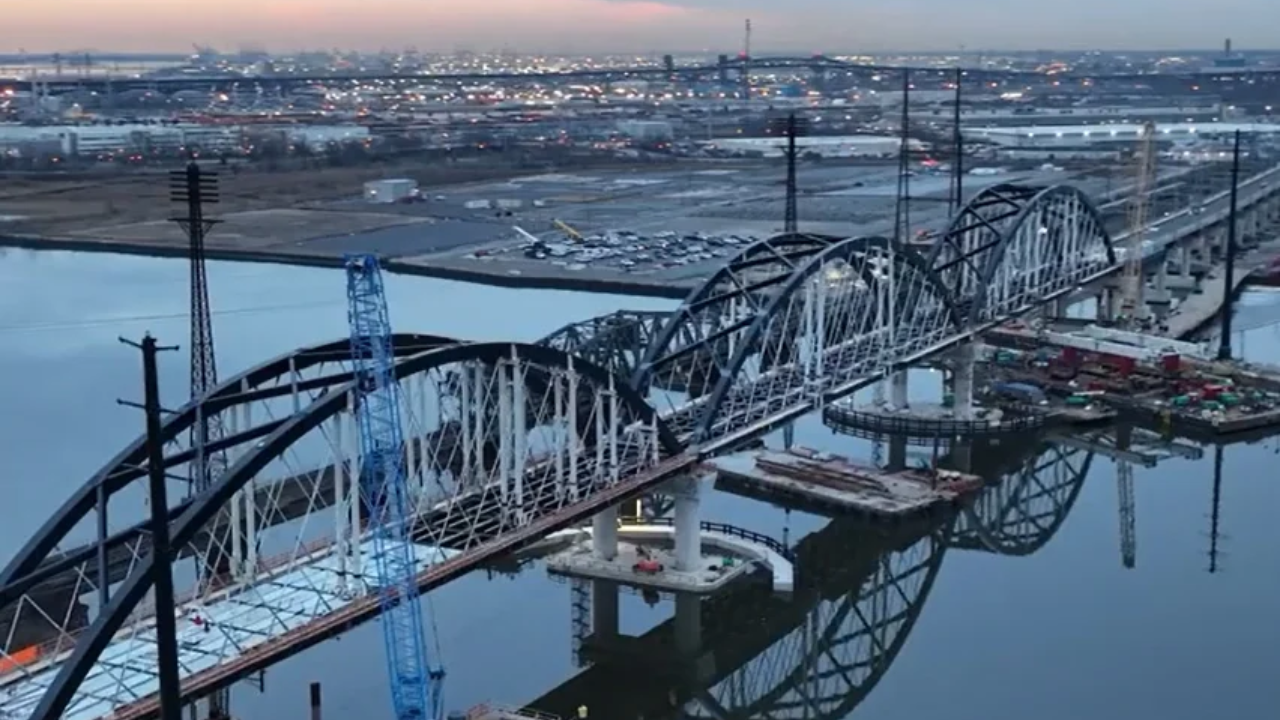
New Jersey replaces 116-year-old railway bridge with $2.3 billion span
For more than a century, a railway bridge in New Jersey had an unusual problem: whenever boats needed to travel along the river below, the entire bridge had to swing open, interrupting train services. Having entered service in 1910, the ageing structure became a recurring source of delays for commuters travelling between New Jersey and New York. Now, after years of construction, a $2.3 billion replacement has entered full service, allowing trains and marine traffic to move independently.According to an announcement by Amtrak and NJ TRANSIT on November 16, 2026, both tracks of the new Portal North Bridge are now operational.
The fixed-span structure replaces the 116-year-old Portal Bridge over the Hackensack River in Kearny, New Jersey. Its elevated design allows boats to pass underneath without requiring trains to stop for a bridge opening, addressing a longstanding problem along one of the busiest passenger railway corridors in the United States.Why the original Portal Bridge had to open for boatsThe original Portal Bridge was built by the Pennsylvania Railroad and entered service in 1910.
It formed an important part of the Northeast Corridor, connecting railway routes between Newark, New Jersey, and New York. Unlike a conventional fixed railway bridge, the Portal Bridge was designed as a movable swing-span structure. It could rotate to create an opening for marine traffic travelling along the Hackensack River. Once the vessels had passed, the bridge had to return to its railway position before trains could resume crossing.Although this arrangement allowed both trains and boats to use the waterway, it created operational difficulties as railway traffic increased over the decades.
The ageing bridge also developed mechanical problems and could sometimes fail to close properly after opening. Before the COVID-19 pandemic, more than 450 NJ TRANSIT and Amtrak trains carrying approximately 200,000 passengers crossed the bridge each weekday. A delay caused by a bridge opening or mechanical malfunction could therefore affect a large number of commuters and disrupt services across the wider Northeast Corridor.How the $2.3 billion replacement worksThe new Portal North Bridge was designed to eliminate the need for a movable railway span.
Instead of swinging open, it remains permanently in position, with enough clearance for marine vessels to pass beneath it. The new two-track structure rises approximately 50 feet above the Hackensack River, doubling the height clearance available under the original bridge. This allows boats to travel along the river without interrupting railway operations.The replacement project extends approximately 2.44 miles along the Northeast Corridor, including the bridge and its approaches.
It also involved constructing retaining walls, concrete piers, deep foundations, steel spans and supporting railway infrastructure. The total project cost is approximately $2.36 billion, funded through federal, state and regional contributions, including investments from the US Department of Transportation, New Jersey and Amtrak. A $1.56 billion construction contract was awarded to the Skanska/Traylor Bros joint venture in October 2021.The project is part of the broader Gateway Program, which aims to modernise and expand passenger railway infrastructure between Newark and New York.Both tracks are now in full serviceThe transition from the original bridge to the replacement took place in stages to maintain railway operations during construction.
The first track of the new Portal North Bridge entered service on March 15, 2026, while the old swing bridge continued operating for trains using the second track. The final transfer began on October 9 and was completed on November 16, when both tracks became fully operational.The transition involved five weeks of railway service adjustments, including diversions affecting some NJ TRANSIT commuters travelling towards New York.
With the second track now operational, regular service has resumed and the temporary diversions have ended. The new bridge is expected to reduce delays, improve reliability and allow trains to operate more efficiently. It also supports higher train speeds, with the new crossing designed for speeds of up to 90 miles per hour, compared with 60 miles per hour on the original bridge.The 1910 Portal Bridge is scheduled to be dismantled in 2027.
Its replacement marks the end of a century-long arrangement in which railway services had to make way for passing vessels. For commuters and river traffic alike, the new crossing represents a significant change: trains can continue moving while boats pass underneath, without either having to wait for the bridge to open or close.You use AI every day. Now get your AI Quotient. Take the AIQ test.