EXCLUSIVE | 'Olympics medal nahi, Olympics gold': Manisha Bhanwala's promise to her late father
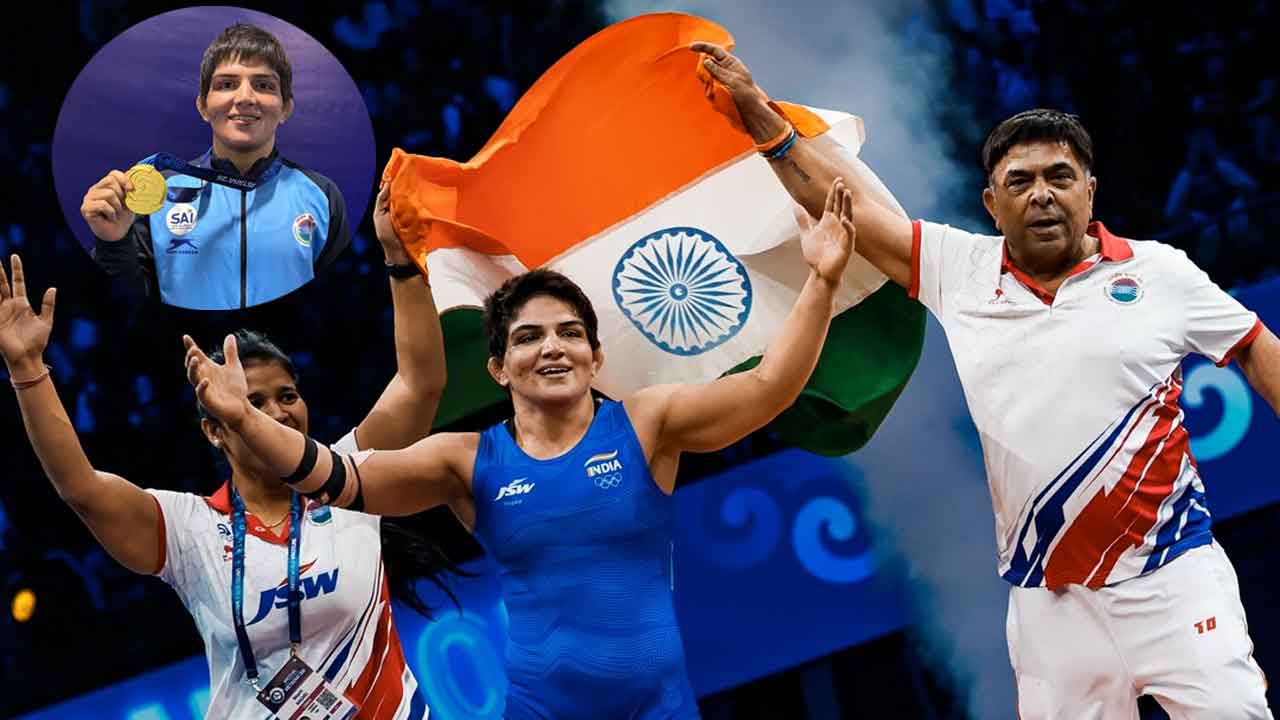
NEW DELHI: “Bhai saab, Jind Pandavon ki nagari hai, kuch to baat to hogi [Jind is the land of the Pandavas. There must be something special about it]”Manisha Bhanwala said these words with a smile a day after creating history at the World Wrestling Championships on Friday. The wrestler from Jind, Haryana, had just become the first Indian woman to win a gold medal at the World Championships.Perhaps there is something special about this town - Jind.
Manisha is not the only athlete from Jind to make the country proud this year.Exactly a month earlier, another daughter of the town, Neeru Dhanda, won gold in trap shooting at the Asian Games in Aichi-Nagoya. She became the first Indian woman to win an individual Asian Games gold medal in trap shooting.Jind has a deep connection with the stories of the Mahabharata. According to local belief, the Pandavas built a temple dedicated to Goddess Jainti Devi before going to war against the Kauravas.
They prayed to the goddess and sought her blessings for victory. The town was originally known as Jaintapuri, meaning the abode of Goddess Jainti Devi. Over time, the name became Jind.And now, Manisha has added another proud chapter to the story of this town.But for the 59kg wrestler, the biggest moment of her life was also a deeply personal one.When she won the gold medal, she did not celebrate alone.
She kept the medal and a photograph of her late father beside her pillow. She made a video call to her mother and brother before going to sleep. Before kissing her father's photograph, she had one more moment with the man whose memories and teachings continue to guide her.Her father may not have been there to witness her historic achievement, but Manisha made sure he was part of it.The wrestler has often spoken about the lessons she learnt from the Bhagavad Gita through her father.
She believes in the principle of karma - doing one's duty and leaving the result to God. She follows it in her life and carries the same belief onto the wrestling mat.That belief was tested in the World Championships final in Astana, Kazakhstan. Manisha was trailing American wrestler Abigail Nette by six points in the women's 59kg final. But she refused to give up. She fought back brilliantly to win 8-6 and claim the gold medal.With this victory, Manisha became the first Indian woman to win a World Championships gold medal in wrestling.
She is only the second Indian overall to achieve the feat, after the legendary Sushil Kumar, who won the men's 66kg title in 2010.TimesofIndia.com spoke to Manisha from Astana about her thrilling comeback in the final, her celebration with a T-shirt carrying her father's photograph, Iranian-style wrestling, her belief in karma and her dream of winning gold at the Los Angeles Olympics.Manisha, what was going through your mind during the final?
You were trailing, and then suddenly you took the lead. What did you do to turn things around? There are times in such situations when things can go either way.I was trailing. When I went to the starting point, I felt that only one point had been scored, so why were they giving that opportunity at that moment? Even then, I challenged the decision, but they still awarded the points.
I objected, but my challenge was rejected. Even after that, I felt that I would be able to do it. I had that feeling.I hadn't had a good Asian Games. I was getting very frustrated. Doubts were also coming into my mind. Was I doing something wrong? This was something I asked myself when I closed my eyes for a few seconds. Was my practice wrong? Many things were going through my mind, but I believed that I could do it.
I felt it from within that I could turn things around. And I did.Did you ever face a similar situation before?Yes. I faced the same situation at the 2025 Asian Championships. I was losing, but I made a comeback and won the bout.What move did you use that turned things in your favour at the Worlds?My style of wrestling is different from that of other girls. I wrestle somewhat like the Iranian style.
The way I am trained is also different. For the last five years, the focus has been on being able to do anything in the first three minutes. But after that, it is about maintaining patience, stamina and strength. I also work on keeping myself mentally strong and excited. I work on all these things.If you dominate the first two to three minutes, the bout is yours. After that, it is all about your patience and analysis of the opponent.
If you are trailing, you will try to score, and in most cases, you lose patience and focus, and eventually the match too.You mentioned the Iranian style. Could you explain it a little?To develop that kind of strength, like Iranian wrestlers have, a lot of force is required. I am a little shorter in comparison, so I have to work harder. First, I practise with boys. If I get injured, I may have to stay away for two days.
So I try to do everything I can. Even if I have pain anywhere in my body, I complete my recovery. I spend my entire day on recovery, and only after that do I go back. I take care of my body as much as I can.What do you tell your sparring partners when you hit the mat during training?I train with multiple partners, including boys. They help me generate more force. After the selection or during camps, when it becomes clear which wrestlers will be going, we practise with those who are selected.
My coach and I tell them what needs to be done and what kind of practice is required. We make a particular plan and follow it.Who is your inspiration?My father sahab. My entire life is dedicated to my father sahab. He was such a lovely soul. He was not literate. He never went to school, but always supported me throughout my journey. There were taunts like, 'Ladki hai, padha likha le, shaadi kar de.' But he never listened to them.
Such was my father.I am what I am today because of him. I miss him a lot. But I still feel he is always sitting beside me. He is always there to clap for me, motivate…