Gukesh asked to distance himself from 'what people are saying' ahead of World Championship
NEW DELHI: In 1815, Mount Tambora in Indonesia unleashed one of the most violent volcanic eruptions in recorded history. Though its fury didn't stay buried in Indonesia. Ash and sulphur soon climbed into the atmosphere, altering weather patterns across the globe. Europe turned cold, wet and grey. The year 1816 would go down in history as the Year Without a Summer.It was summer by the calendar, but nothing about it felt that way.
A group of young English writers and intellectuals, Mary Godwin, who would later become Mary Shelley; her partner Percy Bysshe Shelley; the famous poet Lord Byron; his physician and fellow writer John Polidori; and Mary's stepsister Claire Clairmont, found themselves holidaying at Villa Diodati, Byron's rented residence overlooking Lake Geneva in Cologny, Switzerland.Confined indoors by relentless rain and gloom, it was Byron who proposed they pass the dreary evenings with a ghost-story competition, each of them tasked with conjuring something frightening enough to unsettle the rest.Initially, Mary struggled to find her idea, until a dream supposedly handed her one.
It was a short story that would eventually swell into one of the most influential novels in the history of literature, Frankenstein.Picture it for a moment. Some of the greatest literary minds of the Romantic era, trapped indoors by foul weather, daring each other to invent something terrifying.That said, Frankenstein wasn't even the only invention born that night. Polidori's own short work of prose fiction, The Vampyre, emerged from the very same contest.That one meeting in Cologny, 210 years ago, revolutionised literature by launching modern science fiction, reshaping Gothic horror, and creating the modern vampire archetype.And now, in that same corner of Switzerland, something with the potential to leave a similarly lasting mark on the game of 64 squares is about to unravel.
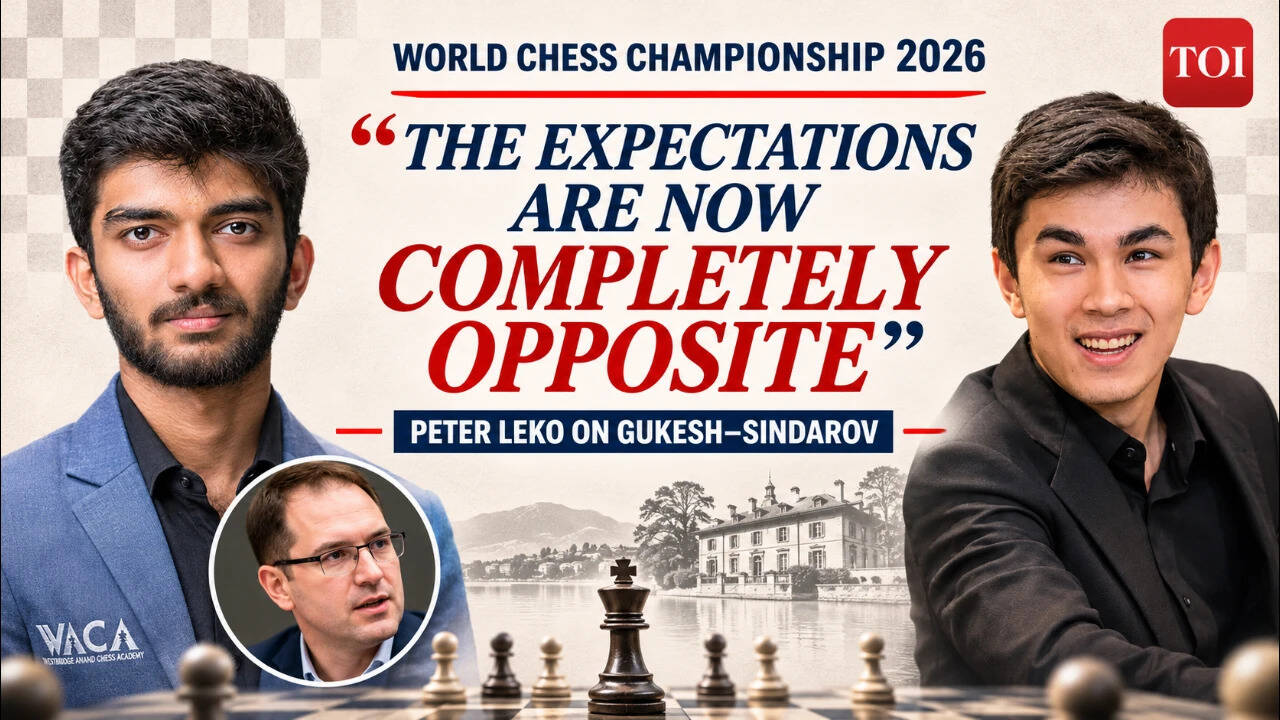
In a battle of 20-year-olds, India's Gukesh Dommaraju will take on Uzbekistan's Javokhir Sindarov for the World Chess Championship crown, in Geneva's Cologny, from November 24 to December 12.The last time Switzerland hosted a World Championship was in 2004, when Vladimir Kramnik met Peter Leko in Brissago. It was a historic match in its own right, but that's a story for another day, because this time, Leko returns to Swiss soil not as a challenger but as a witness.A lesson from the World Championship"I learned a lot from that (2004 World Championship) experience.
Going into a World Championship match, you have to distance yourself from all the expectations and from what people are saying," Leko, known to be one of the most respected voices in the world of chess, told TimesofIndia.com in an exclusive conversation. Leko, who will share the official commentary duties with Russian Grandmaster Peter Svidler for the 2026 FIDE World Chess Championship, didn't need long to find a parallel from the reigning champion's own past."I would also like to relate this to Gukesh's match against Ding Liren," he said.
"I felt that one of the reasons Gukesh lost the first game was the incredible hype surrounding him before the match."It wasn't hard to see why that hype had built."He had a fantastic run, qualified for the Candidates, delivered a phenomenal performance at the Chess Olympiad, and his rating was booming. Ding Liren's rating was going down while Gukesh's was skyrocketing. Everybody was expecting Gukesh to crush Ding Liren," he recalled.That weight of expectation, in Leko's reading, pushed Gukesh into a trap of his own making."I think Gukesh went into that first game feeling that he had to show the whole world that he was the hunter and that he wanted to dominate the match.
It backfired with that terrible loss," the 47-year-old Grandmaster explained.The rest, as chess fans will remember, turned into one of the most dramatic title matches in recent memory."That already signalled that it was going to be a hell of a match. And it certainly was a rollercoaster, which Gukesh eventually managed to win under dramatic circumstances."Why the pressure has switched sidesIf Gukesh walked into Singapore carrying the world's expectations, Leko believes he'll walk into Cologny carrying almost none of them; and that, this time, it's Sindarov who has to live with being the favourite."The expectations are now completely opposite," the Hungarian said.
"Sindarov is the one who has had an incredible year, winning the World Cup in Goa, winning the Candidates, playing fantastic chess with the Uzbek team and winning the Chess Olympiad. He carries the expectations."Gukesh, by contrast, gets to play the role he was denied last time."I believe that, from Gukesh's side, he doesn't care too much about the outside noise. He just wants to focus on himself and show the whole world, as well as himself, that he is capable of retaining his title and playing a fantastic match against Sindarov." Which, Leko says, sets up something close to a mirror image of the match he's already seen up close.
"In this respect, I'm expecting a very close fight, just like the match between Ding and Gukesh two years ago."Fourteen games much better for the match?There's a structural significance to this match too, one that's easy to miss amid the psychological drama. When Kramnik met Leko in Brissago in 2004, it was a 14-game match. The cycles that followed shrank the format to 12 games, and it stayed that way for the best part of two decades until Magnus Carlsen's defence against Ian Nepomniachtchi in 2021 restored it to 14.Gukesh and Sindarov will now play out that same 14-game format in Cologny.
And Leko, unsurprisingly, is thrilled to see the longer format back."One other thing I'm extremely happy about is that the World Championship matches are back to 14 games, as they were last time. In between, we had those 12-game matches. I believe 14 games is much better for a World Championship match," the veteran Grandmaster, also coach of Germany's Vincent Keymer, opined."It means that the play…