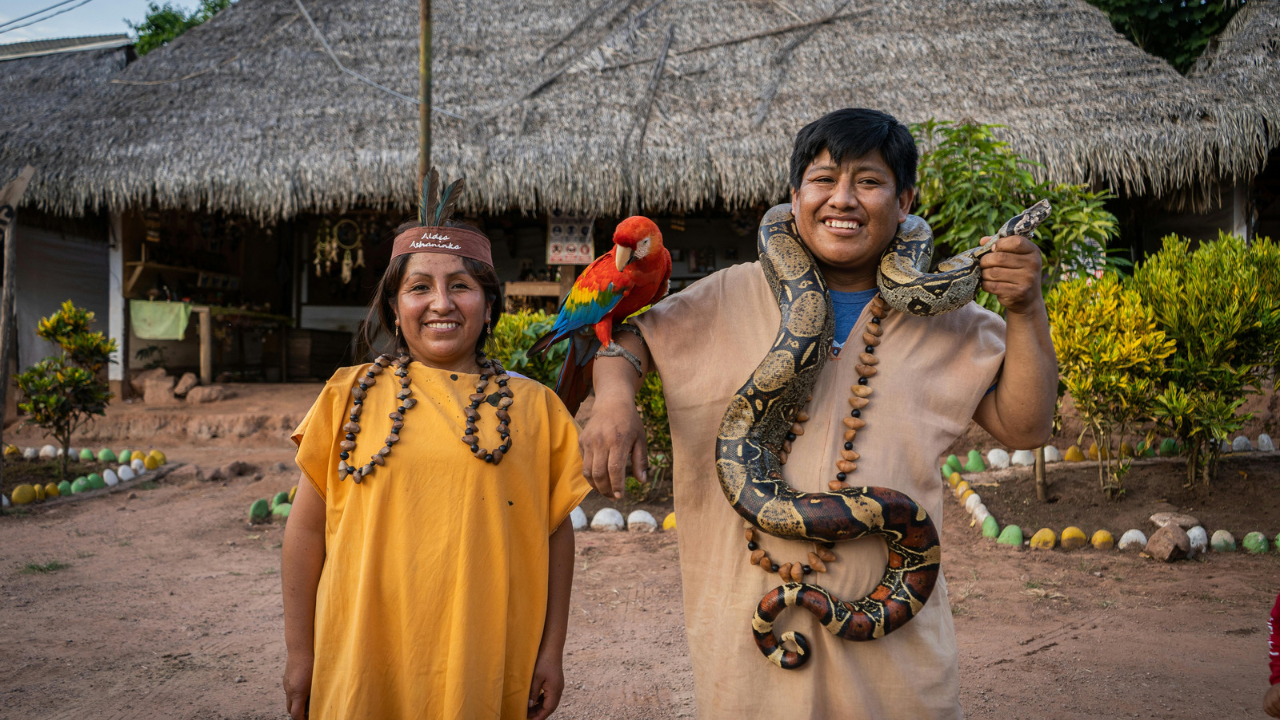
Amazon communities both fear and coexist with giant anacondas, study finds
Snakes are often associated with negative connotations. The word itself is frequently used to describe someone who cannot be trusted, a person who has betrayed someone or someone who is considered deceitful. But beyond these familiar associations, snakes have a rather complicated place in human societies. While some people fear them, others have learned to live alongside them, even when sharing their surroundings with one of the world's largest snakes: the giant anaconda.Ancient communities around the world have always had a complex and mysterious relationship with snakes.
In some communities, they were feared; in others, they were worshipped as protective creatures. Many of the negative connotations surrounding deceit and betrayal come from the biblical story of Adam and Eve, in which a mysterious serpent manipulated Eve into eating from the Tree of Knowledge, bringing upon them original sin and the downfall of humanity. But there are communities that have never considered these creatures as enemies or outsiders, but rather as fellow passengers on the journey of life and sometimes even as a part of the community, well, not a very friendly one, though.In the floodplains of the Lower Amazon, giant anacondas are more than just enormous snakes lurking in the water.
They are also part of local folklore, often associated with mythical serpents such as the Boiuna and the Cobra Grande. But for families living along the river, the relationship with these reptiles is not always shaped by myths and legends. Sometimes, it is as practical as protecting their chickens."Chicken is her favourite dish. If one clucks, she comes," one resident told researchers studying the relationship between local communities and anacondas.A 2025 study published in Frontiers in Amphibian and Reptile SciencetitledThe Myth of the Serpent: From the Great Snake to the Henhouse.
explored how people living in the Lower Amazon perceive these giant reptiles. It found that while anacondas have a place in local beliefs and traditional knowledge, encounters with them can also create conflict, particularly when poultry and livestock are at risk.Between local legends and everyday encountersThe relationship between humans and anacondas in the Amazon is not a recent one.
For generations, riverine communities living in the periodically flooded regions of the Lower Amazon have shared their surroundings with them. Their presence has gradually become part of the region's folklore, with anacondas often associated with mythical creatures such as the Boiuna and the Cobra Grande, both legendary giant serpents in Brazilian folklore.These legends have given the anaconda a place beyond that of an ordinary animal, with some traditional beliefs associating it with spiritual and supernatural powers.
However, as researchers Beatriz Nunes Cosendey and Juarez Carlos Brito Pezzuti explain in their 2025 study, the relationship has also evolved through everyday encounters. For communities that live close to these reptiles, sharing the same waterways and surroundings means that encounters are sometimes unavoidable.The researchers explored this relationship across five communities in the Aritapera region of Pará, Brazil, drawing on more than 43 hours of conversations with residents.
What emerged was a complicated picture: although people possessed considerable knowledge of anacondas and their behaviour, their perceptions of the snakes were often negative. And increasingly, the conflict was no longer just about folklore or fear. It was about something much closer to home: their chickens.When coexistence becomes complicatedBut not every relationship is harmonious.
Living alongside these big creatures has its own challenges, and sometimes it is not harmonious. For the communities studied, these reptiles were not merely creatures of folklore or a familiar presence in the surrounding waterways. Their presence could also become a source of conflict, particularly when anacondas entered areas where families kept domestic animals.For many residents, the conflict is rooted less in the fear of being attacked and more in the losses these animals can cause.
The researchers found that the primary reason people killed anacondas was to protect their domestic animals, particularly poultry. In fact, 47.7% of the reported motivations for killing were linked to protecting livestock. Other reasons included personal safety and the search for anaconda fat, while the trade in their skins had also contributed to hunting in the past.Interestingly, fear itself was not the strongest motivation behind these killings.
The study found that anger over economic losses played a much greater role, while fear often acted as a deterrent. This was particularly evident in the differences between men and women interviewed: men were more likely to report having killed an anaconda, while some women said that fear had prevented them from doing so.The findings reveal a rather unexpected shift in how these communities view the giant snake.
An animal once associated with mythical powers and the legendary Great Snake is increasingly seen through the more immediate concerns of everyday life. For some residents, the anaconda is no longer simply a creature of folklore; it has become a source of economic anxiety.And perhaps this tells us more about human behaviour than about snakes. An animal that occupies a place in local myths and traditional beliefs can also become a source of fear, conflict and economic loss.
Yet, this does not necessarily make it an enemy. The study highlights how coexistence is shaped not only by cultural beliefs but also by the everyday realities of the people who share their surroundings with these reptiles. After all, living alongside wildlife is not always about learning to love or fear it, but sometimes about finding a way to share the same world. Whatever becomes worthy of worship because of the benefits it offers is, perhaps, simply a reflection of human nature, whether we ar…