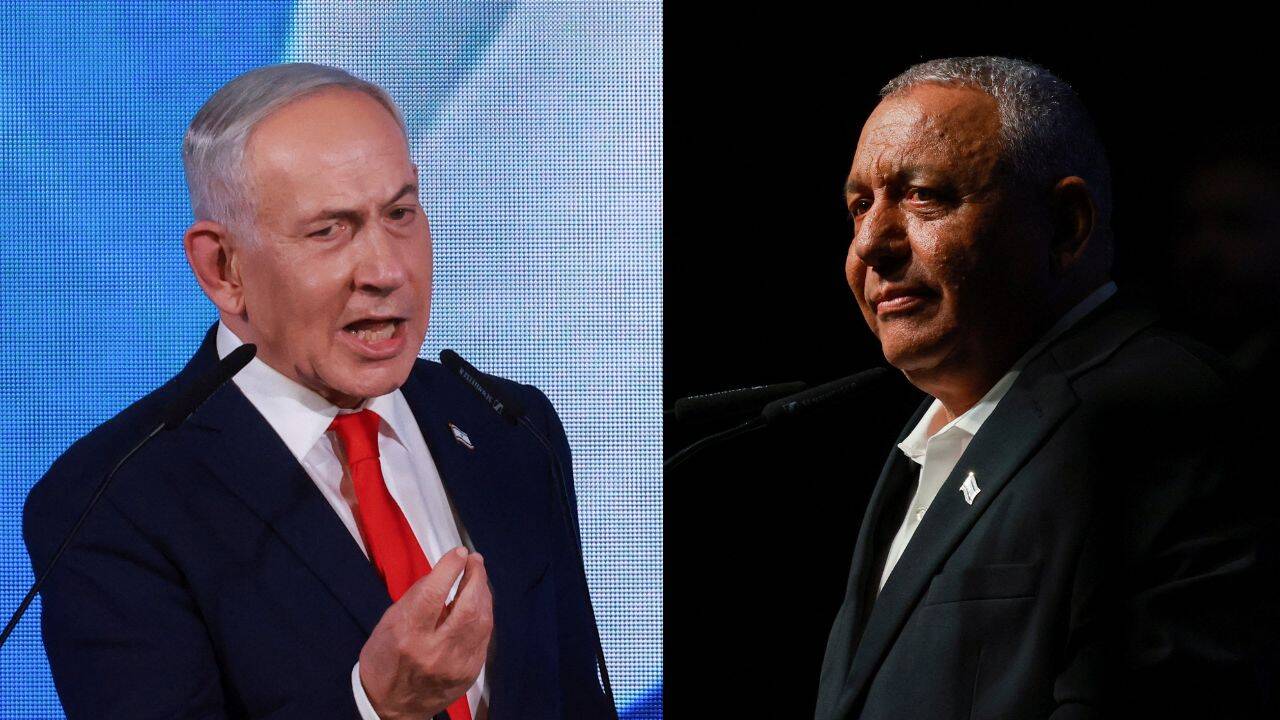
Is Netanyahu's time up? 10 things to know as rival Eisenkot gets shot at power
Israeli President Isaac Herzog has tasked opposition leader Gadi Eisenkot with forming the country's next government after the October 27 election failed to produce a clear parliamentary majority. It has given Prime Minister Benjamin Netanyahu's main challenger the first opportunity to take power.Eisenkot, a former chief of the Israel Defence Forces (IDF), secured recommendations from lawmakers representing 67 of the Knesset's 120 members.However, forming a coalition remains a challenge, as his bloc lacks a confirmed majority and potential partners disagree over the role of Arab parties and ultra-Orthodox factions.
Netanyahu, whose Likud remains the largest party, is meanwhile pushing for a national unity government.Here are 10 things to know about the political developments in Israel.1. Eisenkot gets six weeks to form Israel's next governmentHerzog announced his decision on Saturday after consultations with representatives of political parties and separate discussions with Eisenkot and Netanyahu.
The mandate gives the former military chief up to 42 days to negotiate with potential partners and secure the parliamentary support needed to form a government.The decision marks a significant setback for Netanyahu, Israel's longest-serving prime minister, whose attempt to retain power suffered a blow after most parliamentary factions recommended Eisenkot for the post.In his first reaction, Eisenkot called for a national emergency government.
"Now is the time to form a national emergency government. I will do everything to ensure we are worthy," he wrote on X.2. How Eisenkot secured backing of 67 lawmakersEisenkot received recommendations from factions representing 67 lawmakers in the 120-member Knesset. These included the Jewish-led opposition bloc, which holds 48 seats, Arab party Ra'am with eight seats and the Joint List with 11 seats.The Joint List's unanimous endorsement proved crucial in taking Eisenkot past the 61-seat threshold needed for a parliamentary majority.Netanyahu, meanwhile, received recommendations from factions representing 46 lawmakers.
Seven lawmakers did not endorse either candidate.However, the recommendations do not automatically translate into a governing coalition. Eisenkot must still negotiate with potential partners and secure their support on key policy issues.3. Arab parties could determine whether Eisenkot forms a governmentThe backing of Ra'am and the Joint List has given Eisenkot an important advantage.
Their combined 19 seats could help him secure a majority, but working with the Arab-led parties presents a political challenge.An Arab party has been part of an Israeli governing coalition only once before. Ra'am joined the government led by former prime minister Naftali Bennett in 2021. That administration collapsed after 18 months, partly because of disagreements over the occupied West Bank.Eisenkot could form a minority government with his natural allies, including Together, The Democrats and Israel Our Home, while relying on the Arab parties for external support.
Such an arrangement would give the broader grouping 67 seats.However, Avigdor Lieberman's Israel Our Home has repeatedly ruled out supporting a minority government backed by Arab parties. Only The Democrats has publicly called for their inclusion.The political sensitivities have also intensified following the October 7, 2023, Hamas attacks and the subsequent war in Gaza.4. Ultra-Orthodox parties offer another possible route to a majorityEisenkot and his partners could also approach Israel's two ultra-Orthodox parties, which collectively hold 13 seats.
Their support could help the opposition bloc reach the 61-seat majority without relying on Arab parties.However, negotiations could run into disagreements over military service exemptions traditionally granted to ultra-Orthodox seminary students.Eisenkot and Lieberman have strongly criticised these exemptions. Many Israelis believe the arrangements place an unfair burden on other citizens who serve in the military.United Torah Judaism declined to endorse either candidate during the presidential consultations, while Shas backed Netanyahu.
This leaves the possibility of an agreement open, but any deal would require difficult compromises.5. Eisenkot wants a national emergency government with four key principlesEisenkot has pitched a national emergency government to address Israel's political and security challenges. His proposed administration would be guided by four principles: recognising Israel as a Jewish and democratic state, upholding the Declaration of Independence, ensuring universal national and military conscription, and dismantling Hamas' military and political wings.His party, Yashar, has also indicated that it would only work with parties and lawmakers who accept its principles.In a statement responding to Netanyahu's appeal for a unity government, Yashar urged Likud members to distance themselves from what it described as an alliance with "radical parties", apparently referring to the far-right factions in Netanyahu's religious-nationalist bloc.6.
Netanyahu loses his parliamentary majority, but Likud remains the largest partyDespite the setback, Netanyahu remains a significant force in Israeli politics. His Likud party emerged as the largest single party in the October 27 election, securing 27 seats.However, his religious-nationalist bloc has fallen from its original 64 seats to 53, leaving it short of the 61 required for a parliamentary majority.The prime minister also suffered a setback when United Torah Judaism refused to endorse him during consultations with Herzog.
The party's decision has raised questions about the stability of his long-standing political alliance with ultra-Orthodox factions.7. Netanyahu calls for a national unity government to counter Eisenkot's bidFollowing Eisenkot's appointment, Netanyahu called for the immediate formation of a broad national unity government comprising all Zionist political factions.In a televis…