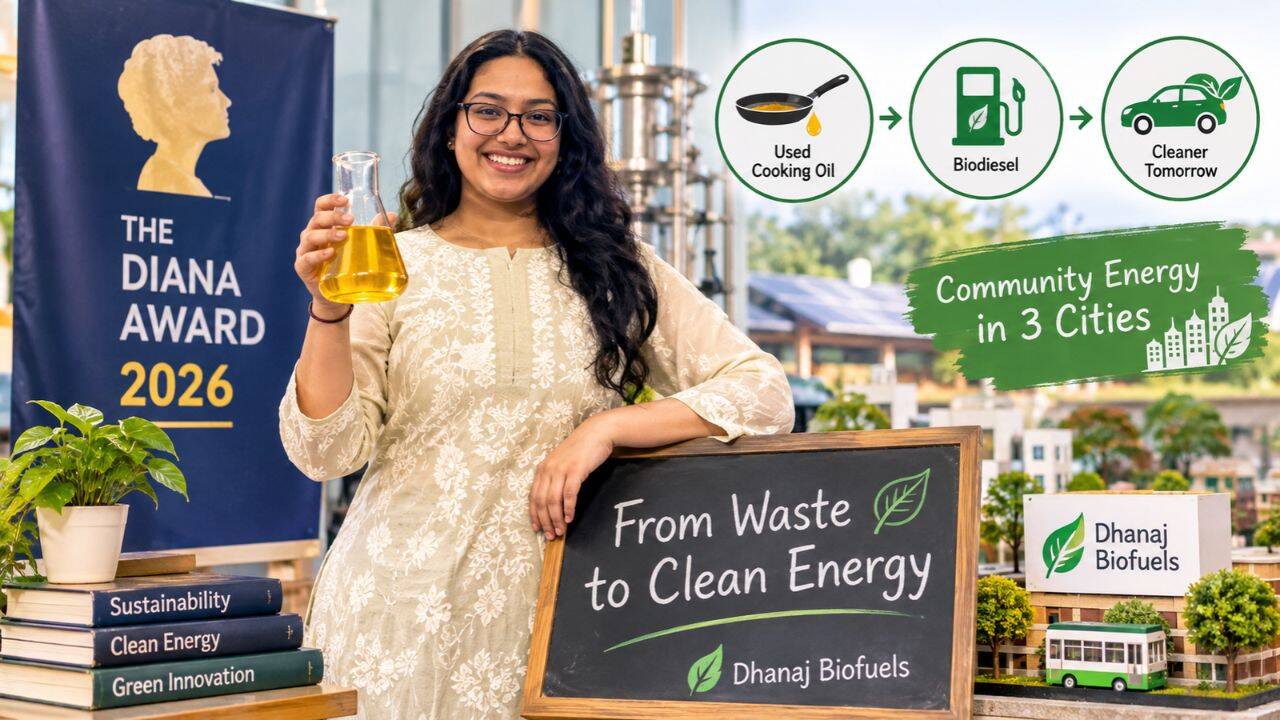
Aarya Borele turns waste oil into biodiesel, wins Diana Award for 3-city venture
What began with discarded frying oil at a university dining hall has grown into a sustainability venture with a bigger purpose. Through Dhanaj Biofuels, Aarya Borele is transforming waste into fuel while making clean energy a community-led effort. What most people see as waste after cooking is over, Aarya Borele sees as an opportunity to rethink how energy is produced, consumed and recovered.A leftover batch of cooking oil may seem insignificant, but when discarded improperly, it can contribute to clogged drains, water pollution and waste-management problems.
Aarya began exploring how this everyday waste could be put to better use, turning an environmental concern into a practical clean-energy solution.Her journey began at the University of California, Berkeley, where she worked with used cooking oil from dining facilities and explored its conversion into biodiesel. That experience eventually helped inspire Dhanaj Biofuels, her initiative in India, which now aims to make waste-based energy accessible through community participation.
Her work has earned her the 2026 Diana Award, recognising young people who create meaningful change in their communities. But for Aarya, the recognition is part of a larger journey to build an energy system that benefits not just the environment but also the people who make it possible.The first spark came from a campus kitchenWhile studying at UC Berkeley, Aarya became involved with the university's Biofuels Technology Club, which works on converting waste cooking oil from campus dining halls into biodiesel.
The work gave her an opportunity to understand how a material that is often thrown away could become an alternative fuel. The club's work involved more than simply collecting oil. Students explored the chemistry behind the conversion process, tested production methods, worked on purification and experimented with ways to improve fuel quality. The team also developed systems to increase production beyond small laboratory batches.Aarya was part of this ecosystem of experimentation, where sustainability was not just discussed in classrooms but tested through hands-on engineering.
In an interview published by UC Berkeley's International Office in October 2025, she spoke about the thinking behind her venture, connecting waste management with the livelihoods of people who work in the informal sector. Her goal was to make waste valuable while ensuring the people who collect and manage it are not left out of the green economy. The experience at Berkeley eventually became the foundation for Dhanaj Biofuels in India.Turning discarded oil into something valuableDhanaj Biofuels works around a simple idea: used cooking oil should not be treated as something to dispose of carelessly when it can be converted into a useful resource.
The venture brings together waste-oil collection and biodiesel production, creating a link between households, housing societies, food businesses, vendors and energy production. Rather than relying only on large industrial systems, Aarya is exploring a decentralised approach in which smaller community-level energy systems can work with waste generated locally.This model has a social dimension, too.
Food vendors, waste collectors and local workers are important to the collection process. By involving them in the system, the venture aims to create additional earning opportunities while encouraging better waste-handling practices.In her Berkeley interview, Aarya emphasised that a greener economy cannot be built by excluding the people who already work within the waste ecosystem.
For her, sustainability also means dignity, participation and making sure communities have a stake in the transition. The idea is to create a circular system in which waste is collected, processed and reused, instead of allowing its value to disappear.Clean energy that communities can run themselvesOne of the most significant aspects of Aarya's work is its focus on community ownership and independence.
According to The Diana Award's official 2026 recipient profile, Dhanaj Biofuels has developed community-run energy systems that now operate independently across three cities. This marks an important shift in how the initiative is approaching growth. The aim is not simply to produce biodiesel at one location but to build a model that communities can sustain and operate themselves.Decentralised energy systems can help bring solutions closer to the places where waste is generated.
They also create opportunities for people to participate directly in energy production rather than remaining only consumers. Aarya's work combines chemical engineering, environmental innovation and community engagement. She has also led the Biofuels Technology Club's scale-up team at Berkeley and mentored more than 30 young engineers, extending her work beyond her own venture.The model is still part of a developing clean-energy landscape, where challenges such as consistent oil collection, fuel quality, logistics, infrastructure and regulatory requirements remain important.
However, the community-led approach offers a way to think about expansion that does not depend entirely on centralised facilities.An award for seeing value where others see wasteThe 2026 Diana Award recognises Aarya's efforts to address an environmental problem through innovation and community involvement. It also brings attention to a larger idea: climate solutions do not always have to begin with expensive technology or entirely new resources.
Sometimes, they begin by rethinking what already exists.Used cooking oil is a familiar waste product, generated in homes, restaurants, canteens and food stalls every day. Aarya's work asks what could happen if that waste were collected responsibly and converted into something useful, while the people handling it were included in the process. Her journey from a university dining hall experiment to developing community energy systems across three cities reflects the power of turning an id…