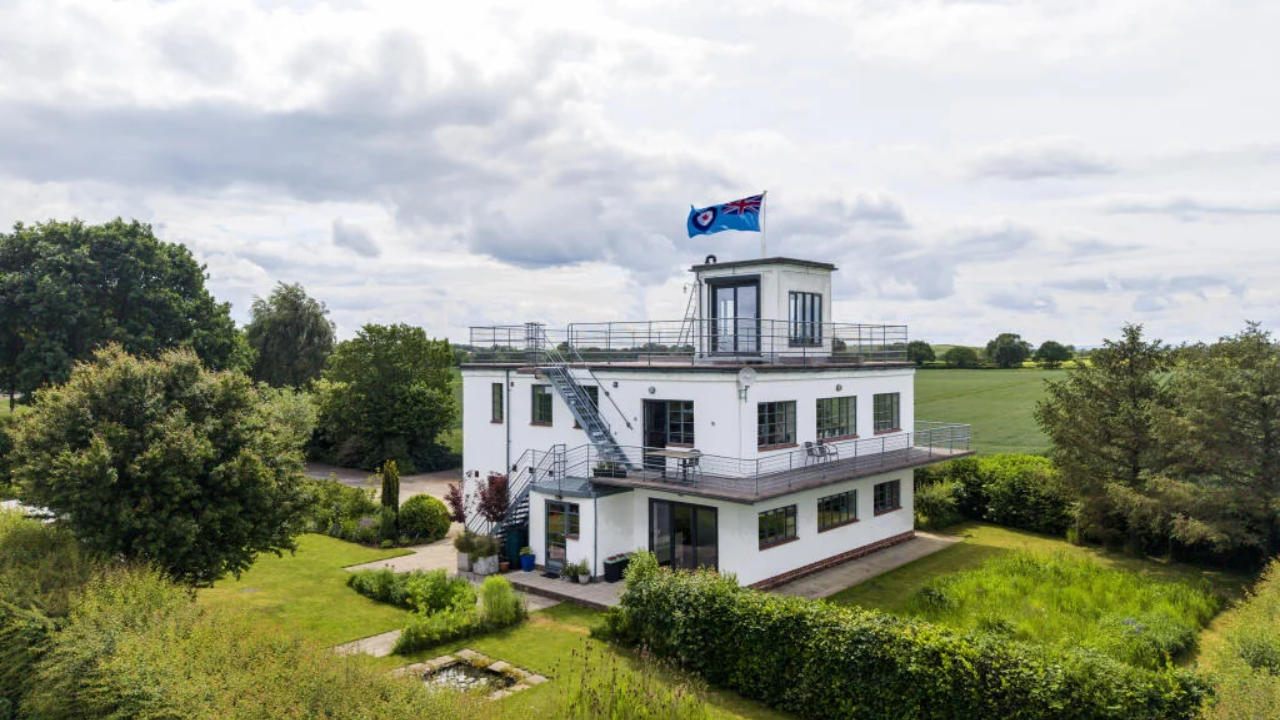
WWII Yorkshire bomber control tower turned into 4-bed home, listed for £875k
A Second World War control tower in Yorkshire, once part of a Royal Canadian Air Force bomber station that supported Halifax operations, has been transformed into a four-bedroom family home and is now on the market for £875,000.Known as The Control Tower, the property stands at the former RCAF Tholthorpe airfield, about 12 miles north of York. Built in 1943, the Type 343/43 structure has been converted into a modern residence while retaining several features linked to its wartime past, according to Vintage Aviation News and the property listing on Rightmove.The detached home has a guide price of £875,000 and extends to around 2,181 square feet.
It includes four bedrooms, three bathrooms, a study, multiple living spaces and a double garage. The property sits on an enclosed plot of approximately half an acre, with a garden, vegetable patch, lawn, outdoor kitchen and patio.The asking price has been reduced from £900,000, which was reported when the property first went on the market in July 2026.From bomber station to family homeTholthorpe was developed as an airfield during the expansion of Britain's wartime aviation infrastructure.
The Royal Canadian Air Force operated several squadrons from the station, which became part of No. 6 (RCAF) Group under RAF Bomber Command.No. 434 Squadron, also known as the Bluenose Squadron, was formed at Tholthorpe on June 13, 1943. The official Royal Canadian Air Force history says the unit initially flew Handley Page Halifax bombers and carried out its first combat operation against Milan on the night of August 12-13, 1943.The airfield also hosted No.
431 Squadron, which operated Halifax aircraft, and later No. 420 and No. 425 Squadrons. The Atlantikwall Archive's history of RAF Tholthorpe records that the station's control tower was listed as Building 81 on the airfield plan, with its construction designation given as 343/43.After the war, the building went through a series of agricultural and industrial uses before planning permission was granted for its conversion into a private residence.
The former airfield itself was eventually taken over largely by farming, while the tower became one of the surviving reminders of its aviation history.Owners spent a year living in a caravanThe property was bought by Paul and Rosy Walker in 1993, when it was derelict. The couple spent almost a year living in a caravan on the site while they worked on converting the tower, according to a July report by The Yorkshire Post.The restoration retained much of the original layout and preserved architectural details, including cast-iron balcony posts and rooftop railings.
The former control room has since been adapted into an open-plan kitchen, dining and living area.The owners also installed aluminium double-glazed windows and doors designed to echo the appearance of the original Crittall-style fittings, while updating the kitchens and bathrooms for contemporary use.The building has an unusual arrangement, with most of the bedrooms on the lower level and the main open-plan kitchen, living and dining space upstairs.
The upper floor also has a study and bathroom, while a separate room at roof level provides access to a terrace with views across the surrounding countryside.A rooftop view of YorkshireThe former observatory and rooftop terrace are among the property's distinctive features. The listing describes views towards the White Horse at Kilburn, while the Yorkshire Post reports that the elevated terrace looks across the Vale of York.The home has also been used as a self-contained Airbnb apartment on the upper floor in previous years, demonstrating the flexibility of its layout.
It is currently being marketed as a family home.Its wartime connection remains part of its identity. The owners have welcomed former servicemen and relatives associated with RCAF Tholthorpe, and a commemorative plaque donated by ex-servicemen more than 25 years ago is still displayed on the building, Vintage Aviation News reported.You use AI every day. Now get your AI Quotient.
Take the AIQ test.