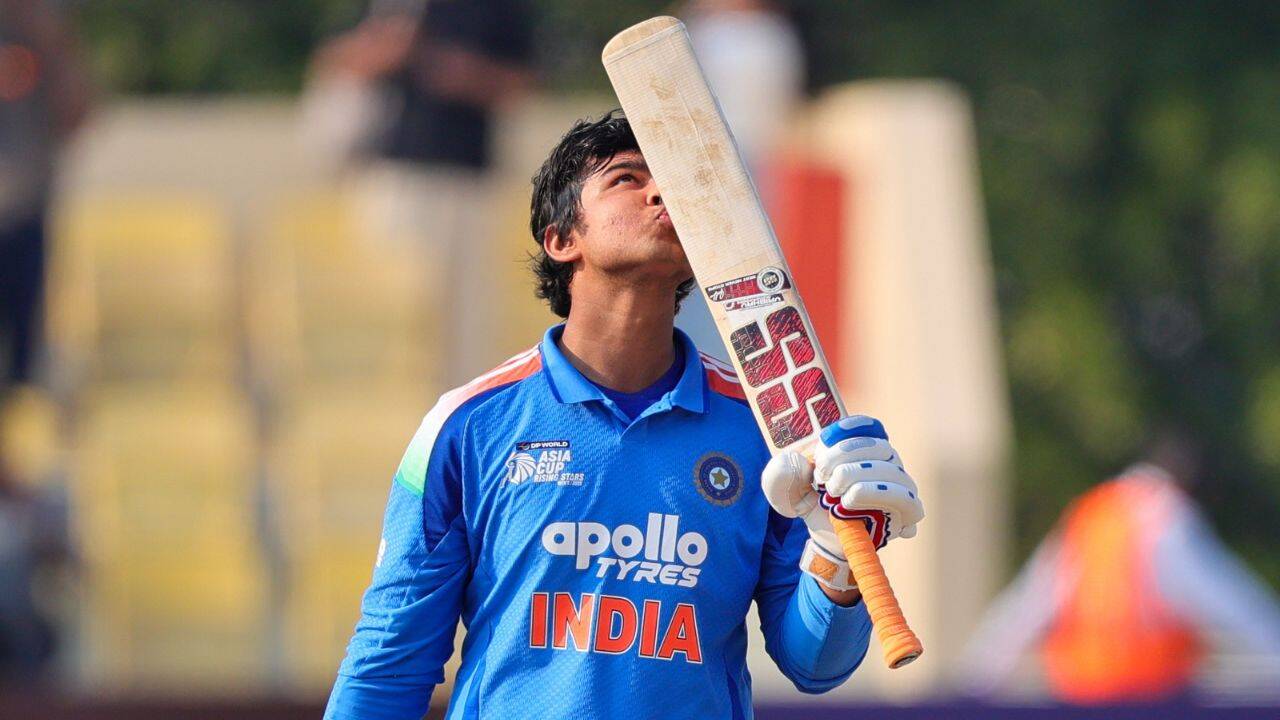
Vaibhav Sooryavanshi, a big fish in a small pond
NEW DELHI: Vaibhav Sooryavanshi is explosive, yet his movements are remarkably minimal. Few batters have dismantled back-of-a-length and length deliveries down the ground with the kind of authority he has displayed over the last 18 months. He doesn't need a big stride or elaborate trigger movements to generate extraordinary power. Sometimes, all it takes is a shift in weight and those long levers.On Tuesday, the last ball of the 10th over between India A and UAE in the Asia Cup Rising Stars, when he brought up his 150 off just 40 balls, was perhaps the shot of the match.
UAE pacer Zahid Ali bowled wide of the off stump, almost on the eighth-stump line. Sooryavanshi, with his long levers, transferred his weight onto the front foot and launched it over deep extra cover for six. A ball that was meant to keep him quiet was sent soaring into the stands.In recent months, Sooryavanshi has left everyone scrambling for superlatives. But Bihar coach Ashok Kumar, who has worked closely with the teenager alongside Manish Ojha, believes the bigger picture is still waiting to unfold."Badi machli hai aur talab chota hai uske liye (He is a big fish in a small pond)," Ashok told TimesofIndia.com."Wo paida hua hai samundar ke liye, abhi wo bas ek chote se talab mein hai (He belongs to the ocean; currently, he is in a small pond)."The evolutionFollowing Virat Kohli’s unbeaten 82 off 51 balls against Australia during the 2016 World T20, Australian cricket writer Gideon Haigh summed up the masterclass with a memorable line in *The Australian*: “Much as the marketers would like to take the cricket out of T20, Kohli keeps putting it back.”Even in T20 cricket, the Kohli-esque style of batting was needed.
It survived and thrived despite the 360-degree batting of exemplary players such as AB de Villiers and Suryakumar Yadav.But on Tuesday, the way 15-year-old Vaibhav Sooryavanshi batted, it looked to be a case of putting the T20 into an ODI, almost video game-esque. At his age, kids do spend a lot of time in front of screens. Vaibhav, however, was tearing helpless UAE bowlers apart in Doha."People complain that there are too many sixes and boundaries and that the grounds are too small.
But the reality is that batting has evolved massively, and it continues to evolve very quickly. Batters are now hitting length balls. The only delivery you can't really hit is a yorker," power-hitting coach Julian Wood told this website.Look at Vaibhav in the IPL. He hit Jasprit Bumrah for six off the first ball and also hit Pat Cummins for six. It's almost as if there's a lack of respect, but he knows that if the bowler misses, he can hit him for six."If you look at Vaibhav's boundary-hitting patterns, he hits all around the ground, from mid-off all the way around to fine leg.
If you're going to bowl wide to him, you'd probably have to bowl wide and full. But you have to execute that delivery perfectly. The problem for bowlers is that when they miss, the ball doesn't just go for four; it goes for six. That puts them under tremendous pressure."Look at Vaibhav in the IPL. He hit Jasprit Bumrah for six off the first ball and also hit Pat Cummins for six.
It's almost as if there's a lack of respect, but he knows that if the bowler misses, he can hit him for six. The mindsets of both batters and bowlers have changed. Batters now think, 'If he misses, I'm going to hit him for six,'" explained Wood.Minimal yet so explosiveZubin Bharucha, one of Sooryavanshi’s mentors, has explained how the teenager manages to hit length deliveries with extraordinary power.
He attributes it to Sooryavanshi’s coiled upper body, deep torso bend and weight-loaded back leg, which allow him to get his head outside the line of the ball and bring deliveries outside off stump directly into his eyeline."What enables him to achieve this is a superbly coiled upper half, combined with a considerable bend in his torso at the top of his swing. This allows his head to get outside the line of most deliveries," Bharucha explained.It is all driven by the hip not sliding forward, and this enables him to remain in such a strong coiled position on one leg, from which he can create that hip-and-shoulder separation and attack every ball.With almost all his weight loaded onto the back leg, Sooryavanshi limits forward movement of his hips and avoids the conventional transfer of weight onto the front foot.
His front foot often moves only marginally, remaining relatively unloaded, which allows him to finish shots with his foot flared open and ankle turned over."He is effectively operating on one leg, which in itself suggests the weight has to remain back," Bharucha said, explaining why Sooryavanshi can generate power without committing his weight forward.The technique also allows Sooryavanshi to keep his body inside the line of the ball while his hands and bat operate in front of the stumps, a trait Bharucha compares with former greats Don Bradman and Graeme Pollock."This is driven by the deep bend in his back, which allows his hands to operate in front of the stumps, much like some of the greats of the past.
They would stand well outside leg stump to ensure the bat operated in front of the stumps while the body remained well inside the line. This resulted in Bradman being dismissed LBW fewer than 10 times in his entire career, while players like Graeme Pollock never got out LBW at all. The deep bend in Sooryavanshi’s back accentuates this trait. Even though he doesn't take an outside-leg-stump guard, he is still able to achieve positions on the crease similar to those of these former greats," he said."It is all driven by the hip not sliding forward, and this enables him to remain in such a strong coiled position on one leg, from which he can create that hip-and-shoulder separation and attack every ball," he added.Bharucha believes this allows Sooryavanshi to avoid committing early to a particular length and instead turn almost every delivery into a scoring opportunity.Blessed wit…