Yalta 2.0 in making? Nuclear arms, two wars on the table as Trump, Xi and Putin meet
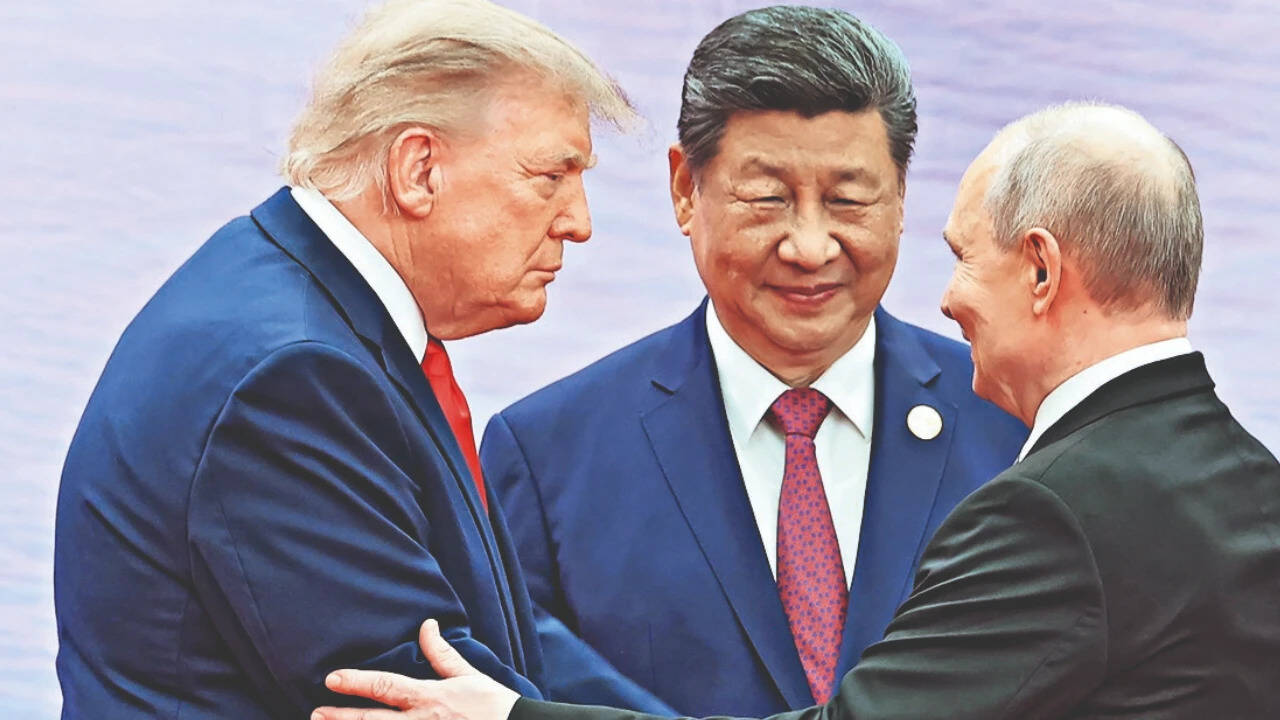
In a meeting that could reshape the global geopolitical order, US President Donald Trump, Chinese President Xi Jinping and Russian President Vladimir Putin are set to hold historic trilateral talks in China on Thursday, bringing together the leaders of three of the world's most powerful countries at a time of escalating international tensions.The meeting on the sidelines of the Asia-Pacific Economic Cooperation (APEC) summit in Shenzhen comes against the backdrop of two ongoing wars, the expiration of a key US-Russia nuclear arms control treaty, growing competition over artificial intelligence (AI) and unresolved trade disputes.
The discussions could also test whether personal diplomacy between the three leaders can translate into concrete agreements on some of the world's most pressing security challenges.The gathering has drawn comparisons with the 1945 Yalta Conference, when the leaders of the United States, the Soviet Union and Britain came together towards the end of World War II to discuss the defeat of Nazi Germany and the political future of post-war Europe.
However, unlike Yalta, where the three Allied powers were negotiating the future of a continent devastated by war, the Shenzhen meeting brings together leaders whose countries are competing for influence across multiple regions.The symbolism is particularly striking. Nearly eight decades after the Yalta Conference, the leaders of Washington, Moscow and Beijing are meeting at a time when the international system is increasingly shaped by great-power rivalry, competing security interests and questions over the future of the existing global order.Trump, who has repeatedly projected himself as a dealmaker capable of negotiating with rival leaders, has presented the meeting as an opportunity to discuss nuclear arms control and explore ways to end the wars in Ukraine and Iran.
However, expectations of an immediate breakthrough remain limited, with major differences separating the three countries.From Yalta to Shenzhen: Are three powers preparing to shape the world order?The comparison with Yalta is rooted in the strategic importance of the three countries represented at the meeting and the possibility that decisions taken by their leaders could have consequences far beyond their borders.The Yalta Conference, held from February 4 to 11, 1945, brought together US President Franklin D Roosevelt, Soviet leader Joseph Stalin and British Prime Minister Winston Churchill in Crimea.
The meeting took place as the defeat of Nazi Germany became increasingly inevitable.The three leaders discussed the final military campaign against Germany, the occupation of the country after its surrender, the establishment of the United Nations and the political restructuring of Europe. They also reached understandings on the division of Germany into occupation zones and the Soviet Union's role in the post-war European settlement.However, the agreements also exposed competing visions for Europe's future.
Differences over the political direction of Eastern European countries, particularly Poland, contributed to tensions between the Western powers and the Soviet Union. These disagreements eventually became part of the broader confrontation that developed into the Cold War.The Shenzhen meeting is not a formal equivalent of Yalta. The geopolitical circumstances are different, and there is no indication that the three leaders intend to negotiate a comprehensive division of territories or spheres of influence.Nevertheless, the presence of the American, Russian and Chinese presidents at the same table carries considerable strategic weight.
Together, their countries possess the world's largest nuclear arsenals, hold permanent seats on the United Nations Security Council and exercise considerable influence over international security, trade, technology and energy markets.The central question is whether the meeting will produce a framework for cooperation or reinforce the idea that global affairs are increasingly being shaped through negotiations among major powers, sometimes without the direct participation of countries most affected by their decisions.Nuclear arms control: Can Trump bring Washington, Moscow and Beijing together?Nuclear arms control is expected to be one of the most consequential issues discussed during the meeting.The last remaining nuclear arms control treaty between the United States and Russia, known as New START, expired in February 2026.
The agreement placed limits on the two countries' deployed strategic nuclear warheads and delivery systems and provided mechanisms for transparency and verification.Its expiration has removed a key framework governing the world's two largest nuclear arsenals.Trump has expressed interest in negotiating a new agreement that would include China alongside Russia and the United States.
He has described his proposal as a "new, improved and modernised" deal.However, bringing Beijing into a trilateral nuclear arms control framework presents a major challenge.China's nuclear arsenal is estimated to contain more than 600 warheads, considerably fewer than the more than 5,000 warheads believed to be held by each of the United States and Russia. Beijing has therefore been reluctant to accept restrictions designed around the much larger arsenals of the other two countries.From China's perspective, agreeing to numerical limits at its current level could constrain its ability to expand its nuclear deterrent while Washington and Moscow retain substantially larger stockpiles.For the United States and Russia, meanwhile, the absence of a binding framework raises concerns about transparency, strategic stability and the possibility of an unrestricted nuclear competition.Daryl Kimball, executive director of the Arms Control Association, said Trump's diplomatic initiative could potentially provide the starting point for more sustained negotiations, but warned against expecting immediate results."We need more than diplomatic theater a…