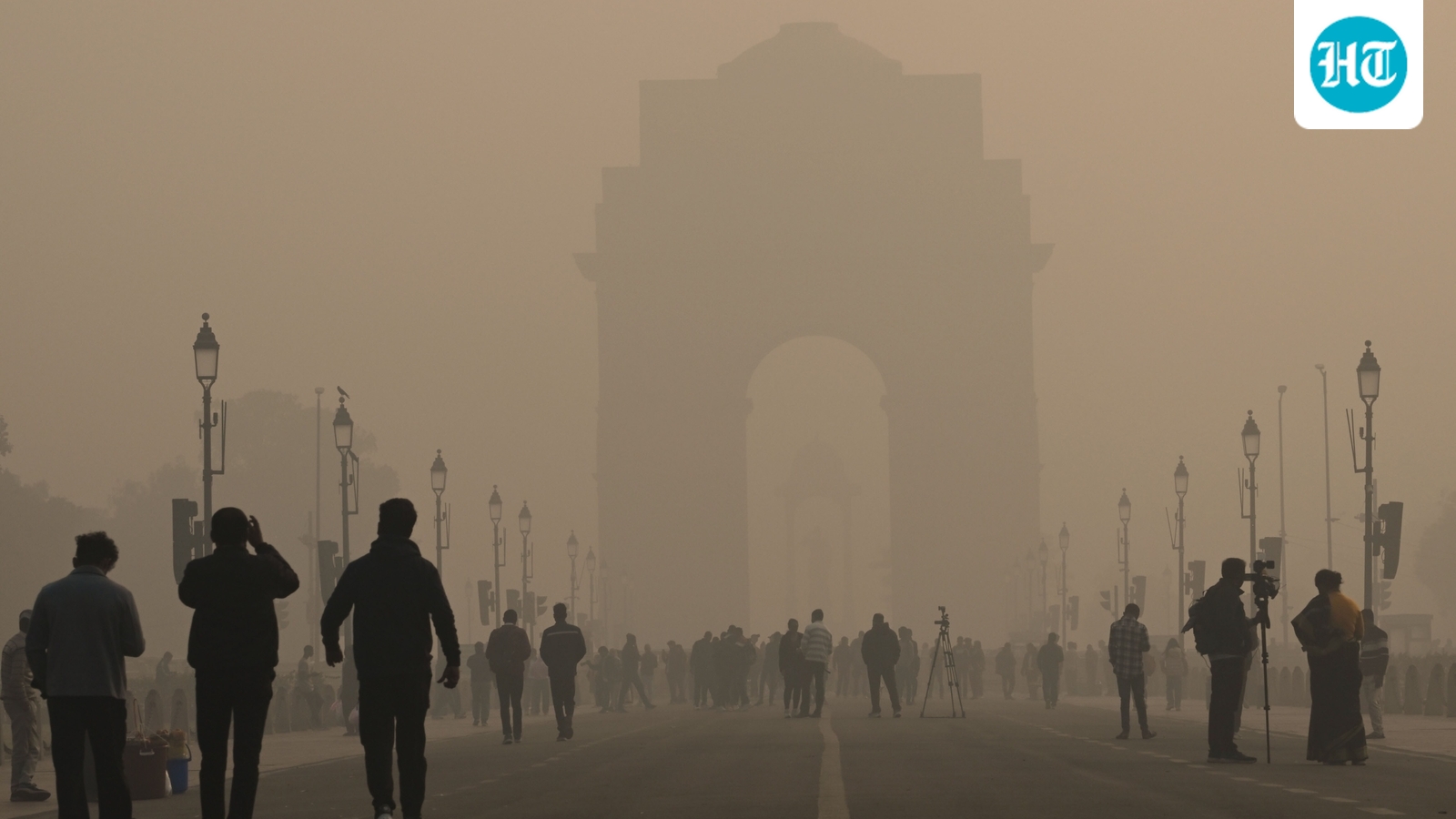
CPCB’s AQI method understates severity of Delhi’s worst pollution days
India’s official air quality index has been underestimating how bad the air is on polluted days, because the Central Pollution Control Board (CPCB) seemingly does not follow the index’s own published definition when calculating it, according to CPCB documents and Delhi figures analysed by HT.HT ran the index’s calculations on a year of hourly readings from Delhi’s government monitoring stations and found that, scored by the index’s own definition, set out in at least four CPCB and government documents, the city would have been rated “severe” on 23 days, more than double the 10 that CPCB’s daily 4pm bulletins reported.
The difference is starkest on the most polluted days.A stark example is this November, where HT’s calculations show Delhi’s air would have been “severe” on two days had the index been worked out as defined, while CPCB’s bulletins have yet to call a single day “severe”. No November since at least 2015 has gone without one, HT’s analysis of the bulletins shows, and November is usually the city’s most polluted month.The two days were Diwali, November 8, and the day after; CPCB’s bulletins called both “very poor”.
On November 9, the index should have been 411 instead of the 344 CPCB published.Also Read: CAQM sets 15-20% pollution reduction target for Delhi-NCR in 2027, seeks district-wise action plans The undercount shows across the city’s monitors as well. On November 9, the day after Diwali, CPCB rated just one of Delhi’s monitoring stations “severe”, where 29 would have been “severe” had the definition been followed.“Nearly seventy points is almost a seventh of the whole scale, and it crosses the boundary that matters most,” said professor Gautam Menon of Ashoka University, of the gap on November 9.While HT’s analysis covers PM2.5 and PM10 in Delhi, on days when particulates were the main pollutants, the problem is not Delhi’s alone: CPCB’s published figures for more than 500 stations elsewhere in India are averaged from hourly scores in the same way, HT found.Also Read: Report links cloud-seeding to AQI gain in Delhi; but western disturbance may have had a roleTo be sure, CPCB’s practice makes cleaner days look slightly worse than they were, by less than 10 points, and it ranked Delhi in a worse category than it would have been in had the definition been followed, on only two days in the year.
The error is far larger, and runs the other way, on the days when the air is most polluted.Why 24-hour average mattersTo understand the problem, it helps to first unpack what the index is meant to capture, and how it does it.The air quality index is a single number meant to reflect the dose of pollution a person takes in over a day, from fine particles to gases such as nitrogen dioxide, and to tell people what that dose means for their health.India defines the acceptable limit of exposure as a 24-hour average of 60 µg/m³ for PM2.5 -- the particles most harmful to human health and the kind that causes smog and haze.
The World Health Organization advises a lower limit of 15µg/m³ -- Delhi’s “severe” days run far beyond both.Readings, methods and calculationsDelhi’s monitoring stations record each pollutant every hour. The index’s definition, laid out by CPCB and in the IIT Kanpur report that set up the index, requires each pollutant’s readings first to be averaged over 24 hours. That one average is then converted into a score, called a sub-index, using a fixed table, and the highest sub-index becomes the station’s AQI.HT found the same 24-hour average in five documents behind the index: three of CPCB’s own (its website note on the calculation, its AQI calculator and its November 10 clarification), the government’s 2009 notification of national air quality limits, and the 2014 report IIT Kanpur prepared for the expert group that set up the index.
That report drew every band in terms of that 24-hour average and anchored the scale to the law: a score of 100, the top of the “satisfactory” band, matches India’s 24-hour legal limit for PM2.5.The index uses the average because the health effects of pollution are “believed to be largely cumulative”, said Menon, a physicist and biologist who models the spread of infectious disease.
A day’s air could be summed up in other ways, by its worst hour, for instance, but the index was built to read the average -- the good hours and the bad.CPCB’s own documents describe this calculation. A note on its website, “How is AQI calculated?”, says the sub-index for each pollutant is “calculated using its 24-hourly average concentration value”. Its AQI calculator, a spreadsheet the board built for manual monitoring stations, scores a 24-hour average once, and in its clarification of November 10, 2026, issued to defend its Diwali figures, the board wrote that each pollutant’s sub-index “is calculated from its hourly average over the previous 24 hours”, and that the US Environmental Protection Agency follows a similar method.Where CPCB deviatesBut CPCB’s published numbers follow a different calculation.
CPCB converts each hourly reading into a score separately, then publishes the average of the last 24 hourly scores as the AQI. CPCB’s live feed shows this: the score it posts each hour matches that one hour’s reading, not the day’s average.To corroborate this, HT scored each hour’s raw reading separately, the way CPCB scores each hour for its website, and averaged the 24 scores.
The results matched CPCB’s station and city figures to within a fraction of a point. At R K Puram on Diwali night, for instance, averaging the 24 hourly scores gave 397, the figure CPCB showed at 11pm on November 8. Averaging the day’s PM2.5 readings first and converting that one average, as the definition says, gave 462, which is “severe”.The order matters because the index does not rise evenly.
Low on the scale, a little more pollution pushes the score up a lot. High on the scale, a lot more pollution pushes it up only a little: an hour twice as smoky as a “very poor” hour scores only abo…