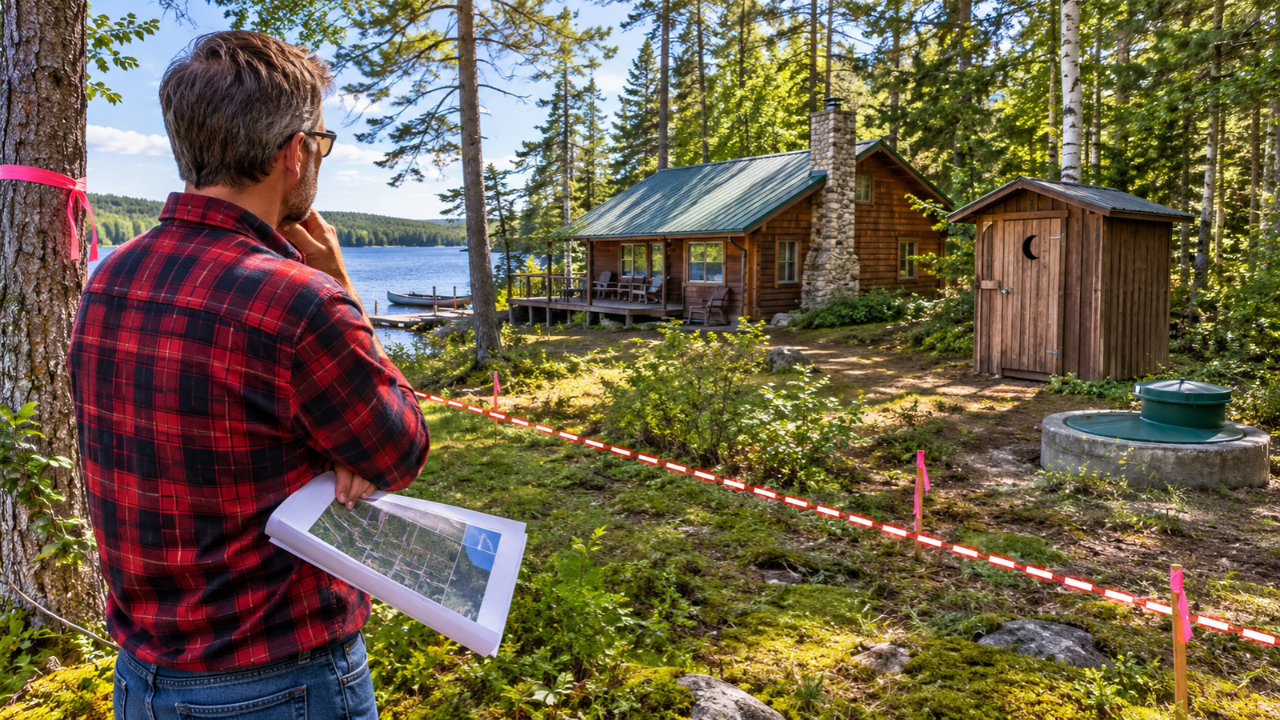
Minnesota appeals court reopens lakefront boundary dispute over cabin and outhouse
A Minnesota man who purchased lakefront property in 2021 discovered that his neighbour's cabin, outhouse and septic system extended onto his land. The dispute eventually reached court, where the neighbour's family trust claimed ownership of part of the property through long-term use and sought damages over trees removed during the expansion of an access path along a utility easement.
However, on November 23, 2026, the Minnesota Court of Appeals reversed part of the lower court's decision, finding that factual disputes remained over a section of land and who had cut down the trees.In its November 23 decision in Gary Ross v. Dennis Hubbard, available on Justia, the Minnesota Court of Appeals affirmed part of the judgment but reversed the rulings on adverse possession of a portion of the disputed land and tree-damage liability, sending those issues back to the lower court.Neighbour's structures extended onto newly purchased landAccording to the court's decision, Gary Ross and the Williams Revocable Family Trust owned adjoining properties along Lake Vermilion in St Louis County.
Ross purchased his property in 2021 and commissioned a survey after completing the purchase. The survey revealed that a cabin and subsurface sewage treatment system belonging to the neighbouring property encroached onto his land, identified as Lot 4. An outhouse was also entirely situated on his property.The structures had a long history. The cabin and outhouse were built in the 1950s, before the Williams family purchased the neighbouring property in 1967.
In 1979, the family installed the septic system, part of which also extended onto Lot 4. The family had believed that an ash tree located about 25 feet inside Ross's property marked the boundary. They also used portions of the lakeshore to store firewood, canoes and other belongings.After discovering the encroachments, Ross asked the neighbour to remove the satellite dish and stored items.
The disagreements eventually led to competing property claims.Trust claimed ownership through long-term useRoss filed a lawsuit seeking to establish trespass and recover possession of the affected land. The Williams family trust responded with counterclaims, including adverse possession, trespass and nuisance. Adverse possession allows someone to acquire legal ownership of land by actually possessing it in an open, hostile, continuous and exclusive manner for the legally required period.
In Minnesota, the required period is 15 years.The district court granted summary judgment in favour of the trust, finding that it had established adverse possession over the entire disputed eastern 25-foot portion of Lot 4. The court also ruled that Ross was responsible for removing trees from the neighbouring property and awarded the trust $106,890 in treble damages, which means three times the assessed damages.
Ross challenged both findings before the Court of Appeals.Appeals court reopens part of boundary disputeThe appeals judges agreed that the trust had established adverse possession over the front portion of Lot 4, extending from the lakeshore to the northernmost point of an existing trail. However, they found that the evidence did not establish the same claim for the back portion, which extended from the trail towards the public road.The court noted that the family's predecessors had constructed buildings, while the family had installed equipment and stored personal belongings on the front portion.
These activities provided evidence of ownership over the required period. But the back portion had largely remained in its natural, wooded state. There was insufficient evidence of visible acts demonstrating that the family had openly occupied that section as its own.The judges therefore found that a genuine factual dispute remained over whether the previous owners had received clear notice that the neighbouring family was claiming ownership of the back portion.
The court reversed the summary judgment on that part of the adverse-possession claim and sent it back for further proceedings. The trust's claim to the front portion remained undisturbed.Court reverses $106,890 tree-damage awardThe appeals court also examined the dispute over trees removed to create an expanded access path along a utility easement. Ross maintained that the local electric utility had removed the trees while installing a powerline in November 2021.
However, the trust's representative disputed this, stating that a utility employee had told him the company had not constructed the path. Neither side provided direct evidence from the utility establishing who had carried out the work.The judges found that the competing accounts created a genuine issue of material fact. Since the identity of the person responsible for cutting the trees was unresolved, the lower court could not establish Ross's liability through summary judgment.
Consequently, the appeals court reversed the summary judgment on the trespass-to-chattels claim and the $106,890 treble-damages award, remanding the issue for further proceedings.Case sent back for further proceedingsOn November 23, 2026, the Minnesota Court of Appeals affirmed the lower court's decision in part, reversed it in part and remanded the case.The ruling preserves the trust's ownership claim over the front portion of the disputed land but reopens the question of ownership over the back portion.
It also removes the existing tree-damage award pending further examination of who actually removed the trees. The decision is nonprecedential under Minnesota's appellate rules.You use AI every day. Now get your AI Quotient. Take the AIQ test.