Watch: SpaceX's Starship completes first-ever midair catch on return from orbit
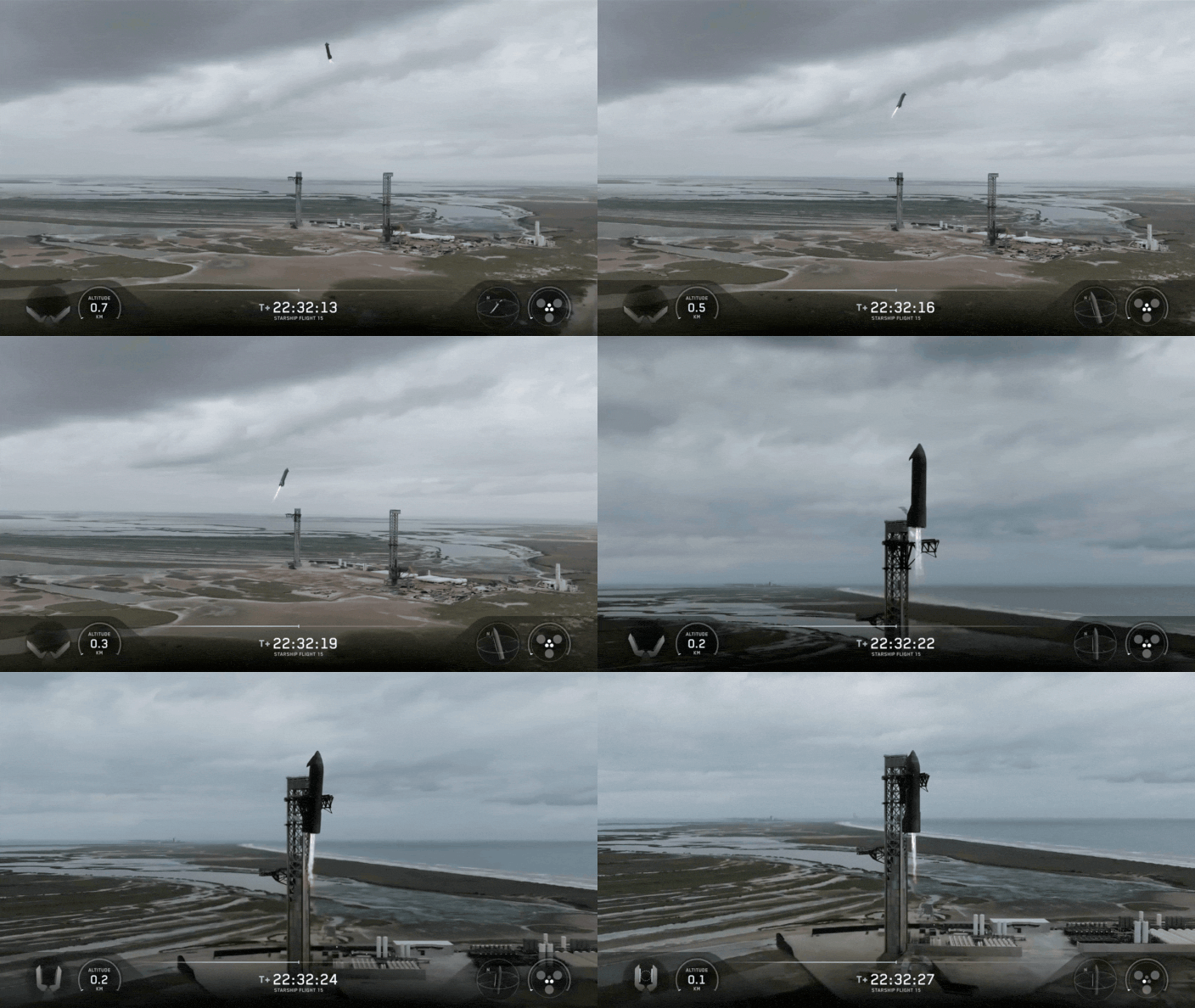
SpaceX's Starship spacecraft returned from a 22-hour journey in orbit on Saturday and was caught by giant mechanical arms at the Texas launch tower from which it had taken off a day earlier, marking the first successful recovery of the spacecraft in midair.The dramatic landing was a major milestone in Elon Musk's effort to develop a fully reusable rocket system. However, SpaceX fell short of its goal of recovering both stages of the rocket after the Super Heavy booster exploded shortly after Friday's launch.The stainless steel spacecraft descended through clouds over SpaceX's Starbase facility, reignited its engines to turn upright and slowly lowered itself into the launch tower's mechanical arms, known as Mechazilla.Its engines shut down after the catch, leaving the charred spacecraft suspended above the ground.SpaceX shared a video of the historic landing, showing Starship descending towards the launch tower before being caught by its giant mechanical arms.
The spacecraft was seen settling into the arms and remaining suspended above the ground after its engines shut down.Sharing the footage, SpaceX wrote: "Mechazilla catches Starship! Congratulations to the entire SpaceX team on this incredible achievement!""Can you believe it?" SpaceX commentator Dan Huot exclaimed during the broadcast. "Look at her! Baby, she's back!"Musk congratulated his team after the successful recovery, while SpaceX officials said the achievement demonstrated the potential for Starship's full reusability, which is central to the company's plans for faster and lower-cost space travel.Nasa administrator Jared Isaacman also welcomed the development.
"It was almost magic," he said in a post on X, adding that the achievement was making "more believers by the day".Starship completes 14 orbits and deploys 26 satellitesThe 407-foot (124-metre) rocket lifted off late Friday afternoon from SpaceX's Starbase facility in Texas, near the US-Mexico border. Its two stages separated successfully, allowing the upper-stage Starship spacecraft to continue towards orbit.During the mission, Starship deployed 26 advanced Starlink satellites before continuing to circle Earth at an altitude of around 161-165 miles (260-265 kilometres).
It completed 14 orbits over more than 22 hours, a significant increase from the one to two laps completed during the previous mission.The flight was SpaceX's 15th full-scale Starship mission since 2023 and only its second trip to orbit. The company said the spacecraft's systems, including its heat shield, appeared to have worked well.Starship began its return by firing an engine to initiate its descent into the atmosphere.Travelling at an orbital speed of around 17,000 miles per hour, it faced intense heat as it slowed during re-entry before reaching the launch site.The Super Heavy booster, which carried the spacecraft into space, failed to complete its own recovery attempt around 10 minutes after liftoff.
SpaceX official Kate Tice said the booster's engines had stopped firing too early during its return.Its guidance system detected that it was not in the correct position and automatically initiated a diversion towards the water, followed by the booster's destruction. Engineers are investigating the cause of the failure. Wreckage remained in the Gulf of Mexico, cordoned off by buoys.Full reusability remains a work in progressWhile Saturday's successful catch marked a key step towards recovering Starship, SpaceX has yet to retrieve both stages of the rocket in the same mission.
The spacecraft's heat shield, made up of black hexagonal tiles designed to withstand the extreme temperatures of atmospheric re-entry, is also not yet fully reusable, Reuters reported.The company is developing new tile designs that would require little or no refurbishment between flights.SpaceX's existing Falcon 9 rocket has a reusable first stage and has completed more than 700 launches since 2010.
Its second stage, which carries payloads into orbit, is discarded into the ocean after each flight.Musk wants Starship to operate more like a commercial aircraft, travelling to space and returning for repeated flights with minimal refurbishment. The system is expected to support the company's Starlink satellite business, as well as its ambitions involving orbital data centres, lunar exploration and eventual human settlement on Mars.Starship central to Nasa's Artemis moon programmeNasa is also relying on Starship for its lunar exploration plans, paying billions of dollars for the spacecraft to serve as a lunar lander for Artemis astronauts later this decade and support the development of a permanent base on the Moon.SpaceX expects to begin launching Starships from Florida's Kennedy Space Center within the next few months.The facility is expected to be the starting point for Nasa's next Artemis mission, which will remain in orbit around Earth rather than travel to the Moon, allowing astronauts to practise lunar lander operations.For Artemis III, four astronauts are expected to attempt to dock their capsule with both SpaceX's Starship and Blue Origin's Blue Moon lunar lander.
The two companies are expected to take turns delivering crews to the lunar surface.Nasa is targeting 2028 for Artemis IV, which aims to achieve humanity's first Moon landing since the Apollo era more than half a century ago.The successful recovery also comes as SpaceX continues to develop Starship for Musk's longer-term ambition of sending a fleet of spacecraft to Mars and building a city there.Your child uses AI every day.
But do they understand it? Find out in the TOI AI Masterclass.