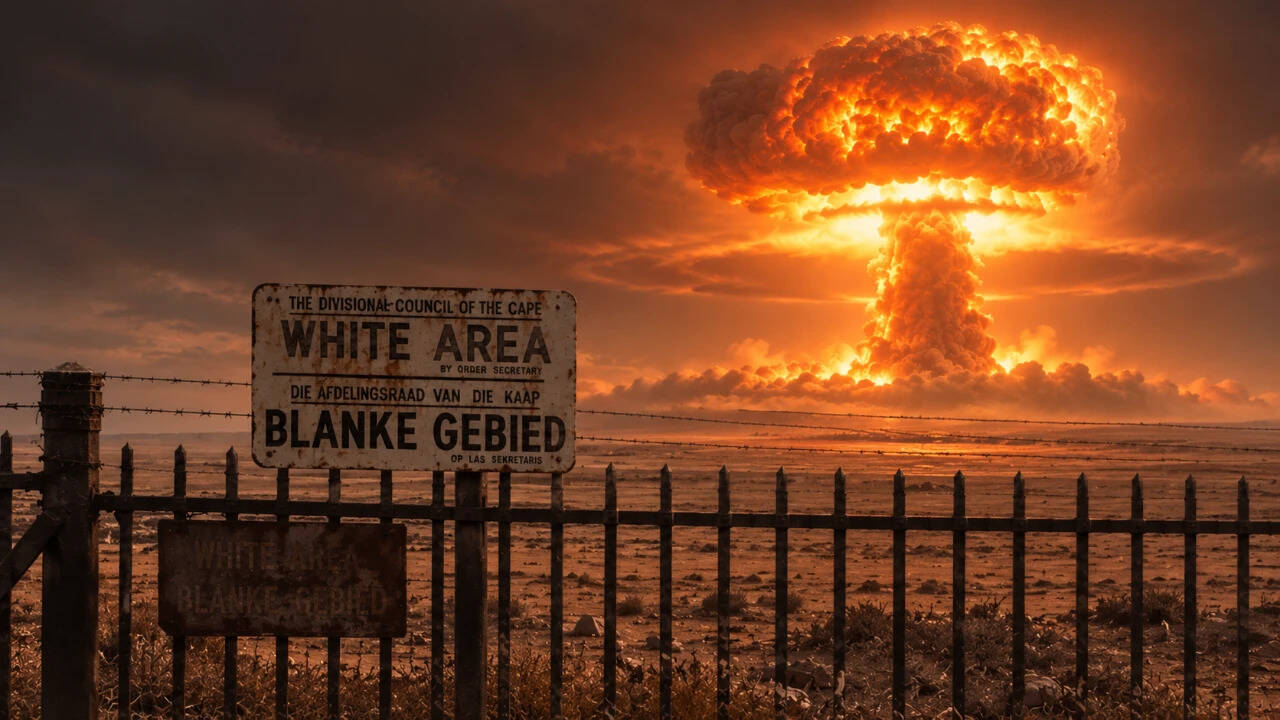
The black & white of why South Africa took singular step to destroy its nukes
Last week, the leaders of the United States, Russia and China held a trilateral in Shenzhen and came to a common conclusion: Nuclear war "cannot be won and must never be fought".The big three also agreed to hold a dialogue on reducing nuclear risks and preventing the proliferation of nuclear weapons. However, none of them announced specific commitments to reduce their arsenals.Turns out, the only country known to have independently developed nuclear weapons and subsequently dismantled its entire arsenal is South Africa.However, the decision wasn’t taken as a step to pursue global peace objectives.The denuclearisation came just before the country's transition from white-minority rule to a black-majority-led democratic government, raising significant debates about the intent and reasons that led to the decision.Did the apartheid government dismantle its nuclear weapons because it did not want an incoming African National Congress (ANC)-led government to inherit them?
Or had changing geopolitical circumstances made the arsenal unnecessary? The answer involves a combination of political, security and diplomatic considerations, with the precise weight of each factor still debated.Nucleus of South African politicsApartheid was a system of institutionalised racial segregation and white-minority rule in South Africa. It became official government policy after the National Party came to power in 1948.Under the system, the Black majority was denied meaningful political representation and subjected to racial discrimination in housing, education, employment, land ownership and access to public facilities.
The government maintained white political control through discriminatory laws, restrictions on movement, forced removals and state repression.The African National Congress (ANC) emerged as the principal organisation opposing the system. Its leaders included Nelson Mandela, who spent 27 years in prison for his involvement in the anti-apartheid struggle.The political transition began under President F.W.
de Klerk, who took office in September 1989. On February 2, 1990, he announced that the ANC and other banned organisations would be legalised. Mandela was released from prison nine days later.Negotiations between the government and anti-apartheid organisations eventually paved the way for South Africa's first democratic elections on April 27, 1994. The ANC won the election, and Mandela became the country's first Black president.But before the transfer of political power, the apartheid government had already taken a significant decision concerning South Africa's nuclear capabilities.A nuclear deterrentSouth Africa's nuclear weapons programme emerged during the Cold War, when the apartheid government feared the expansion of Soviet and communist influence in southern Africa.The independence of Angola and Mozambique in 1975, the civil war in Angola and the presence of Cuban troops in the region reinforced Pretoria's security concerns.
The government also feared that its growing international isolation could leave it without external military support in the event of a conflict.In 1974, the government approved development of a limited nuclear deterrent. The programme eventually produced six completed nuclear devices, while a seventh remained under construction when the decision to terminate it was taken in November 1989.The weapons were relatively simple gun-assembled fission devices, rather than sophisticated thermonuclear weapons.
Their intended role, according to de Klerk's subsequent account, was primarily deterrence.The strategy was also unusual. Rather than planning to use the weapons in a conventional nuclear exchange, the government envisaged revealing its capability to a major power, such as the United States, in a severe regional crisis in the hope of prompting outside intervention.In a speech to Parliament on March 24, 1993, de Klerk said the programme had been initiated in response to the perceived Soviet threat and the build-up of Cuban forces in Angola.Why did South Africa dismantle its nuclear weapons?De Klerk took the decision to terminate the programme in November 1989, shortly after becoming president.
On February 26, 1990, he issued a written instruction directing that all existing nuclear devices be dismantled and the nuclear material returned to the Atomic Energy Corporation (AEC).The timing is significant. The order came after the ANC had been unbanned and Mandela released, but more than four years before the first democratic elections.The possibility that an incoming ANC-led government could inherit nuclear weapons has consequently remained one of the most debated explanations for the decision.Waldo Stumpf, former head of South Africa's Atomic Energy Corporation, later recalled that de Klerk believed transferring nuclear weapons to an incoming government would complicate the handover of power because they would become a "hot potato".A 2025 study by historian Robin E.
Möser examined the political and diplomatic calculations behind South Africa's disarmament using archival material and interviews with former officials.The study noted that the possibility of a future ANC government inheriting the arsenal had concerned international observers. However, it found little in the South African archival records to establish that this was a decisive consideration for de Klerk and his advisers.The study suggested that dismantling the arsenal also served the outgoing National Party government's domestic political interests.
By giving up nuclear weapons and embracing non-proliferation, the government could secure international goodwill and support for its political reform process before negotiations and democratic elections determined the country's future.The concern about transferring the weapons therefore cannot be dismissed, but neither can it be established as the principal reason.End of the Cold War and changing security environmentAnother major explanation was the transformation of South Af…