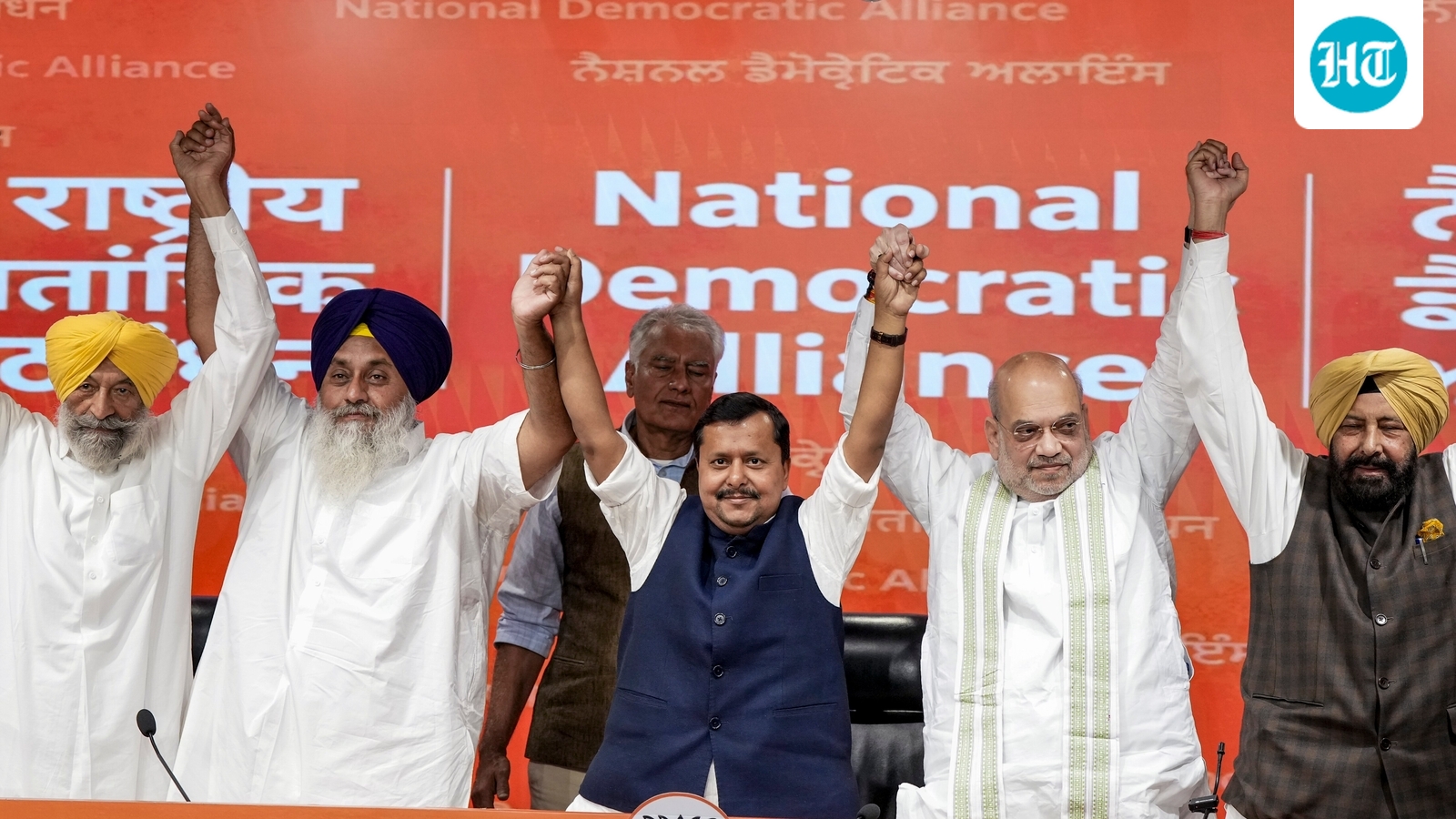
BJP-SAD reunion: Can the alliance alter Punjab's political landscape?
The Bharatiya Janata Party (BJP) and the Shiromani Akali Dal (SAD) on Tuesday revived their alliance ahead of the Punjab assembly elections, six years after the Akali Dal walked out of the National Democratic Alliance (NDA) on the issue of the now withdrawn three farm laws.The two parties had first come together in the 1996 Lok Sabha elections. The alliance formed governments in Punjab in 1997, 2007 and 2012, with Parkash Singh Badal becoming chief minister.Ahead of the high-stakes polls, here's a look at what a BJP-SAD alliance could mean for Punjab's electoral arithmetic.Both the SAD and BJP have suffered since parting ways in Punjab The alliance between the two parties ended after the SAD withdrew from the National Democratic Alliance (NDA) in 2020 in protest against the (now-withdrawn) three farm laws, which triggered a large farmers’ protest in Punjab.
The rupture cost a lot for both the SAD and the BJP. While the BJP-SAD alliance won the highest number of assembly constituencies (AC) or parliamentary constituencies (PC) in six of the 12 elections held between 1996 and 2019, the two parties put together won just 4.3% and 7.7% of the ACs and PCs in the 2022 assembly and 2024 Lok Sabha elections, the worst performance for both these parties in a long time.
To be sure, things had started going downhill for the SAD-BJP alliance even before they parted ways in 2020. The 2020 breakup also came in the backdrop of two back-to-back electoral losses: the 2017 assembly and 2019 Lok Sabha elections. Punjab’s political churn goes beyond the rupture between BJP and SADPunjab, today, is India’s only major state with a polity that is decidedly not bipolar.
The median Effective Number of Participants (ENOP) for Punjab in the 2022 assembly elections is 3.23, the highest among all states and union territories with at least seven PCs or more. ENOP is the reciprocal of the sum of squares of the vote share of each candidate in a constituency and decreases with decreasing fragmentation. For example, if three parties poll 40%, 35%, and 25% votes, the ENOP in the AC is 2.9.
If this distribution changes to 80%, 15%, and 5%, the ENOP is 1.5. Punjab’s median ENOP was just 2.4 in 2007. The rise in political fragmentation in Punjab is primarily a result of the Aam Aadmi Party’s (AAP) entry in the state’s politics in 2014, and increased further when the BJP and the SAD parted ways. At this level of political fragmentation, the Congress can gain disproportionatelyThe Congress won seven out of the 13 PCs in Punjab in the 2024 Lok Sabha elections with a vote share of just 26%.
Not only was Congress’s seat share to vote share ratio the highest for major political parties in the 2024 Lok Sabha election in Punjab, but it was also the highest for any of the four major political parties in the state in all Lok Sabha elections since 2014. If one were to add BJP and SAD votes at the PC level in 2024, the picture would change drastically, and the hypothetical alliance would end up with a vote share and seat share of 32% and 48.7% when results are disaggregated at the AC level.
Compelling as the mathematical case is for the resurrection of the alliance between the BJP and the SAD, politics is not always driven by arithmetic. There was a lot of bad blood between the two parties during the farmers’ agitation, and there is good reason to believe that some of that animosity among farmers vis-à-vis the BJP still persists in the state. However, politics is always the art of the possible, and if the alliance were to indeed happen, the political contest in Punjab could take a new turn.
What might also help the SAD-BJP alliance is the infighting in the Congress, which, until the alliance was announced, was seen as the principal challenger to the incumbent AAP.