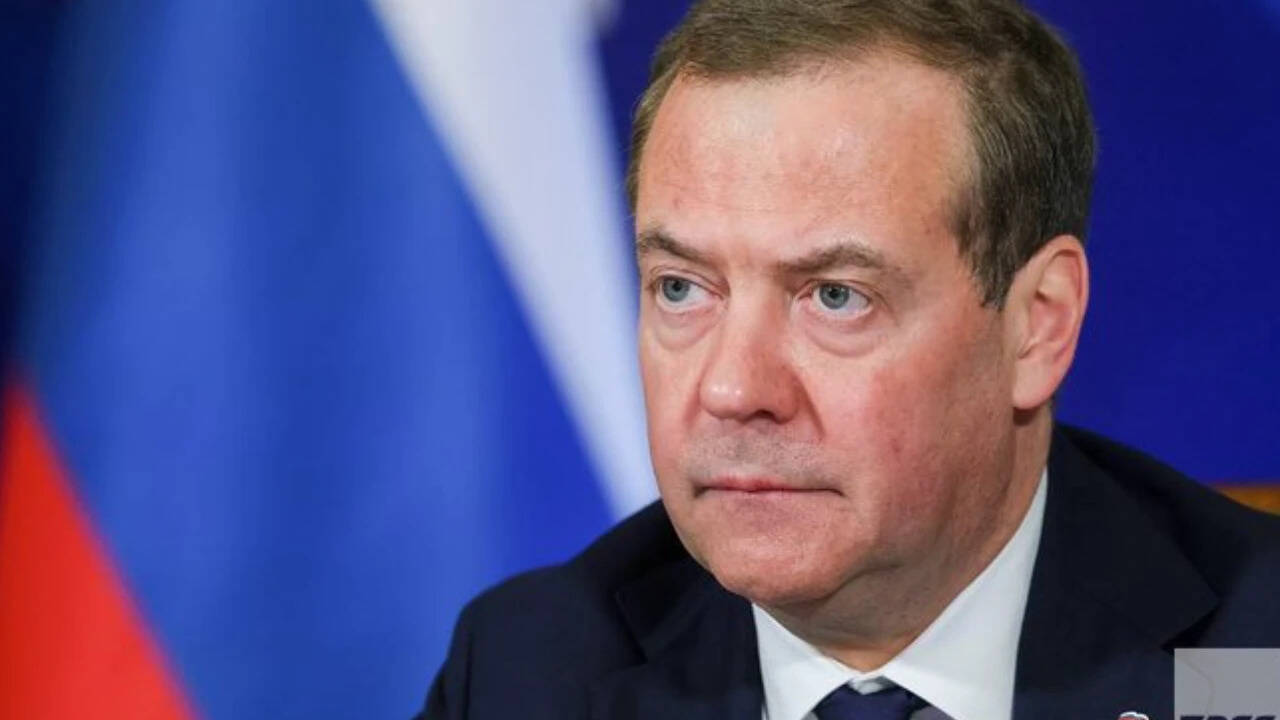
Ex-Russian president warns Ukraine of nuclear strike: What options does Moscow have
Former Russian president Dmitry Medvedev is back with another chilling nuclear warning, this time spelling out the circumstances that could push Moscow towards using atomic weapons in the Ukraine war.Medvedev has warned that massive conventional attacks capable of causing catastrophic damage could make a preventive nuclear strike by Russia possible, raising the stakes for Ukraine and its western allies.Going a step further, he has argued that covert western supplies of nuclear weapons to Kyiv would also justify such an attack, claiming that Russia has not only the right but, under certain circumstances, the obligation to use its nuclear arsenal.According to Russian state news agency TASS, Medvedev argued that the large-scale use of conventional weapons capable of causing man-made, environmental or social catastrophes could bring a preventive nuclear strike into consideration."The foundations of state policy effectively provide for a pre-emptive nuclear strike if the very existence of our state is threatened or our country has sustained unacceptable damage," he wrote in the article published in the Moscow Journal of International Law.He further claimed that Ukraine, Nato members and other western countries had already created situations in which Moscow could consider using its nuclear arsenal.In his strongest warning, Medvedev said Kyiv and its western supporters must understand that Russia could be compelled to cross the nuclear threshold under certain circumstances."Kyiv and its allies must remember that the Russian Federation not only has the right, but in various situations has the obligation to use nuclear weapons," he wrote.However, Medvedev acknowledged that Moscow had not yet considered nuclear weapons necessary in the nearly five-year war against Ukraine."Obviously, so far the course of events in the Ukrainian crisis has not created a state of direct necessity to use nuclear weapons," he wrote, adding that the decision rested with President Vladimir Putin.He said Putin would make such a decision after a comprehensive assessment of the circumstances, weighing the actual damage inflicted on Russia against the proportionality of any retaliatory measures.Russia lowered its nuclear threshold in 2024Medvedev's latest warning comes against the backdrop of Russia's decision to expand the circumstances under which it could consider using nuclear weapons.In November 2024, President Vladimir Putin approved a revised nuclear doctrine, lowering the threshold for a potential nuclear strike and broadening the range of conventional attacks that could trigger such a response.The move came days after the Joe Biden administration authorised Ukraine to use US-supplied long-range ATACMS missiles against certain targets inside Russian territory, a decision Moscow had repeatedly warned could escalate the conflict.The revised doctrine identifies five circumstances in which Russia could consider using its nuclear arsenal.The revised doctrine identifies five circumstances in which Russia could consider using nuclear weapons.
These include reliable information about an incoming ballistic missile attack. The use of nuclear or other weapons of mass destruction against Russia or its allies is another trigger.Moscow could also consider nuclear use if an attack targets critical government or military facilities and threatens its ability to retaliate with nuclear weapons. The doctrine further includes conventional aggression posing a critical threat to the sovereignty or territorial integrity of Russia or Belarus.The fifth condition covers reliable information about a mass launch of aircraft, cruise missiles, drones or hypersonic weapons crossing Russia's borders.What nuclear options does Russia have against UkraineRussia possesses one of the world's largest nuclear arsenals, including both tactical and strategic nuclear weapons.According to the UK Parliament's House of Commons Library, Moscow had an estimated stockpile of around 1,558 non-strategic nuclear warheads in its December 2024 assessment.
These weapons are designed primarily for regional military scenarios and could potentially be used in a conflict such as the war in Ukraine. However, the estimate does not mean all these warheads are deployed or immediately available for use.Among Russia's key nuclear-capable delivery systems is the Iskander-M short-range ballistic missile, which can carry either conventional or nuclear warheads.Russia also has nuclear-capable aircraft, including the Tu-22M3 bomber and Su-34 fighter-bomber, alongside cruise missile systems such as nuclear-capable variants of the Kalibr and 9M729.
These platforms provide Moscow with multiple delivery options, although their conventional use in Ukraine does not indicate that nuclear warheads are involved.Beyond tactical weapons, Russia maintains a strategic nuclear triad comprising land-based intercontinental ballistic missiles, submarine-launched ballistic missiles and nuclear-capable strategic bombers.These weapons are primarily intended to deter or conduct nuclear operations against major adversaries.
Their use against Ukraine would represent a far more extreme escalation, with potentially devastating consequences for European and global security.A limited tactical nuclear strike could trigger a much wider international confrontation, forcing the United States and Nato to consider their response while increasing the risk of further escalation.Although Moscow could theoretically use a nuclear demonstration or battlefield nuclear weapon to pressure Kyiv and its western supporters, such a move would carry enormous military, diplomatic and economic consequences.You use AI every day.
Now get your AI Quotient. Take the AIQ test.