17 tiny coffins found in Edinburgh cave in 1836 remain a mystery 190 years on
Talk about a little mystery with a rather grave history!In 1836, a group of boys hunting rabbits on Arthur's Seat in Edinburgh stumbled upon 17 tiny coffins tucked away inside a rocky recess. Nearly two centuries later, their discovery continues to puzzle researchers. Each of these miniature coffins reportedly contained a tiny carved figure.According to National Museums Scotland, in its account, “An unsolved mystery: The coffins found on Arthur's Seat”, the discovery dates back to late June 1836.Arthur's Seat is a prominent hill overlooking Edinburgh's Old Town.
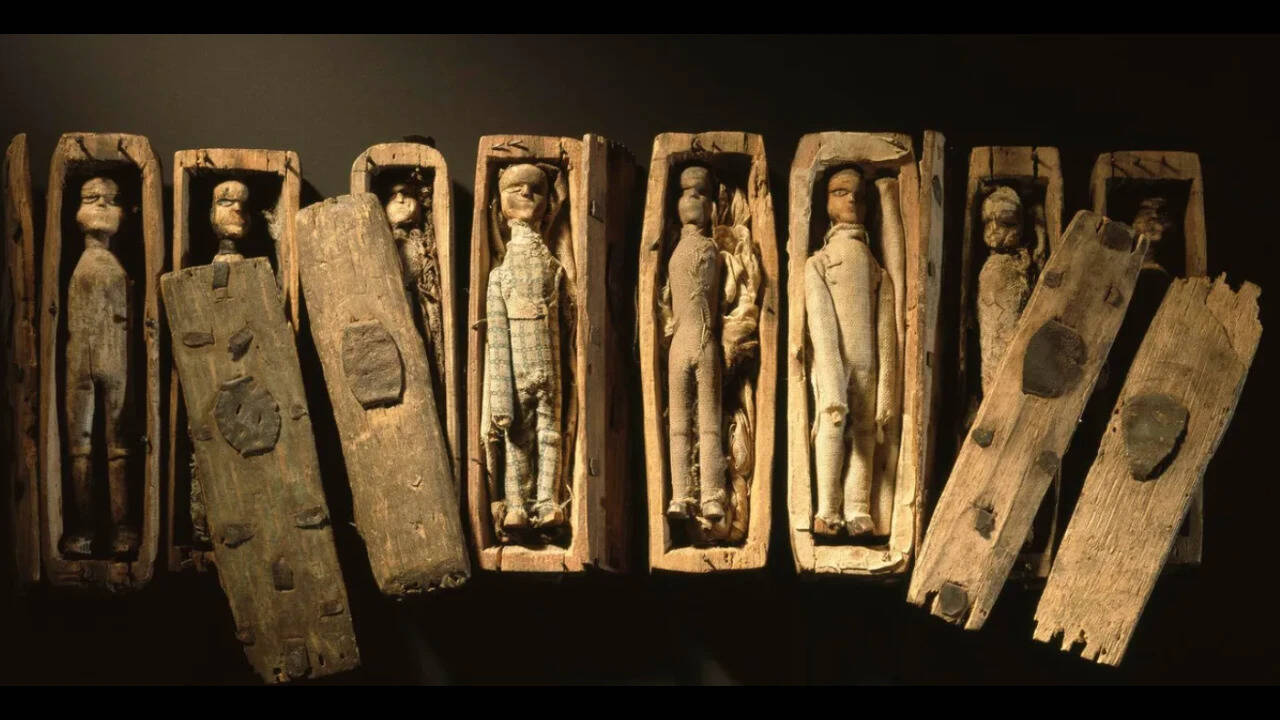
While searching for rabbits along its north-eastern slopes, the boys came across a small cave where the tiny coffins had reportedly been placed beneath three pointed slabs of slate. They were arranged in three tiers, with eight coffins in each of the first two tiers and a solitary one placed on top.Each coffin contained a small wooden figure measuring approximately 9.5 centimetres in length.A rather unusual discoveryArthur's Seat is a renowned volcanic hill in Scotland, and over the years, accounts of the place have been filled with local legends and stories.
The discovery of these coffins adds another curious chapter to its history.The figures found inside the coffins had been dressed in clothes that were stitched and glued around them, making the objects appear rather more intricate than simple miniature wooden figures.Of the original 17 coffins, only eight have survived. Over time, these became part of the collections of the National Museum of Scotland, where they continue to be exhibited.
The remaining nine, however, have never been accounted for, although local newspaper reports suggested that some were destroyed by the boys who initially discovered them.From witchcraft to mysterious burial practicesWhile there have been myriad bizarre theories about the truth behind the coffins, newspaper publications have offered some particularly intriguing explanations. The Scotsman, which first reported the incident on 16 July 1836, even suggested that they could have been connected to witchcraft and spells intended to bring about someone's death.
Rather than offering a straightforward explanation, the newspaper's account leaned into the supernatural associations surrounding the objects.Another theory emerged in August 1836, when the Edinburgh Evening Post suggested that the coffins could be connected to an ancient Saxon custom of burying effigies of friends who had died in distant lands. The Caledonian Mercury also proposed a possible connection to a seafaring superstition in which sailors who feared they might be lost at sea asked their wives to give them a Christian burial through an effigy.A further theory was put forward in 1976 by Walter Hävernick, the director of the Museum of Hamburg History.
He suggested that the coffins could have been connected to a German seafaring superstition involving the practice of keeping mandrake roots or dolls in tiny coffins as talismans. According to this explanation, the objects might have been a collection of lucky charms hidden on the hillside by a merchant who intended to sell them to sailors. While the use of charms was not uncommon in 19th-century Scotland, no evidence supporting this particular seafaring tradition has been established.The coffins eventually passed into private collections before resurfacing in 1901, when eight of them were donated to the Museum of the Society of Antiquaries of Scotland.
They eventually made their way into the collections of National Museums Scotland.Could they have something to do with Edinburgh's dark history?One intriguing theory regarding the coffins emerged from Edinburgh's history of body snatching and the infamous murders committed by William Burke and William Hare.Burke and Hare took the practice of body snatching to an even more horrifying level by murdering people and selling their bodies to the anatomist Dr Robert Knox.
Their crimes became one of the most notorious episodes in Edinburgh's history.The connection to the miniature coffins comes from a rather striking coincidence: there were 17 coffins, and Burke and Hare were responsible for supplying 17 bodies for dissection. However, these comprised 16 people they had murdered and one person who had died of natural causes.As mentioned by National Museums Scotland, this has led to the curious question of whether the tiny coffins could have been symbolic burials for these individuals, perhaps created by someone who wanted to commemorate them.
It remains one possible explanation, although there are reasons to be cautious. Twelve of the 17 individuals were women, whereas the figures inside the coffins were dressed as men.What did examining the coffins reveal?When the objects were studied in greater detail in the 1990s by Professor Samuel Menefee and Dr Allen Simpson, a curator at the museum, their investigation offered a few clues about how the coffins and the little occupants inside them might have been made.The researchers suggested that the figures appeared to have been created by the same person, although the coffins themselves could have been the work of two different people.
The materials and tools involved, including iron embellishments, nails and a sharp, hooked knife, also contributed to the conjecture that a shoemaker might have made them.Interestingly, the figures' appearance did not necessarily suggest that they were intended to represent dead people. Their upright posture, flat feet and swinging arms indicated that they might originally have been toy soldiers.
Moreover, their eyes were open, adding another reason to question whether they had been designed as representations of corpses. Some figures were also missing an arm, possibly because their limbs had been removed to make them fit inside the tiny coffins.The researchers also found that the fabric used to dress the figures dated back to the early 1830s, suggesting that they could not have been buried for more than six years before thei…