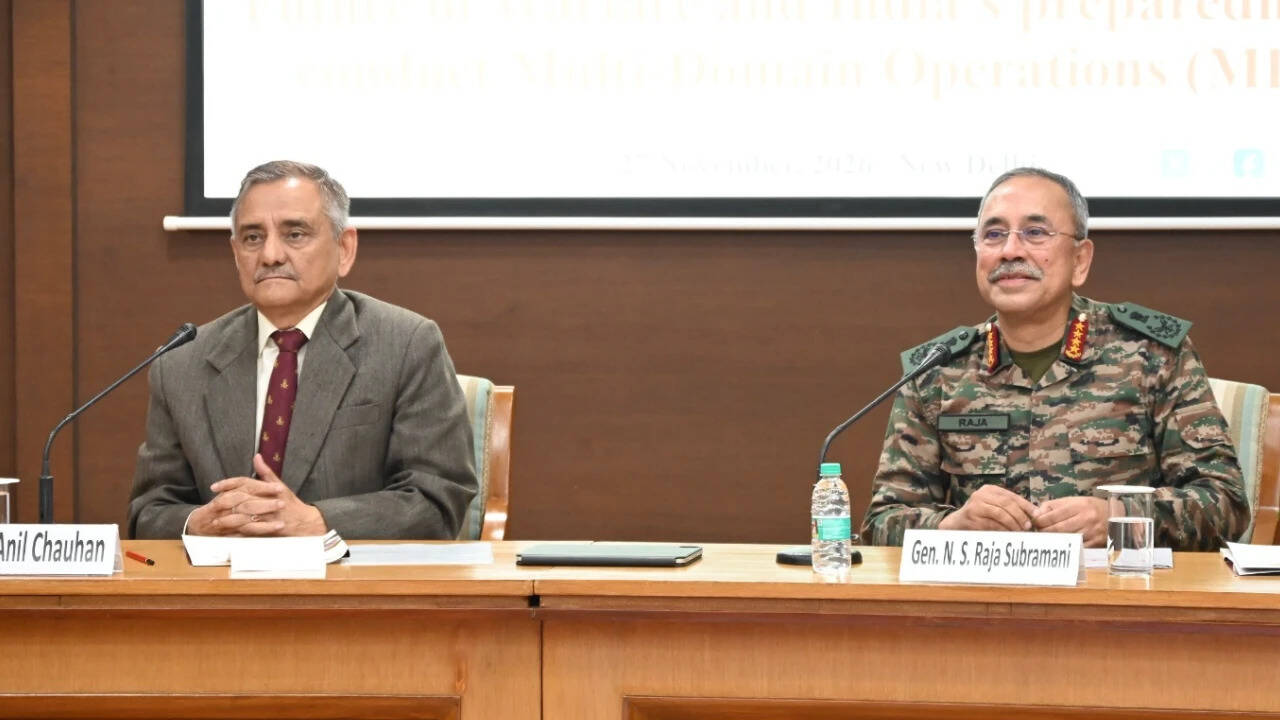
Pak's space capability improving with China's help: CDS Gen Subramani
NEW DELHI: Chief of Defence Staff General N S Raja Subramani said on Friday that Pakistan's space capability is “improving” with China’s help, and Pakistan Space and Upper Atmosphere Research Commission (SUPARCO), the national space agency of Pakistan, is also “working to develop its own capability”. He asserted that India too needs to factor in these developments to enhance its space capabilities.While replying to media queries during an address on ‘Future of warfare and India's preparedness to conduct multi-domain operations’, Gen Subramani said, “We also have to take it for granted that Pakistan will be helped by the Turkish too, and whatever capabilities are available with the Chinese in terms of intelligence, surveillance, and reconnaissance, positional navigation, timing, etc., will be available to the Pakistanis, so that we will have to factor in into our calculus.
Their ISR will be better. But, for us, having factored in into our calculus, we will have to look at enhancing our capabilities.The CDS said when India’s Space-Based Surveillance Phase-III (SBS-3) programme becomes operational, it will “enhance our capabilities to a great extent”. SBS-3, approved by the Cabinet Committee on Security in Oct 2024 at an estimated cost of Rs 26,968 crore, is a national space programme to deploy 52 reconnaissance and surveillance satellites to strengthen the country’s land, air, and maritime domain awareness across its borders and the Indian Ocean Region.
“Simultaneously, we are also working on methods to ensure that we are able to build, as also launch more satellites. We are also working with our private sector and entrepreneurs,” he said.His comments came in response to a media query on China successfully launching its Shenzhou-24 crewed spaceship, carrying three astronauts, including Pakistan's Muhammad Zeeshan Ali, last Wednesday.On matching capabilities along the northern front and in space, CDS emphasized that India does not need to enter an arms race to match China’s global military or space inventory one-for-one.
“I don't think that neither should we plan nor compete to try and get whatever China has got. We need to have enough to look at our borders and the ability to reduce that revisit time." He said this while citing ongoing rollouts of NavIC, SBS-3, and GSAT-7 constellations.Gen Subramani confirmed that directed energy weapons (DEWs) are being operationalised for hard-kill counter-drone missions.
“Laser and directed energy weapons will form a very important component as far as counter-drone is concerned. DRDO has developed laser weapons... Israel has fielded it very effectively, and we are also looking at fielding lasers,” he said, explaining that layered systems will be utilised to bypass laser dwell-time constraints.To prepare the armed forces for fast-evolving combat requirements, CDS stated that military leadership has instituted a policy of “ruthless prioritisation” and initiated systemic reforms to synchronise equipment acquisition with technological change.
He revealed that an overhauled Defence Acquisition Procedure (DAP) draft has been submitted to the PMO to resolve the friction between platform procurement and tech induction.“What you are talking about are two clocks: the platform clock and the technology clock. An armoured vehicle or an aircraft may take years to induct, but the technology is changing every week or every two weeks or every month.
Our acquisition processes have to be different for technology procurement and for platform procurement,” General Subramani said, adding that the revamped process is expected to take effect early next year.During his address, CDS outlined 10 key trends shaping the future of warfare, warning that pervasive surveillance has made modern battlefields environments where “anybody who is seen will be fixed and killed”.
He said the distinction between war and peace is “blurring” today, and there is a “continuous state of contestation”, asserting that efforts are on to modernise the electronic warfare architecture of the military. “We are being subjected to cognitive warfare by adversary in an insidious way”, and emphasised bolstering capabilities in all domains.Former CDS, Gen Anil Chauhan (Retd) moderated the session hosted by think-tank Vivekananda International Foundation in Delhi.“We are transitioning from fighting as isolated platforms to a system of systems.
So the battlefield is increasingly moving from network-centric to decision-centric, from individual platforms to systems of systems,”he said. CDS said that information can no longer be treated as an auxiliary service, declaring: “Information is not going to be a support function; information, in fact, is going to be a predominant function in future operations.”Furthermore, he noted that long-range precision firepower, integrated command and control, and operating logistics within contested environments will be non-negotiable determinants of victory.
He asserted that modern warfare necessitates a “whole-of-nation endeavour”.He also cited Op Sindoor, terming its second phase an excellent example of joint, integrated, multi-domain operations. Demonstrating how contemporary doctrine translates to reality, the CDS pointed to Op Sindoor as a case study in operational calibration, decisive joint action, and escalation dominance. “The time we got out of Op Sindoor was a perfect example of escalation control.
We had achieved whatever objectives we wanted to; we had destroyed the terrorist camps, and we got out at the right time,” Gen Subramani said, addressing retrospective questions on why operations were halted.On military preparedness, Gen Raja Subramani said, “We need not look at a prescribed template. We need to have our own template.” On national readiness, “The direction from the political leadership was very clear.
There was no consideration about the cost of war or whether we should back down… If we go to war, the entire nation, I am sure, will be behind us. That is not a…