3,106-carat Cullinan diamond became 530-carat gem in British royal sceptre
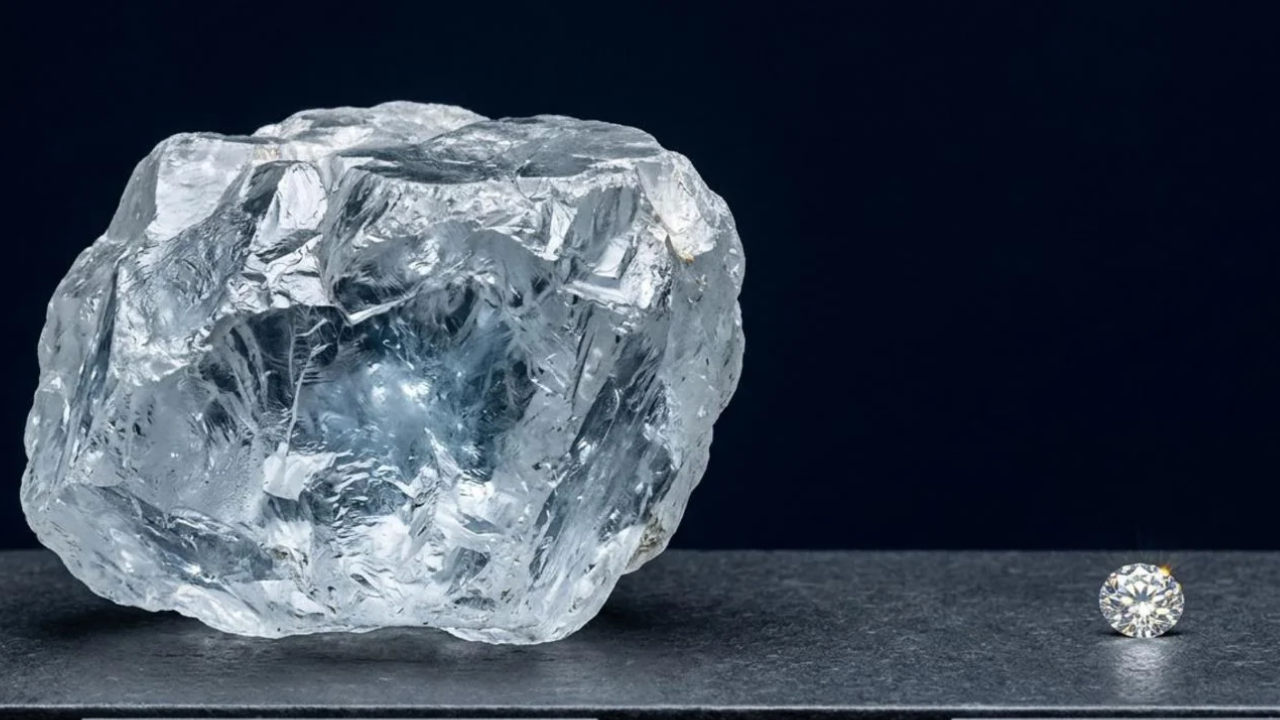
A glint on a mine wall in South Africa led to the discovery of one of the most celebrated diamonds in history. On January 26, 1905, Frederick Wells, the surface manager of the Premier Mine near Pretoria, spotted a large crystal embedded in the rock and prised it out with his pocket knife. What initially appeared to be an unusual find turned out to be a 3,106-carat rough diamond, later named the Cullinan.
More than a century later, its largest polished stone, the 530.2-carat Great Star of Africa, remains set in Britain's Sovereign's Sceptre with Cross, one of the most recognisable objects in the Crown Jewels.According to the Royal Collection Trust, the uncut diamond measured approximately 10.1 cm long, 6.35 cm wide and 5.9 cm deep. Its exceptional size, clarity and blue-white appearance made it an extraordinary discovery.
It remains the largest gem-quality rough diamond ever found, according to the Historic Royal Palaces, which manages the Tower of London's historic site and its display of the Crown Jewels.A discovery that stunned the mining worldWells reportedly spotted the crystal while inspecting the mine, about 18 feet below the surrounding ground surface. He extracted it from the rock and took it to the mine office, where its unusual size quickly attracted attention.
The diamond was named after Sir Thomas Cullinan, the chairman of the Premier Diamond Mining Company and the man associated with establishing the mine. The discovery attracted widespread public interest, with the enormous stone briefly displayed in Johannesburg before being sent to London in 1905.Its size presented an unusual problem: finding a buyer willing to pay for such a valuable and conspicuous gemstone.
The stone remained unsold for a period before the Transvaal government purchased it and decided to present it to Britain's King Edward VII. The gift had political significance as well as monetary value. The Transvaal government presented the diamond to Edward VII in 1907, following the South African Wars of 1899-1902. The gesture was intended to help repair relations between Britain and South Africa after the conflict.A royal gift and an extraordinary journeyTransporting a diamond of such importance required elaborate precautions.
Historic Royal Palaces records that a replica, guarded by detectives, was sent to London by ship, while the genuine diamond was dispatched through ordinary parcel post in an insured package. The unusual arrangement reflected concerns about the security of the stone during its journey. Despite the elaborate decoy operation, the diamond arrived safely.King Edward VII subsequently entrusted the stone to the Asscher firm in Amsterdam, then among the leading diamond-cutting specialists.
Transforming the enormous rough crystal into polished gemstones required careful planning because a mistake could destroy an irreplaceable stone. The Royal Collection Trust records that the cutting process took eight months. Three men worked for approximately 14 hours a day to produce nine large stones, identified by Roman numerals from I to IX, along with 97 smaller brilliant-cut diamonds and unpolished fragments.The first blow broke the knifeThe cutting operation became part of the diamond's enduring legend.
According to the Royal Collection Trust, workers spent four days preparing a groove for the cleaving knife. When the first blow was struck, the knife broke while the diamond remained intact. The subsequent attempt successfully split the stone, allowing the cutters to continue their painstaking work. The operation required an understanding of the diamond's internal structure, as the direction of cleavage determined how the rough crystal could be divided.The resulting nine major stones differed in shape and size.
The largest became Cullinan I, also known as the Great Star of Africa, while the second-largest became Cullinan II, or the Lesser Star of Africa. Cullinan I weighs 530.2 carats. It is a large, pear-shaped brilliant-cut diamond and remains one of the most famous stones in the British royal collection.From rough crystal to the royal sceptreAfter Edward VII's death in 1910, his successor, George V, had Cullinan I incorporated into the Sovereign's Sceptre with Cross.
Cullinan II was placed in the Imperial State Crown. The sceptre itself predates the diamond by centuries. Historic Royal Palaces notes that the Sovereign's Sceptre with Cross has been used at every coronation since the ceremony of Charles II in 1661. The addition of Cullinan I transformed the object into an especially striking piece of royal regalia.The two largest diamonds remain part of the Crown Jewels, displayed at the Tower of London.
Other stones cut from the original crystal eventually became part of royal jewellery. Cullinan III and IV, for instance, have been used in royal ornaments, while other smaller stones were distributed through different arrangements.The original rough diamond therefore did not survive as a single gemstone. Instead, it became a collection of stones with distinct histories and settings, two of which acquired prominent roles in Britain's ceremonial monarchy.You use AI every day.
Now get your AI Quotient. Take the AIQ test.