US intelligence confirms image shows China's secret spaceplane in orbit
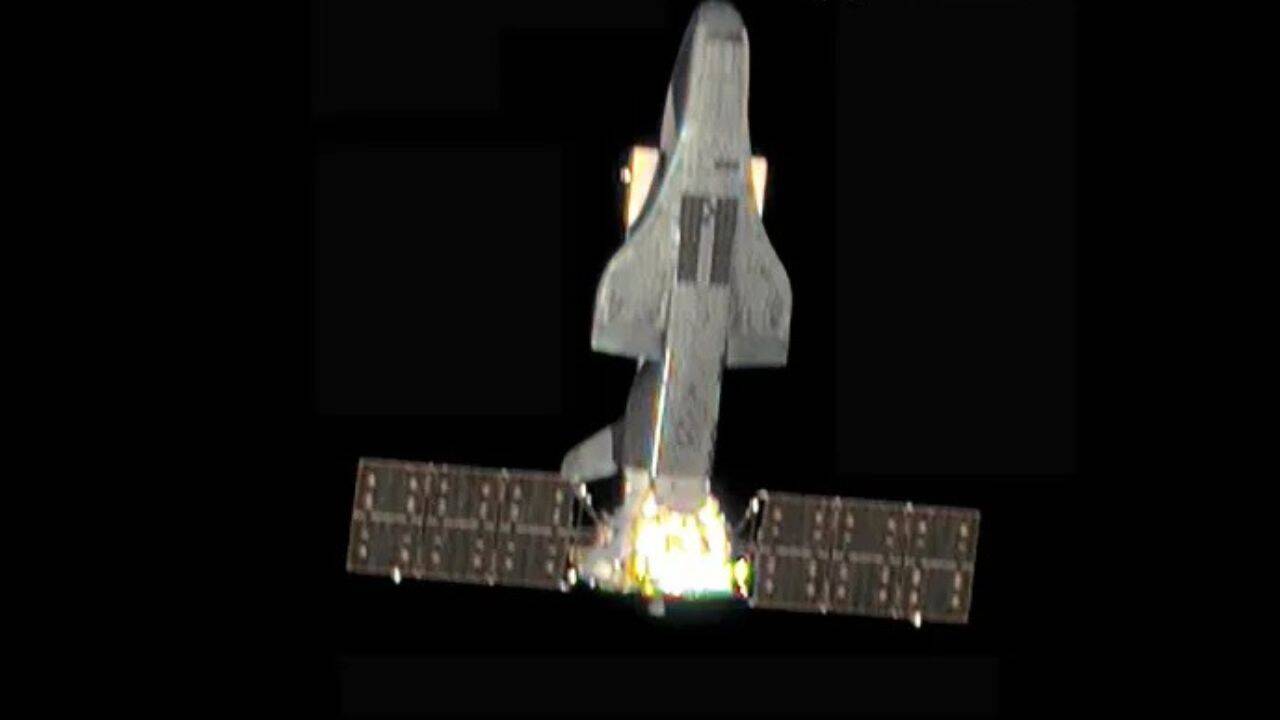
The US Defense Intelligence Agency (DIA) has confirmed that a satellite image released in a newly declassified report shows China's experimental reusable spaceplane in orbit, offering a clearer view of a spacecraft whose design closely resembles the US Space Force's X-37B.The higher-resolution image, captured by a satellite operated by Maxar Technologies, now known as Vantor, was included in the DIA's latest unclassified assessment of security challenges in space, released on October 26.
Although a lower-resolution version had circulated publicly since 2024, the spacecraft's identity had not been confirmed at the time.The image shows a compact, shuttle-like vehicle with wings, twin vertical tails, an open payload bay and a rear-mounted module with solar panels deployed on either side. Its overall configuration resembles the X-37B, an uncrewed reusable spaceplane operated by the US Space Force, although the Chinese vehicle appears to have longer wings.“A key capability for reusable space activities are spaceplanes like this PRC [People’s Republic of China] Spaceplane captured by Maxar.
Spaceplanes can launch into orbit to place objects in space or even test them and return to earth [sic],” reads the caption to the picture in DIA’s report.The exact date and circumstances of the satellite's observation have not been publicly disclosed in the DIA report. However, the image carries a 2024 copyright date, placing it within the period when China's spacecraft was conducting its third orbital mission.China has conducted four spaceplane missions since 2020China is understood to have conducted four orbital missions using its experimental reusable spaceplane since 2020.
The latest mission began on February 7, 2026, and the spacecraft remained in orbit as of the latest available reports.The vehicle's activities have attracted attention because it has reportedly released smaller objects into orbit and carried out operations involving other spacecraft. During its third mission, which lasted from December 14, 2023, to September 6, 2024, the spaceplane was observed releasing multiple smaller objects.
Their identities and purposes remain unknown.Analysis of open-source orbital tracking data by astrophysicist Jonathan McDowell also indicated that the spacecraft involved in the latest mission released and subsequently recaptured a smaller object during a series of orbital operations. These activities point to its ability to interact with objects in space, although its precise mission objectives remain undisclosed.The spacecraft is commonly referred to as Shenlong in Western reports, but its official designation and the model shown in the image have not been definitively established.The DIA report states that “China has two primary spaceplane models: the Shenlong and Tengyun,” without specifying which one appears in the photograph.China's Shenlong programme has been discussed publicly since at least 2007, when images emerged of what was believed to be a prototype or test vehicle mounted beneath an H-6 bomber.
Separately, the state-run China Aerospace Science and Industry Corporation unveiled its Tengyun reusable spaceplane concept in 2016. The proposed system was designed around a two-stage-to-orbit approach involving a carrier aircraft, rather than relying entirely on a conventional rocket launch.It remains unclear whether the planned Tengyun test targeted for 2025 took place.How China's spaceplane compares with the US X-37BThe Chinese vehicle shares several visible design features with the US Space Force's X-37B, including a winged body, payload bay and a configuration intended to support a return to Earth.
Both spacecraft are uncrewed and designed for reusable orbital operations.The US has built two X-37B vehicles, which have flown a total of eight orbital missions since 2010. The spacecraft can carry experiments and payloads into orbit before returning to Earth for recovery and refurbishment. Much of its operational activity remains classified.China's spaceplane is also understood to launch aboard a conventional rocket before operating in orbit and returning to Earth for a runway landing.
A secretive Chinese airbase in the country's northwest, featuring an exceptionally long runway, has been identified in reporting as a possible landing site for the vehicle, although the full details of its recovery operations remain unclear.The image does not establish whether the Chinese spacecraft carries weapons or is being used for offensive missions. However, its ability to manoeuvre, deploy objects and potentially interact with other spacecraft has raised questions about the military applications of reusable spaceplanes.DIA warns of growing competition in spaceThe DIA's report places reusable spaceplanes within a wider assessment of expanding space capabilities and the potential risks they pose to US and allied assets.In general, “spaceplanes are … reusable and feature enhanced maneuverability, making them more suitable for certain missions than traditional satellites,” DIA’s report notes.Such vehicles can potentially deploy small satellites, conduct experiments, inspect other spacecraft and return payloads to Earth.
Their ability to alter trajectories and approach other objects also makes them useful for missions that conventional satellites may find more difficult to perform.The report also discusses China's development of counterspace capabilities, including ground-based laser weapons that could disrupt, degrade or damage satellites in low Earth orbit.“China has multiple ground-based laser weapons with varying power levels to disrupt, degrade, or damage satellites in LEO,” the DIA said.
“By the late 2020s, China may field space-based directed energy systems and higher-powered ground-based directed energy systems capable of threatening satellites in higher orbits.”The assessment also points to China's testing of ground-based anti-satellite missiles, satellite servicing and refuelling technologies, and robotic s…