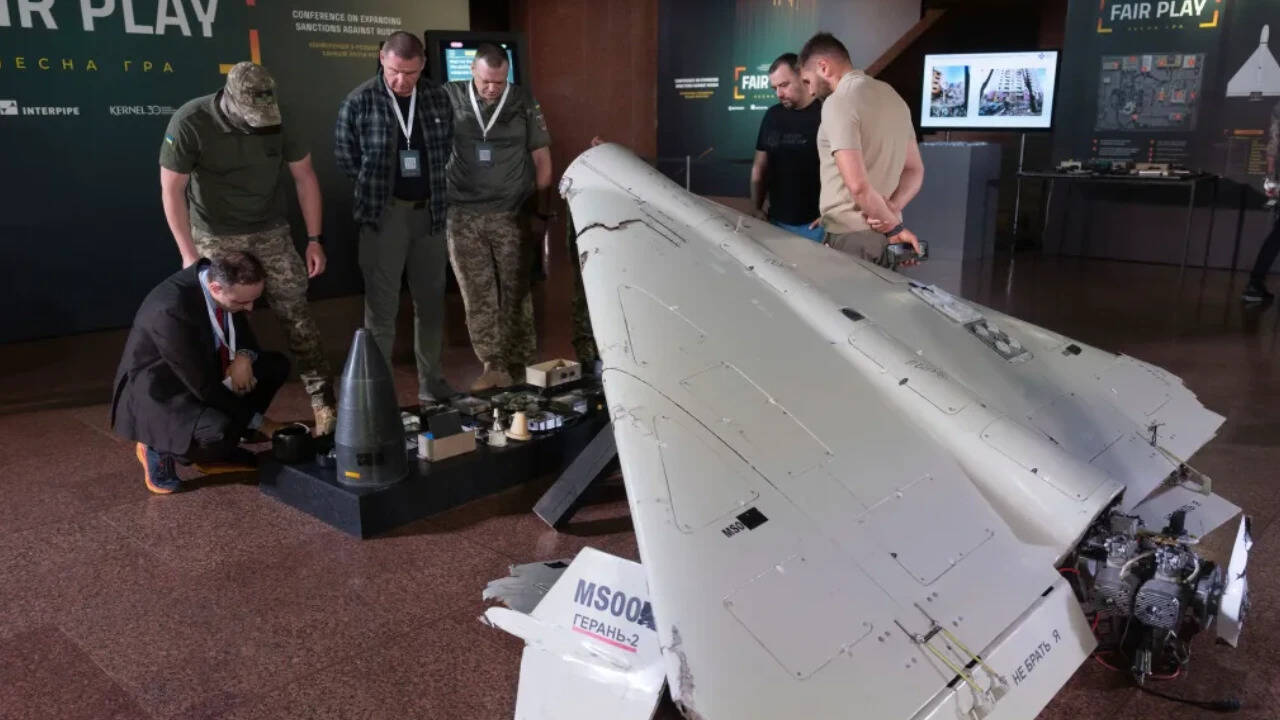
Russia gives its drones bigger antennas to beat Ukraine's jamming
Russia is upgrading its attack drones with larger anti-jamming antennas to counter Ukraine's electronic warfare systems, potentially making it harder for Kyiv to disrupt incoming Russian strikes. The upgrades are aimed at protecting satellite-navigation signals from interference, allowing drones to maintain their programmed flight paths even in areas covered by Ukrainian jamming systems.According to a report by Defense News, Russia is equipping its drones with upgraded Kometa satellite-navigation modules developed by Russian company VNIIR-Progress.
The modules use multiple antenna elements to identify and suppress electronic interference, helping drones maintain navigation despite attempts to disrupt their satellite signals.Russia is already using 16-element antenna arrays at scale and preparing 20-element versions for serial production. Ukrainian forces have also detected Shahed-type drones carrying larger 32-element arrays during attacks on Kyiv, the report said, citing Ukrainian electronic-warfare specialist Serhii Beskrestnov.The upgraded Kometa modules use multiple small receiving elements, known as patch antennas, arranged in an array.
These elements help the drone distinguish genuine satellite-navigation signals from interference generated by Ukrainian jamming systems.By identifying the direction from which interference originates, the system can suppress unwanted signals while continuing to receive satellite-navigation data. Increasing the number of antenna elements improves the system's ability to filter interference from multiple directions.The larger antenna arrays could make conventional GPS jamming less effective against Russian drones.
Ukraine has relied extensively on electronic warfare to disrupt satellite-navigation signals, forcing incoming drones off course or reducing their accuracy.Ukrainian specialists are examining multi-band jamming to disrupt signals across different satellite-navigation frequencies. Another option is GPS spoofing, which involves transmitting false positioning information to mislead a drone's navigation system and divert it from its intended route.Growing threat from Russia's expanding drone arsenalThe antenna upgrades are part of a wider expansion of Russia's drone warfare capabilities.
Moscow has been increasing the scale of its Shahed-type drone attacks while introducing faster jet-powered variants, including the Geran-3, Geran-4 and Geran-5.Unlike conventional propeller-driven drones, these variants use turbojet propulsion, allowing some models to reach speeds of up to 600 kmph. Their higher speed reduces the time available for Ukrainian air-defence units to detect, track and intercept incoming threats.The growing use of jet-powered drones is adding pressure on Ukraine's air-defence network, which relies on electronic warfare, mobile air-defence teams and relatively inexpensive interceptor drones to counter Russian aerial attacks.