Vizag scientist brings Arctic samples to study glacier pollutants, coastal risks
VISAKHAPATNAM: As glaciers melt and the Arctic landscape changes, pollutants locked in snow and ice may not simply disappear. Instead, they could be released into surrounding waters and undergo chemical changes. A month-long Indian Arctic expedition has provided a Visakhapatnam-based researcher with water samples that may help scientists understand what happens to such contaminants in a warming polar environment.Dr Manoj Rayaroth, assistant professor in the Department of Chemistry at GITAM Deemed to be University, was selected by the National Centre for Polar and Ocean Research (NCPOR), under the Union Ministry of Earth Sciences, for the 2026-27 Indian Arctic Expedition.
He travelled to Ny-Ålesund in Norway during August and September as part of the expedition's fourth batch.His project, with Dr NVS Venugopal, professor and head of the Department of Chemistry at GITAM School of Science, as co-investigator, focuses on how organic contaminants reach the Arctic, how they transform under changing environmental conditions and what happens when pollutants trapped in snow and ice are released into water.Tracking pollutants beyond their sourceRayaroth said the study goes beyond identifying pollutants in the Arctic.
It aims to understand what happens to them after they enter the polar environment.“Nature itself is a chemical reaction system,” he said, explaining that pollutants can undergo different reactions after entering Arctic waters or coming into contact with ice. These reactions can alter their chemical forms, persistence and potentially their toxicity.Pollutants can reach the Arctic through long-range atmospheric transport and ocean currents.
Chemicals released through industrial, agricultural and urban activities in other parts of the world can travel thousands of kilometres before reaching the polar region.The Arctic's changing climate adds another layer to this process. Rising temperatures, changing water chemistry and melting glaciers can influence how contaminants behave. Pollutants deposited on snow and ice can potentially be released into meltwater as glaciers retreat, eventually reaching fjords and marine waters.Rayaroth's project aims to understand these transformation pathways.The project was selected through NCPOR's annual call for research proposals covering areas such as physical and chemical oceanography, biology, environmental science and glacier studies.
Rayaroth said his background in identifying organic pollutants in water helped him develop the proposal.During his PhD in Kerala, he studied pollutants in various water resources, including backwater systems and the Periyar river. He used mass spectrometry to identify organic contaminants in water and other environmental samples.The Arctic project extends this research into a much less-studied environment.Samples taken from Arctic watersRayaroth was one of seven scientists in his expedition batch.
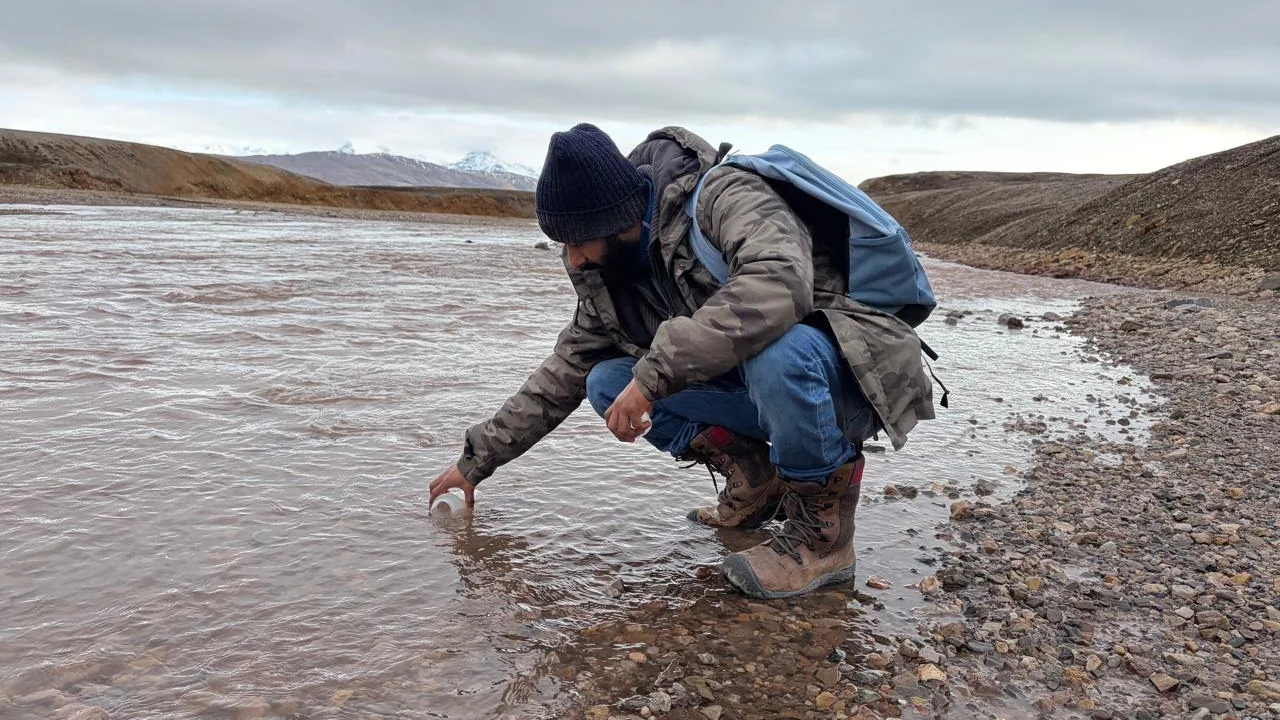
The team included researchers from NCPOR, the National Institute of Oceanography, the Centre for Marine Living Resources & Ecology, Cochin University and Presidency University, among others.The researchers were based at Ny-Ålesund, an international research settlement where several countries maintain scientific stations. India has maintained its Himadri research station there since 2008.Rayaroth collected only water samples, as his project was specifically designed to study water pollution.
The samples were collected from Arctic waters, including areas influenced by glacial meltwater. This water eventually flows into fjords, carrying minerals and other materials from the glaciers and surrounding terrain.Samples to be analysed in VizagThe water samples collected by Rayaroth are yet to be analysed. They are being preserved under controlled conditions and will be transported to India in a refrigerated shipment maintained at around -20°C.
The samples are expected to reach Vizag in two to three months. Samples collected by different expedition batches are consolidated before transportation to reduce shipping costs.Once the samples arrive, the researchers will extract and analyse the contaminants using chromatography and mass spectrometry.The study could also have implications for Indian coastal waters. Ocean currents connect different marine systems, allowing pollutants to travel over long distances.
Rayaroth's research group is already studying marine pollution along the Visakhapatnam coast and in the Bay of Bengal.Pollutants in water can also enter marine organisms and move through the food web. Researchers from different disciplines could use the same samples to study microorganisms, marine organisms and the accumulation of contaminants.Rayaroth said the Arctic project could therefore evolve into a broader interdisciplinary research programme involving chemistry, microbiology, marine biology and environmental science.The expedition itself lasted only a month, but the research project will continue through 2026-27.
The researchers will analyse the samples, publish their findings and explore further studies based on the results.For Rayaroth, the Arctic expedition was also an opportunity to work alongside scientists from different countries and disciplines. The experience, he said, demonstrated how field observations, laboratory chemistry and long-term environmental monitoring can come together to understand changes in one of the world's most sensitive ecosystems.The immediate task is now to analyse the samples collected from Arctic waters.
The findings could provide new insights into the organic pollutants present in the region, how they behave under polar conditions and whether changing ice and water conditions are altering their movement and persistence.You Can Also Check: Gold Rate in Visakhapatnam | Silver Rate in Visakhapatnam | Bank Holidays in Visakhapatnam | Public Holidays in Visakhapatnam | Petrol Price in Visakhapatnam | Diesel Price in Visakhapatnam | CNG Price in Visakhapatnam | LPG Price in VisakhapatnamStay updated wi…